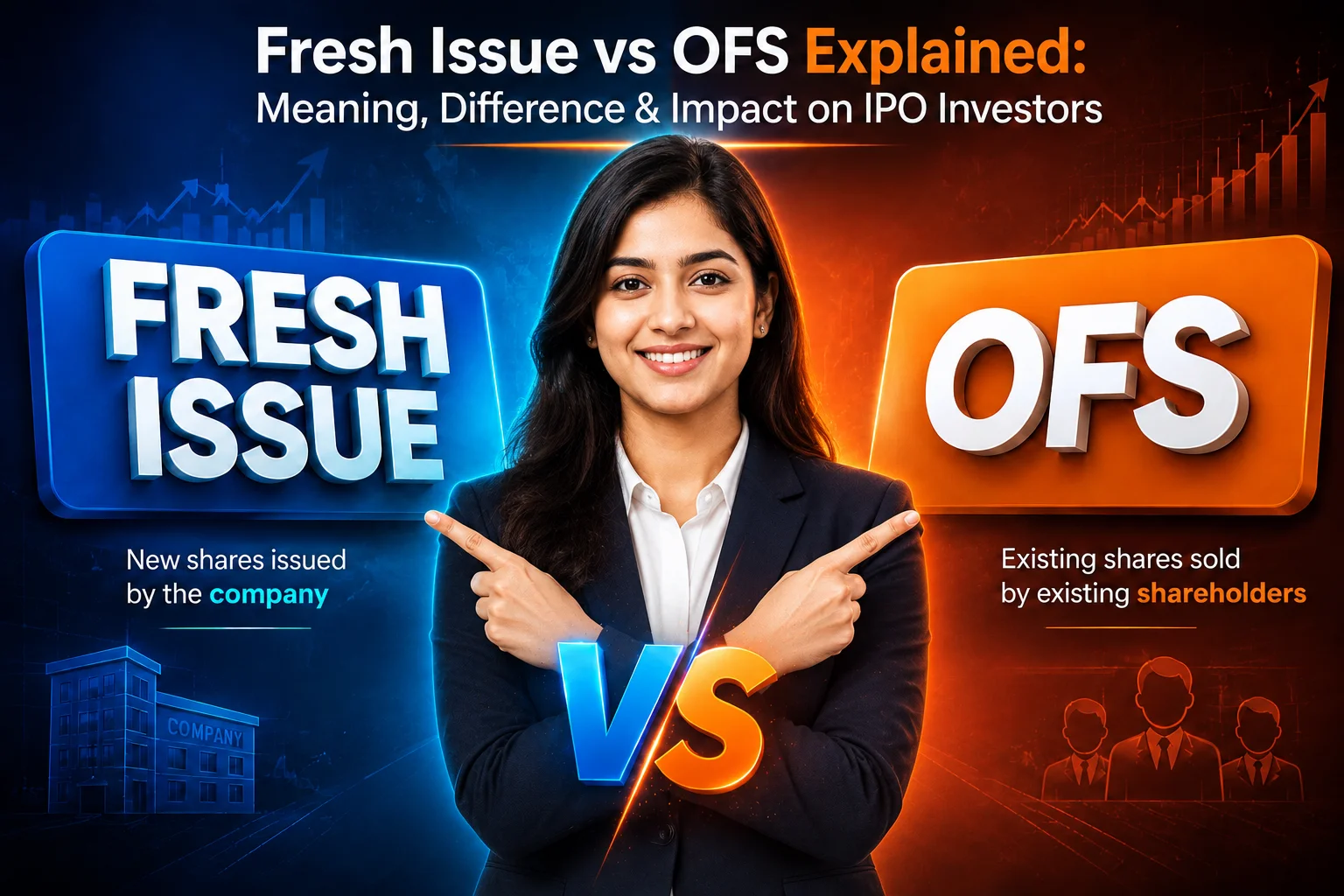
In a fresh issue IPO, the company issues new shares and receives the money directly to fund growth. In an OFS (Offer for Sale), existing shareholders (promoters or early investors) sell their shares, and the money goes to them — not the company.
Most IPOs use a mixed/hybrid IPO structure, combining both. Always read the “Objects of the Issue” in the prospectus to understand exactly where your money is going. This simple check helps beginner investors make smarter choices.
Before applying for any IPO, investors should not only check the Fresh Issue vs OFS split but also understand what happens after the application. Once the IPO closes, you can check your IPO allotment status to know whether shares are allotted or whether your blocked amount will be released.
The Day Rajesh Learned the Hard Truth About IPOs
Rajesh, a 32-year-old software engineer from Lucknow, felt excited about his first IPO. He applied, got shares, and saw a decent listing gain. But months later, the stock price weakened. “Why isn’t the company using this money to expand?” he wondered.
He later discovered that a large part of the IPO was an Offer for Sale (OFS)— promoters and investors were cashing out. Only a small fresh issue brought new money into the company. Stories like Rajesh’s are common. Learning the fresh issue IPO, OFS meaning IPO, and OFS vs fresh issue can help you avoid pitfalls and pick better opportunities.
Let’s break it down simply with real examples, clear tables, practical guides, and balanced views.
Even if an IPO has a strong fresh issue component, allotment is not guaranteed for retail investors. In oversubscribed IPOs, understanding how the IPO lottery system works can help beginners know why some applications get shares while others do not.

What is a Fresh Issue IPO (New Share Issue / Capital Raising Shares)?
Think of a growing chai stall owner who needs funds to open more outlets. He creates and sells new ownership cards (shares). The money goes straight to the business for machines, rent, and staff.
This is a fresh issue IPO (also called a new share issue or capital raising shares). The company issues brand-new shares, and all proceeds go to the company’s account.
Common uses: Expansion, technology upgrades, debt repayment, and working capital.
Investor benefit: More capital can drive future growth and profits, though it causes mild dilution for existing owners.
What is OFS's meaning in IPO (Promoter Selling Shares)?
Now imagine the chai stall is already successful. The owner sells some of his own shares to buy a house. Money goes to his pocket; the business doesn’t get new funds.
This is an Offer for Sale (OFS). Promoters, PE funds, or early investors sell existing shares. No new shares are created, and the company gets zero money.
Why OFS happens: Profit booking, regulatory compliance (minimum 25% public shareholding), PE exits, or personal diversification. OFS is not always negative— it can improve liquidity and meet SEBI rules.
Fresh Issue vs OFS: Side-by-Side Comparison
|
Aspect |
Fresh Issue (Primary) |
OFS (Secondary) |
Mixed / Hybrid IPO Structure |
|
New Shares Created? |
Yes |
No |
Yes + Existing |
|
Money Goes To |
Company |
Selling Shareholders |
Both |
|
Company Cash Impact |
Big increase |
No change |
Partial increase |
|
Dilution |
Yes (mild) |
No |
Partial |
|
Main Purpose |
Growth & expansion |
Exit/liquidity/compliance |
Growth + partial exit |
|
Investor Signal |
Strong growth focus |
Depends on the reasons for selling |
Often balanced |
This primary vs secondary issue understanding is key for every beginner.
Real Examples: Recent Indian IPOs
Here are practical examples with details:
|
IPO Name |
Fresh Issue |
OFS |
Total Issue Size |
What It Means for Investors |
Source |
|
Hero FinCorp |
₹2,100 Cr |
₹1,568 Cr |
~₹3,668 Cr |
Decent growth capital for lending + partial promoter exit. Balanced mixed IPO. |
DRHP / Chittorgarh, mStock |
|
Shiprocket |
₹1,100 Cr |
₹1,242 Cr |
~₹2,342 Cr |
Company gets funds for expansion; early investors get liquidity. |
DRHP filings |
|
PharmEasy (API Holdings) |
₹6,250 Cr (mostly fresh) |
Minimal / None in initial plans |
~₹6,250 Cr |
Strong fresh issue — money primarily for company growth and debt. |
SEBI DRHP |
|
boAt |
₹900 Cr |
₹1,100 Cr |
~₹2,000 Cr |
More OFS — promoters/investors exit; check valuation and debt repayment plans carefully. |
Company filings |
Note on 2025-26 trends: Many recent IPOs had a significant OFS component. Always check the exact split in the latest DRHP/RHP before applying.
IPO Decision Framework: Good vs Risky
Use this simple matrix to evaluate any IPO:
|
IPO Structure |
Signal |
Investor Action |
|
High Fresh Issue + clear capex/expansion |
Positive |
Check valuation, management quality & execution capability |
|
High Fresh Issue + mostly General Corporate Purposes |
Caution |
Read fund use details carefully; ask for clarity |
|
High OFS + low promoter retention post-IPO |
Risky |
Avoid chasing blind listing gains |
|
High OFS + strong business + fair valuation |
Neutral/Positive |
Analyse fundamentals deeply |
|
Mixed IPO + high promoter retention |
Balanced |
Often better for beginners |
Fresh Issue vs OFS tells you where the IPO money is going, but valuation tells you whether the IPO is fairly priced or expensive. Before applying, investors should also understand IPO valuation because even a fresh issue-heavy IPO can be risky if the issue price is too high.

Red Flags in OFS IPOs (Promoter Selling Shares)
Watch out for these warning signs:
- Promoters are selling a very large portion of their stake.
- Low promoter holding after the IPO.
- Expensive valuation with limited fresh capital for growth.
- Private equity investors are fully exiting.
- Weak profitability but heavy OFS.
- The objects of the Issue are not focused on growth.
Red Flags in Fresh Issue IPOs
Fresh issues are not always perfect. Be cautious if:
- Most money is used only for debt repayment (without a clear growth plan).
- Too much allocation under vague “General Corporate Purposes.”
- No clear expansion or capex roadmap.
- Poor past financials or low return on capital despite raising funds.
- Overly aggressive fundraising compared to company's size.
Practical Guide: How to Read “Objects of the Issue” in RHP
- Search “[Company Name] IPO DRHP/RHP PDF” on NSE, BSE, or Chittorgarh.com.
- Open the document and go to the Contents page.
- Find “Objects of the Issue” or “Utilisation of Proceeds” (usually early sections).
- Check exact breakup: Capex, debt repayment, working capital, and general purposes.
- Remember — only fresh-issued money goes here.
- Cross-check with “Capital Structure” for promoter holding before/after.
- Read the Management Discussion for future plans.
This quick review takes 10-15 minutes but greatly improves your decisions.
After checking the RHP, if you feel the IPO structure, valuation, or OFS portion is not suitable, you may still have time to change your decision. Investors should know how to modify or cancel an IPO application before the issue closes.
Other Share Offering Types
- FPO (Follow-On Public Offer): Additional issue by an already listed company.
- Rights Issue vs IPO: Existing shareholders get priority at a discount.
- Secondary Offering: Selling existing shares.
Understanding these public offering types, IPO vs FPO, and rights vs public issuance makes you a smarter investor.
How to Check Before Applying
- Compare Fresh Issue vs OFS size.
- Read the Objects of the Issue and Risk Factors.
- Analyse valuation vs peers.
- Check promoter holding and selling reasons.
- Review financial performance.
Apart from checking Fresh Issue vs OFS, beginners should also understand the difference between the cut-off price and bid price in an IPO. This helps retail investors apply correctly and avoid mistakes while selecting the bidding price.

Conclusion
Next time you see an IPO, pause and ask: “How much is the fresh issue IPO bringing for real growth versus promoter selling shares through OFS?” Rajesh now reviews every IPO structure carefully and makes better choices. You can, too, by mastering OFS vs. fresh issue, primary vs. secondary issue, and IPO share types. Knowledge beats hype in the market. Start small, learn consistently, and invest wisely.
Once you understand the IPO structure and decide to apply, the next step is to know the application process. ASBA in an IPO allows investors to apply through net banking, while the funds remain blocked in the bank account until allotment.
(Sources: Economics Time, Financial Express, NSE Archive, SEBI)

DISCLAIMER: This blog is NOT any buy or sell recommendation. No investment or trading advice is given. The content is only for educational purposes. Always discuss with your SEBI-registered financial advisor for inv