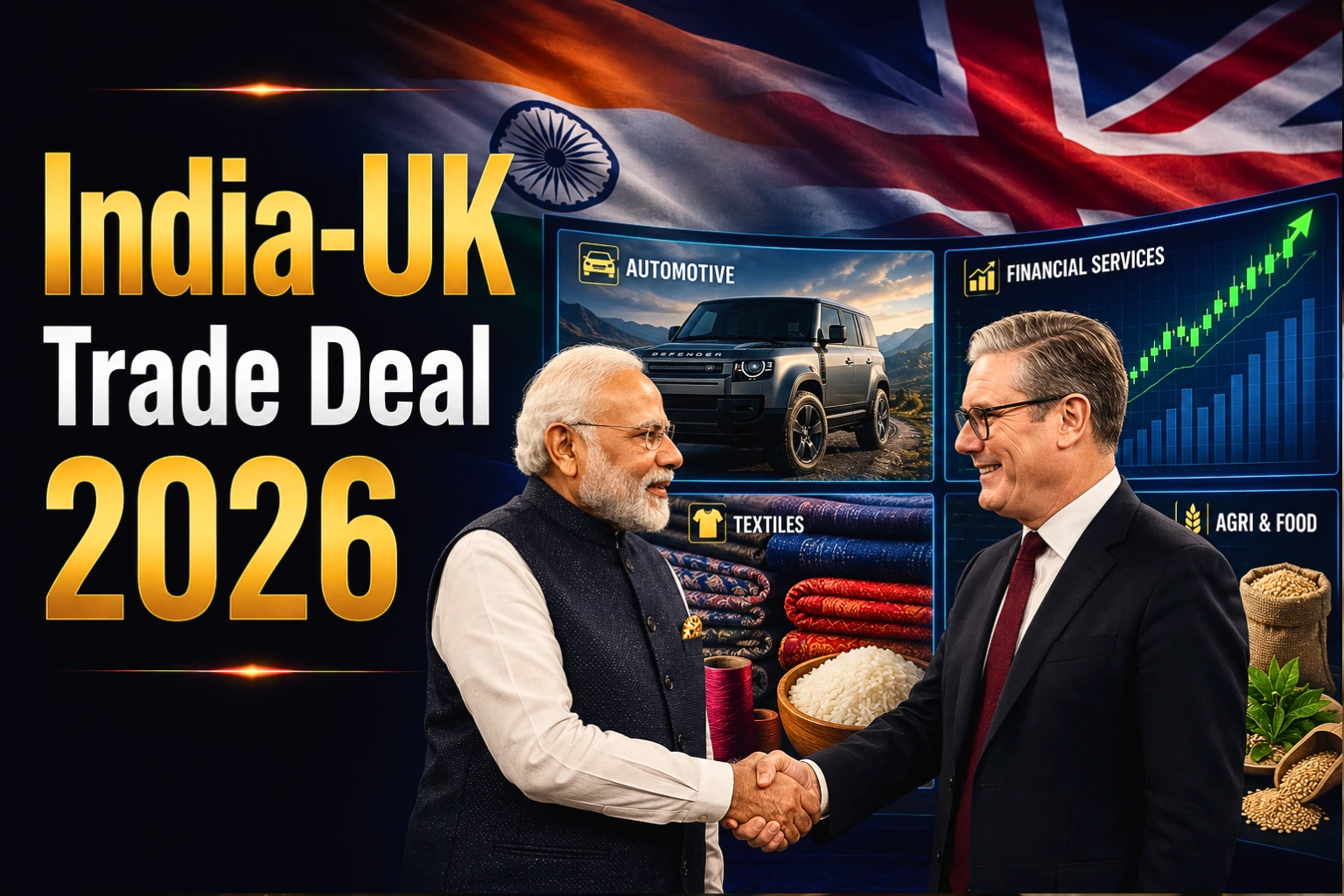
A ₹75 lakh cut on a Range Rover. McLaren's prices are dropping by crores. Import duty on Scotch whisky reduced from 150% to 75%. These headlines make it seem like the India-UK CETA 2026 is mainly for luxury-car buyers and premium-whisky lovers.
Since the agreement took effect on 15 July 2026, Indian exports across textiles, leather, footwear, seafood, gems and jewellery, engineering goods, processed foods and professional services have received improved access to the UK. India, in return, has lowered tariffs on selected British products, including luxury cars and Scotch whisky.
In this blog, you will learn which sectors will benefit the most, which British cars have become cheaper and by how much, how far Scotch whisky prices may actually fall, which stocks could gain or come under pressure, and most importantly, what this deal really means for the Indian economy. Keep reading.
India-UK Trade Deal Explained
From the date of implementation, the India-UK CETA tariff cuts delivered these key shifts:
- The UK provides duty-free access to around 99% of Indian exports, covering nearly 100% of current export value (subject to rules of origin).
- India reduced or removed tariffs on 90% of its tariff lines for UK goods, with many becoming duty-free immediately or in stages.
- Services access expanded across 137 sub-sectors.
- The accompanying social security agreement began, offering relief for temporary assignments.
Tariff benefits apply only to qualifying goods. Not every product automatically receives zero duty.
Who benefits from the India-UK CETA 2026?
Part 1. Luxury British Cars: Models & Price Reductions
These UK-built models (primarily CBUs) are benefiting from lower import duties. Prices shown are approximate ex-showroom in India (post-initial adjustments). Savings vary by model and will increase in phases.

(Img Idea: ET)
Car Price Reduction List
Range Rover SV (Land Rover/JLR)
- Previous: ~₹4.25 Cr
- New (post-FTA adjustment): ~₹3.50 Cr
- Savings: ~₹75 lakh
Range Rover Sport SV (Edition Two) (Land Rover/JLR)
- Previous: ~₹2.75 Cr
- New: ~₹2.35 Cr
- Savings: ~₹40 lakh
- (New base SV variant introduced at ~₹2.05 Cr)
Rolls-Royce Phantom / Ghost / Cullinan
- Expected reduction: 20-40% over initial years (from duties dropping sharply).
- Example: Phantom lineup starts from ~₹6-9.5 Cr previously; significant cuts anticipated.
Bentley Bentayga, Continental GT, Flying Spur
- Major beneficiaries with duties falling from 110% levels.
- Lineup (previously ₹5 Cr+) is expected to see 20-35%+ effective savings phased in.
Aston Martin DB12 / Vantage
- High-end sports/luxury models; notable price corrections expected (from ~₹4 Cr+).
- McLaren models (e.g., Artura)
Supercars are seeing duty relief and planned price drops.
Note: Jaguar Land Rover led with early cuts. Full savings unfold over 5+ years as tariffs phase down to 10%. Locally assembled models see less direct impact.

Part 2. Scotch Whisky & UK Spirits: Becoming More Affordable
British High Commissioner to India Lindy Cameron said, “If you had a Rs 5,000 bottle of whisky that you were going to sell in India, because of tariffs, you tended to sell it for Rs 12,500 yesterday. Today you just have to sell it for around Rs 8,500, and soon for just Rs 7,000,” as per New Indian Express.
Key Scotch Whiskies expected to get cheaper:
A typical premium Scotch bottle could see a ₹1,000–5,000+ reduction depending on the variant, making it more accessible to a larger audience over time. This FTA marks a big win for UK luxury exports to India. Prices continue to be updated by brands—check official dealers for the latest quotes.
Scotch Duty Reduction
- Johnnie Walker (Black Label, Blue Label, etc.) — Notable price relief; previously premium-priced, now more competitive.
- Glenfiddich, The Glenlivet, Macallan—Single malts are becoming more affordable.
- Lagavulin, Chivas Regal, Singleton— Popular blends and malts with phased savings.
Prices Before vs After India-UK Trade Deal
|
Category |
Before |
After |
|
Scotch Duty |
150% |
75% |
|
Luxury Cars |
High tariffs |
Reduced tariffs |
|
Indian Textile Exports |
Tariff applicable |
Mostly duty-free |
Sector-Wise Impact and Stocks to Be Affected
The India-UK CETA benefits by industry vary depending on current export volumes, previous tariff levels, and the ability to meet rules of origin and UK standards. Here is a detailed sector-wise analysis:
1. Textiles & Apparel
This is one of the biggest winners. Many categories now enjoy duty-free access. Indian garments, fabrics, and home textiles become more price-competitive in the UK. Expect higher order volumes, especially from MSMEs in clusters like Tirupur and Surat.
2. Leather & Footwear
Significant tariff elimination helps shoes, bags, and accessories. India can better compete with other suppliers. Labour-intensive sector — good for job creation in Uttar Pradesh, Tamil Nadu, and West Bengal.
3. Marine Products (Seafood)
Shrimp, fish, and processed seafood get duty-free entry on major lines. UK is a premium market.
4. Engineering Goods & Auto Components
Tariff reductions on many parts and machinery improve supply chain integration. Helps companies supplying UK auto and engineering firms.
|
Sector |
Previous UK Tariff Range (approx.) |
New CETA Treatment |
Key Opportunities |
Main Challenges |
|
Textiles & Apparel |
Up to ~12% |
Mostly duty-free |
Higher volumes, better margins |
Quality standards, competition |
|
Leather & Footwear |
Up to ~16% |
Mostly duty-free |
Job creation, new buyers |
Environmental & chemical rules |
|
Marine Products |
4–8.5% on key items |
Duty-free on major lines |
Export volume growth |
Food safety & traceability |
|
Engineering Goods & Auto |
Up to ~18% in categories |
Significant reductions |
Supply chain integration |
Technical certifications |
(Tariff figures are indicative. Always verify the exact HS code in official schedules).
Stocks Likely to Be Affected
For stock market investors, the sectors with the clearest, most immediate tariff-elimination tailwinds are worth tracking closely:
- Textiles & garments — 12% tariff to zero, immediate competitiveness boost
- Leather & footwear — 16% tariff removed
- Engineering goods & auto components — 18% tariff removed, plus UK auto sector projections show a potential 311% increase in exports from tariff liberalisation on the UK side too
- Pharmaceuticals & chemicals — 8% tariff eliminated, aiding India's generics and API exporters
- Marine/seafood exporters — 21.5% tariff removed
- Steel companies — protected from UK safeguard disruption via quota mechanisms
Analysts note that while tariff reductions offer real commercial upside, long staging periods, complex rules-of-origin documentation, and administrative burden could limit how quickly smaller firms and MSMEs can actually capture these benefits — worth watching in quarterly earnings commentary over the next few quarters.
Want to know which listed Indian companies could benefit the most from the India–UK Free Trade Agreement? Read our detailed blog on India–UK FTA beneficiary stocks, where we cover sector-wise winners, company analysis, and the potential long-term impact on the Indian stock market.
Overall Economic Impact
In 2025-26, India-UK trade grew by 8.62% to reach $25.12 billion, up from $23.13 billion the previous year. The official estimate suggests that in the long term, this deal could boost bilateral trade by up to £25 billion annually.
Textile exports alone are projected to grow at 20% per year until 2030 — translating into an additional $1 billion in exports. The leather sector is also expected to see an additional export potential of up to $200 million by 2030.
“The agreement is expected to increase bilateral trade by more than £25 billion annually over the long term and raise the combined GDP of both countries by nearly £5 billion”, Lindy Cameron said.
Risk Factors
However, two risk factors should also be noted.
- There is a risk for steel exporters. The UK has tightened its steel import regime from 1 July. India’s steel exports to the UK were around $900 million — accounting for roughly 7% of total exports. This could come under pressure.
- The currency effect. As mentioned earlier in the car segment, the rupee’s weakness against the pound somewhat reduces the benefit of the duty cuts. This applies to cars as well as overall imports.
Practical Example: A qualifying ₹10 lakh shipment of textiles that previously attracted around 12% UK duty could save approximately ₹1.2 lakh in customs duty. Real savings vary based on exact classification, origin qualification, shipping costs, and other factors.
The industry body CIABC has also openly raised red flags. They worry that if this same tariff pattern is repeated in future trade deals with the EU and the US, the domestic alcobev sector could face a serious structural challenge.
Realistic View: Benefits and Limitations
The India-UK trade deal impact includes potential long-term GDP and trade gains, but results are not automatic. UK food-safety requirements, sanitary and phytosanitary controls, certifications, labelling rules, and documentation remain essential. Quotas, safeguard mechanisms, and supply-chain factors also matter. Non-tariff barriers can influence success as much as tariff cuts.
Looking Ahead with the India-UK CETA 2026
Since the agreement took effect, it has created a more open framework for trade and investment between India and the UK. For exporters, MSMEs, and professionals, it opens doors through lower duties, clearer rules, and better mobility — when requirements are met.
This India-UK CETA 2026 strengthens economic ties practically, supporting jobs and growth while encouraging quality and compliance.
Key Takeaways
|
Item |
Update |
|
Effective Date |
15 July 2026 |
|
UK Duty-Free Access |
99% of Indian exports |
|
India Tariff Reduction |
90% of tariff lines |
|
Biggest Winners |
Textiles, IT, Pharma, Jewellery |
|
Biggest Consumer Benefit |
Luxury cars & Scotch |

Conclusion
The India-UK CETA 2026 is a significant milestone that opens premium UK markets for Indian exporters, creates jobs, supports economic growth, and strengthens bilateral ties. Whether you are an exporter, investor, or professional, understanding rules of origin, compliance, and sector-specific opportunities will be key to maximising benefits from this landmark deal.
(Sources: Business Standard, Parliament UK, Times of India, Indmoney, Livemint, Whales Govt)

DISCLAIMER: This blog is NOT any buy or sell recommendation. No investment or trading advice is given. The content is only for educational purposes. Always discuss with your SEBI-registered financial advisor for investment-related decisions.


.webp)










 (1).webp)