RBI Banking Rules have transformed how banks interact with customers in India. In short, these guidelines stop forced bundling of extra products like insurance with loans, ban tricky designs in apps known as dark patterns, require clear and separate consent for sales, ensure all charges are shown openly, and boost Banking Customer Rights with stronger transparency and better support for issues.
These RBI New Rules in RBI Banking Guidelines 2026 help everyday people avoid unnecessary costs and make smarter choices.
RBI Dark Patterns Banking Rules 2026: How New Guidelines Protect Bank Customers
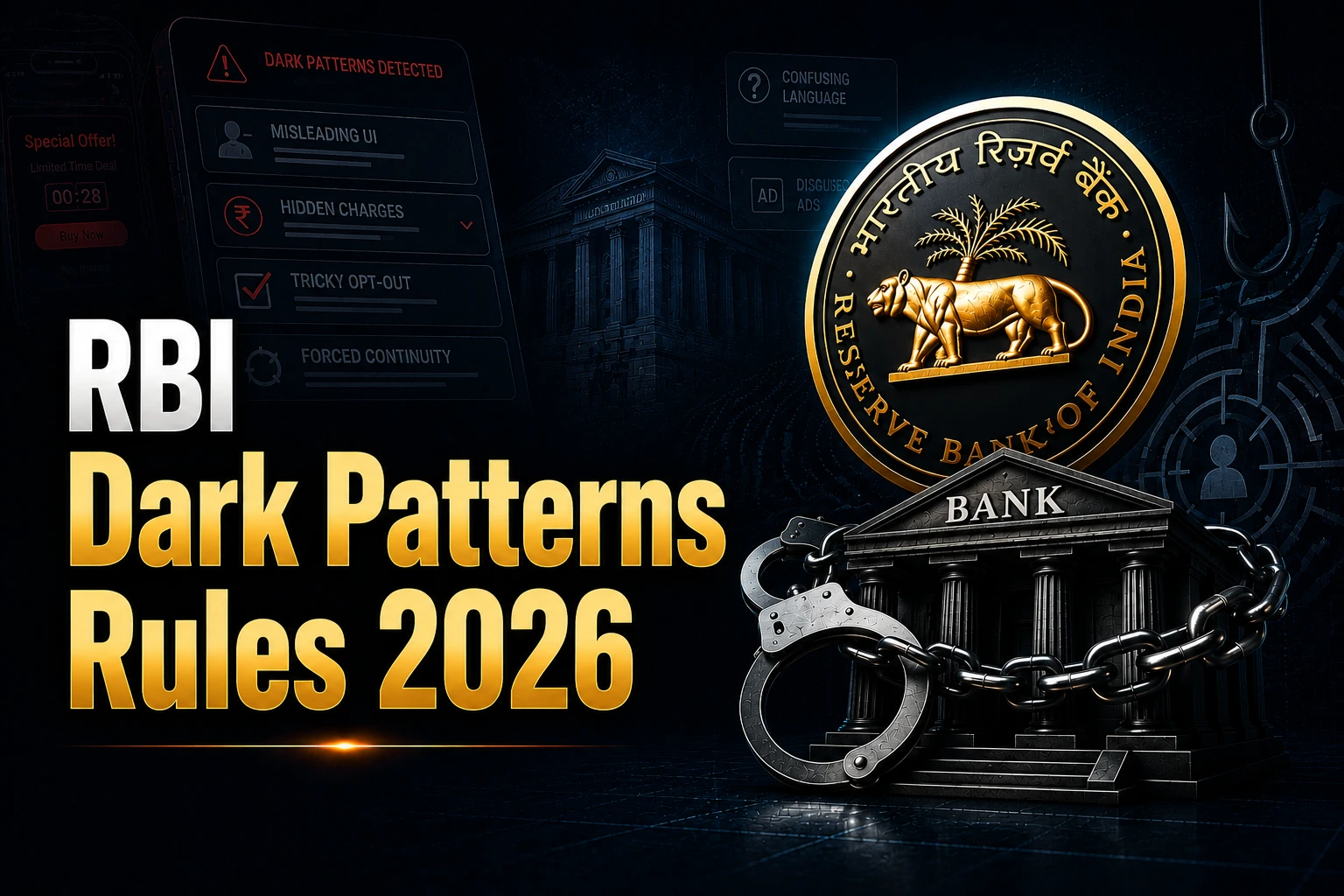
The RBI Dark Patterns Banking Rules 2026 are draft guidelines issued by the Reserve Bank of India on February 11, 2026 (Circular DOR.MCS.REC.No./01-01-032/2025-26), set to take effect from July 1, 2026. These rules prohibit banks from using deceptive app and website designs (dark patterns) to push unwanted products, require separate explicit consent for every product sold, mandate full refunds in proven mis-selling cases, and apply to all commercial banks, NBFCs, housing finance companies, and co-operative banks across India.
Imagine walking into a bank for a simple savings account, only to leave with an insurance policy you never asked for, a credit card you do not remember approving, and a list of charges you cannot explain. Or tapping a button on your bank's app — one that looked like a routine confirmation — and discovering you had just subscribed to a paid product. These experiences have frustrated millions of Indians for years.
India's banking regulator, the Reserve Bank of India (RBI), has now stepped in with a sweeping set of rules targeting the root cause: the deceptive design tactics — formally called dark patterns — that banks use to steer customers toward unwanted products. Issued as a draft circular on February 11, 2026, the Draft (Commercial Banks – Responsible Business Conduct) Amendment Directions, 2026 are proposed to come into force from July 1, 2026. Here is everything you need to know as a bank customer in India.

Definition — dark pattern in banking (RBI, 2026)
A dark pattern in banking is, per the RBI draft circular, "any practice or deceptive design pattern using user interface or user experience interactions" that steers customers toward buying unwanted products or services. Examples include pre-ticked insurance checkboxes on loan forms, hidden opt-out buttons, false urgency countdown timers, basket sneaking (adding products at checkout without clear consent), bait-and-switch tactics, and trick wording that makes opting out harder than opting in.
Key Provisions of the RBI Draft Circular (February 2026)
The draft directions (Circular: DOR.MCS.REC.No./01-01-032/2025-26, dated February 11, 2026) introduce several concrete obligations for regulated banks and financial institutions:
a) Compulsory bundling is banned
Banks cannot make one product or service conditional on the purchase of another — whether it is their own product or a third-party one (insurance, mutual funds, etc.). Offering multiple products as a voluntary package at no extra cost remains permitted, but the customer must actively and freely choose each item.
b) Explicit consent for every product
Banks must obtain specific, informed, and unambiguous consent recorded separately for each product or service sold. The consent process must be designed so that customers cannot give consent without actually reading the applicable terms and conditions. Pre-ticked boxes and passive consent are prohibited.
c) Dark patterns banned from all digital interfaces
All banking apps and websites must be free of dark patterns. Under Section 85X of the amendment directions, banks must conduct user testing and periodic internal audits of their digital interfaces to identify and remove any manipulative features. Banks must also comply with the Central Consumer Protection Authority (CCPA) Guidelines for Prevention and Regulation of Dark Patterns, 2023.
d) Suitability assessment before every sale
Before marketing or selling any financial product, a bank must assess whether the product is suitable for that specific customer based on their age, income level, financial literacy, risk tolerance, and the product's complexity, fees, and risk-return profile. Banks cannot sell an unsuitable product even if the customer has given consent.
e) Full refund + compensation for mis-selling
Where mis-selling is proven, the bank must refund the entire amount paid by the customer and compensate them for any further loss — even if the customer had given explicit consent at the time of the sale. This removes the defence that consent was obtained.
f) 30-day customer feedback mechanism
Banks must establish a system to seek feedback from customers within 30 days of selling any product, to verify that customers have genuinely understood the features and risks. This can be done via call-backs or surveys conducted by a department independent of the sales function.
g) No promotional communication without opt-in
Banks may not send promotional messages or alerts about their own or third-party products unless the customer has explicitly consented to receive such communication. Sharing a customer's information with any third party also requires explicit consent.
Old Ways vs New RBI Banking Rules
For a long time, customer protections existed in a general form, relying a lot on banks managing themselves. This sometimes left people struggling with proof of issues or slow resolutions. Digital challenges, such as confusing app layouts, were not covered in much detail.
The latest RBI Banking Rules make these protections more direct and useful:
Here is a simple table comparing key areas:
|
Banking Aspect |
Earlier Common Practices |
Under New RBI Banking Rules |
Benefit for You |
|
Product Bundling |
Extra items are often pushed together |
Separate clear consent needed, no forcing |
Full freedom to pick only what suits you |
|
App and Website Experience |
Sometimes, tricky buttons and layouts |
Ban on misleading designs |
Easier and safer daily use |
|
Charges |
Fees are not always shown upfront |
Open display with notice for changes |
Helps you plan money better |
|
Sales and Explanations |
Quick talks with limited details |
Simple language and time to decide |
You understand before buying |
|
Handling Customer Issues |
Resolutions could take longer |
Stronger process for refunds and support |
Faster help when needed |
|
Overall Fairness |
General expectations |
Clearer rules focused on customer needs |
More trust and confidence |
This table shows how the new approach shifts focus toward real customer benefits.
The draft directions apply broadly across India's regulated financial sector:
- Commercial banks (public sector, private sector, foreign banks)
- Small finance banks and payments banks
- Non-banking financial companies (NBFCs)
- Housing finance companies
- Urban co-operative banks and rural co-operative banks
- Regional rural banks and local area banks
- All-India financial institutions: NABARD, National Housing Bank (NHB), EXIM Bank, and SIDBI
The RBI circular provides an illustrative list of dark patterns relevant to banking. Here are the seven most common ones — and what they look like in practice:
|
Dark pattern |
What it means |
Banking example |
|
Basket sneaking |
Adding insurance or fraud cover at checkout without asking you |
Loan protection insurance added by default to a loan application |
|
Pre-ticked boxes |
Checkboxes already selected for products you did not choose |
Auto-selecting a ₹999/year accident cover on account opening form |
|
False urgency |
Countdown timers or 'Offer Ends Soon' messages on financial products |
Pre-approved loan popup with 47-minute countdown |
|
Bait and switch |
Advertising one product but delivering a different, usually costlier one |
Advertising 8.5% FD rate but offering 7.2% at branch |
|
Drip pricing |
Showing base price first, then adding fees/charges at the end |
EMI shown without processing fee until final confirmation screen |
|
Disguised ads |
Making advertisements look like genuine system notifications |
A 'Congratulations' message that is actually a credit card upsell |
|
Trick wording |
Confusing language that makes opting out harder than opting in |
'Uncheck this box if you do NOT want offers' — a double negative |
Why These Changes Matter
Banking issues affect lakhs of people. In the financial year 2025-26, banks and financial institutions together reported over 10,000 fraud cases involving around ₹48,000 crore. While the number of cases came down from previous years, the money involved went up significantly.
These figures highlight growing risks in digital banking and the need for better safeguards. The RBI Banking Rules directly target problems like aggressive selling and unclear interfaces to reduce such troubles and build greater trust.
For someone just starting out, like a student or a first-time salary earner, this feels like a welcome support. Banks now have clearer duties to offer products that actually match your situation.
Example- Priya’s Story: Finding Relief
Priya works as a teacher in a smaller town. She once faced trouble with an online payment that was not hers. In the past, sorting it out took a lot of time and effort. With improved RBI Customer Protection, banks now follow tighter timelines and clearer responsibilities, helping customers like Priya get quicker and fairer outcomes.
Everyday Ways These Rules Help You
You can benefit by asking questions when something feels unclear. Always request simple explanations. Feel comfortable refusing extra offers — it is now fully your choice. Keep an eye on your account statements for any charges. These small actions make you stronger under the Bank Transparency Rules and protect your hard-earned money.
You do not need to wait for July 2026 to start exercising your rights as a bank customer. Here is a practical checklist:
- Always ask for a plain-language explanation of every product before signing. If the executive cannot explain it simply, that is a red flag.
- Check every digital form carefully for pre-ticked boxes before confirming. Uncheck anything you did not consciously choose.
- Feel confident refusing any additional product — insurance, credit card, mutual fund. It is your legal right, and no bank can deny you a service solely because you refused an add-on.
- Check your account statements monthly. Any unexpected deduction can be raised as a complaint.
- Lodge a complaint with your bank in writing first. If unresolved within 30 days, escalate to the RBI Banking Ombudsman at bankingombudsman.rbi.org.in — the service is free.

Conclusion
The RBI's 2026 draft banking rules represent a meaningful shift in how India's regulator thinks about customer protection — from a focus on disclosure to a focus on design. The rules acknowledge that in a digital world, a confusing button or a pre-ticked box can do as much financial harm as an outright fraudulent transaction. By banning dark patterns, mandating suitability checks, and making refunds automatic in mis-selling cases, the RBI is pushing banks to earn customer trust through genuine service rather than manipulation.
If you are a bank customer in India, these rules give you new and stronger grounds to question, refuse, and challenge any product or service pushed onto you without your full understanding. Share this information with your family — especially elderly relatives and first-time digital banking users who are most vulnerable to these tactics.
For the latest updates on the final RBI circular, visit: rbi.org.in or the Banking Ombudsman portal at bankingombudsman.rbi.org.in.
(Sources: bfsi.economictimes.indiatimes.com, tradingview.com, thehindu.com, rbi.org.in).

DISCLAIMER: This blog is NOT any buy or sell recommendation. No investment or trading advice is given. The content is purely for educational and information purposes only. Always consult your eligible financial advisor for investment-related decisions.