The rapidly changing world requires smart and quick decisions to ensure your child will have a prosperous future, and as parents, you can start building future wealth with mutual funds for minors. That's starting your child's financial education and encouraging a good habit. This will require manoeuvring through minor mutual funds account rules and mutual funds tax rules.
However, with investing in a child's name, you understand that investing in funds isn't as easy as opening a bank account, and several factors determine the complexities that will help you avoid errors that will cost you a lot in the long run.
Investors planning long-term wealth creation through index funds can also explore SIP planning strategies and estimate future returns using a SIP Calculator before investing in NFOs or mutual funds.
This guide will help you with everything you need to know, starting from minor mutual fund account rules, and the tax on minor investment India, to common mistakes people make in investing in child name. You will be able to successfully comply with mutual fund tax rules and put your family's ambitions in line with your wealth objectives. These mechanisms will help you turn your child's financial goals away from mere "pocket money" fantasies and create a cash reserve.
Why Invest In Mutual Funds For Minors? Benefits of Early Investing
Starting an investment early means that over time the investment will be able to make money from the investment and money will be made without further funding the investment. Mutual funds for minorsare even more enticing because they take money from a multitude of investors and use that combined capital to buy a varied selection of assets (like a diversified collection of stocks, bonds, etc.) and this is handled by experts. For Indian parents, this means investing on behalf of your child does not require a large initial investment.
The attractive feature is that a minimum investment requirement does not exist. mutual funds for minorsallow for your child to begin investing at a young age, and, while other investment opportunities like fixed deposits or real estate investing, have large minimum investment amounts and limits, Mutual Funds allow for a minimum investment of just ₹500 a month, and, over time, equity-oriented funds can return an average of 12-15% of your investment. The average savings account will be far surpassed by this return.
What's an investment in a child name fund? By legally putting the fund in your child's name. This ensures that the fund is used for education, marriage, or other life/events.
As the accounts of minors at mutual fund companies (such as HDFC, SBI, or ICICI Prudential) are opened by the parents/guardians, the operating holder is the parent/guardian while the beneficiary is the child, thus the fund belongs to the child. Attachments to this are that the account will fall under the minor mutual fund account rulesand that they will be strictly enforced.
Consider this: A SIP of ₹5,000 in an equity fund at 12% CAGR could reach ₹1 crore in 20 years! That’s the magic of starting young. But before you dive into this opportunity, it’s important to understand some minor mutual fund account regulations to ensure a smooth process.

A Simple Guide to the Minor Mutual Fund Account Rules
Starting mutual funds for minorscomes with the minor mutual fund account regulationsestablished by the Association of Mutual Funds in India (AMFI) and the Securities and Exchange Board of India (SEBI). These rules enable the minor to retain control of the assets while defining the power of the guardian to control the investments.
First, let’s clarify some important points. Any child under 18 years can open a mutual fund folio. The primary account holder (i.e. guardian) can be the minor (i.e. joint holder). In the absence of both parents, a court-appointed guardian can take their place. Importantly, only one guardian can control the account; no joint account guardians are allowed for transactions.
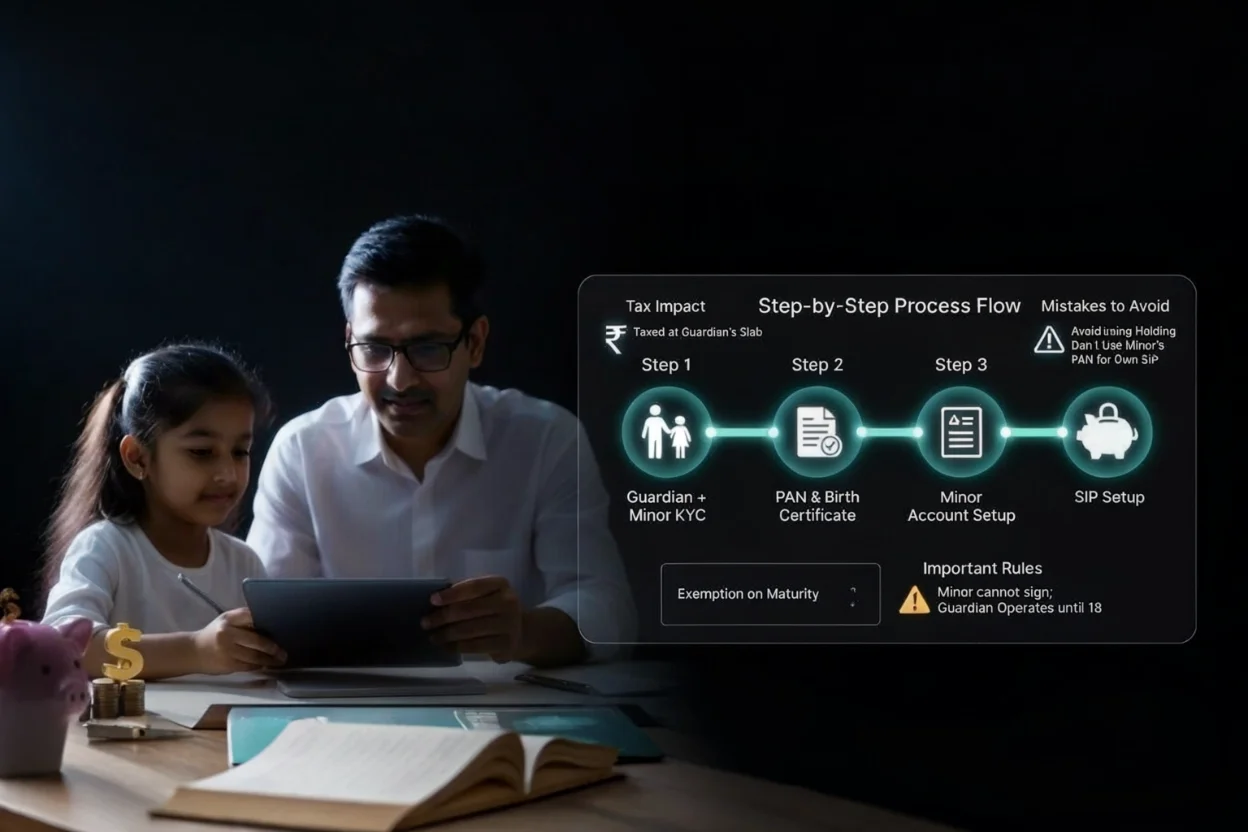
The KYC process is non-negotiable. Know Your Customer (KYC) verification is required for both the child and the guardian. If it is for the child, it includes a birth certificate or a school ID. For the guardian, it is PAN, Aadhaar, and a proof of address. While digital KYC is done via Video Verification, this process is a little simpler. Just remember to e-sign KYC forms. Once done, your folio will be updated with KYC “Minor” attached to it. This means that your folio will now have restrictions, such as no redemptions or no switches to other schemes without permission from your guardian.
While you have the option to consider investing via other means, such as lump sum or SIPs, the rules of minor mutual fund accountswill cap the guardian’s authority. Therefore, while the dividends and capital gains will accrue to the account, this is not the case for the parents. When a child turns 18 years old, this is when the account matures and the account will then need to complete the KYC again. If this is not done again, the account will freeze and will no longer be able to do any transactions. This is something that most people forget to do.
There are rules around transmission as well. In the case of the guardian’s demise, the surviving parent or the court nominee will take over. Sadly, if a minor passes away, the funds will be distributed to the legal heirs as per succession laws. Most fund houses will have their own sites integrated with platforms like Groww or Zerodha Coin for easy online setup. Always double-check with the fund house before proceeding.
When investing in mutual funds for minors, consider selecting growth options as a strategy to postpone taxes that you would otherwise incur when redeeming funds. Further, by complying with the minor mutual fund account rules, you create a legacy with built-in protections.
Understanding the Tax on Minor Investment in India: A Guide for Parents
Taxes can take a big bite out of profits, and that is why it is critical to understand the tax on minor investment India when considering mutual funds for minors in India. The Indian tax system is regulated by the Income Tax Act of 1961, which, in the case of minors, considers them as a “proxy” for the parents. Income clubbing is an important aspect of mutual fund tax rules that apply to minors.
Let’s summarise: any money earned through investing in a child’s name, including dividends and capital gains from mutual funds and/or dividends and capital gains from mutual fund, is added to the parent’s income and taxed. This is the case when the investment was made using the parents’ money.
There is an exception to this for income earned by the minor through his or her skill, talent, or manual work (for example, if the child wins a coding contest and invests the prize money), but this is unlikely to apply to mutual funds.
Mutual fund tax rules explained include:
- Debt Funds: As an investment type, all gains will now be taxed at the investor's slab rate. With minors, this means parental slabs will come into play, possibly pushing the family into a new tax bracket.
- Dividends: They are taxed like any other income. If the total income from dividends is greater than ₹5,000 within a financial year, TDS will apply at a rate of 10%.
The primary purpose of the clubbing provision is to prevent tax evasion by children. It does not apply to cash or other assets given to the child prior to the investment, like the situation where the child inherits the cash. Once the person turns 18, the clubbing rules no longer apply, and the adult child’s income will be taxed separately.
To reduce the tax implications of minor investments in India, you can consider the following:
1. The Gift Approach: You can give the minor the funds through a legally documented gift deed. Any income generated from the principal amount in the future won’t be clubbed.
2. SIPs from Known Sources: Ensure that you maintain adequate and detailed records of all contributions for audit purposes.
3. ELSS Funds: These funds are equity-linked savings schemes and are eligible for a deduction under section 80C of the Income Tax Act up to ₹1.5 lakh, which will reduce your taxable income before clubbing.
Common Mistakes to Avoid When Investing in Child's Name
Let's break down each mistake so you can set up your mutual funds for minors with no regrets.
Mistake 1: Ignoring Account Maturity Rules. Those turning 18 can change the ownership of a mutual fund account to their name. Accounts that haven't been converted are frozen. Make a note to start the adult KYC process 3 months before their 18th birthday.
Mistake 2: Not Understanding Tax Clubbing. Many parents think that mutual funds in a child's name mean that investment income won’t be taxed. This is not true. The investment income is attributed to the parent(s), meaning the tax bill can be higher. The solution is to spread out the investments, including a PPF investment.
Mistake 3: Investing in 100% Equity Funds. If a mutual fund is marketed as a fund for minors, a parent might assume that it is safe. This is incorrect. Equity funds can be volatile and often concern parents. Investing in a fund that is exclusively small-cap fund is a mistake because many people do not have a long enough investment horizon. The solution is to invest in a balanced fund and also use tools like the Morningstar rating.
Mistake 4: Lack of Documentation. Tax on investments in India is complicated, and poor record-keeping can lead to numerous issues. If you contribute to your child’s account and do not document it with a gift deed, you are inviting problems. Keep records such as statements and transaction IDs.

Conclusion
A vote of confidence in your child's future, mutual funds for minors are more than just investments. Investing in child names can become a strategic powerhouse by understanding minor mutual fund account laws, navigating the tax on small investments in India, and following mutual fund tax regulations. Watch money blossom if you start small and maintain discipline.

DISCLAIMER: This blog is NOT any buy or sell recommendation. No investment or trading advice is given. The content is purely for educational and information purposes only. Always consult your eligible financial advisor for investment-related decisions.












.webp "growth-vs-idcw-mutual-fund")