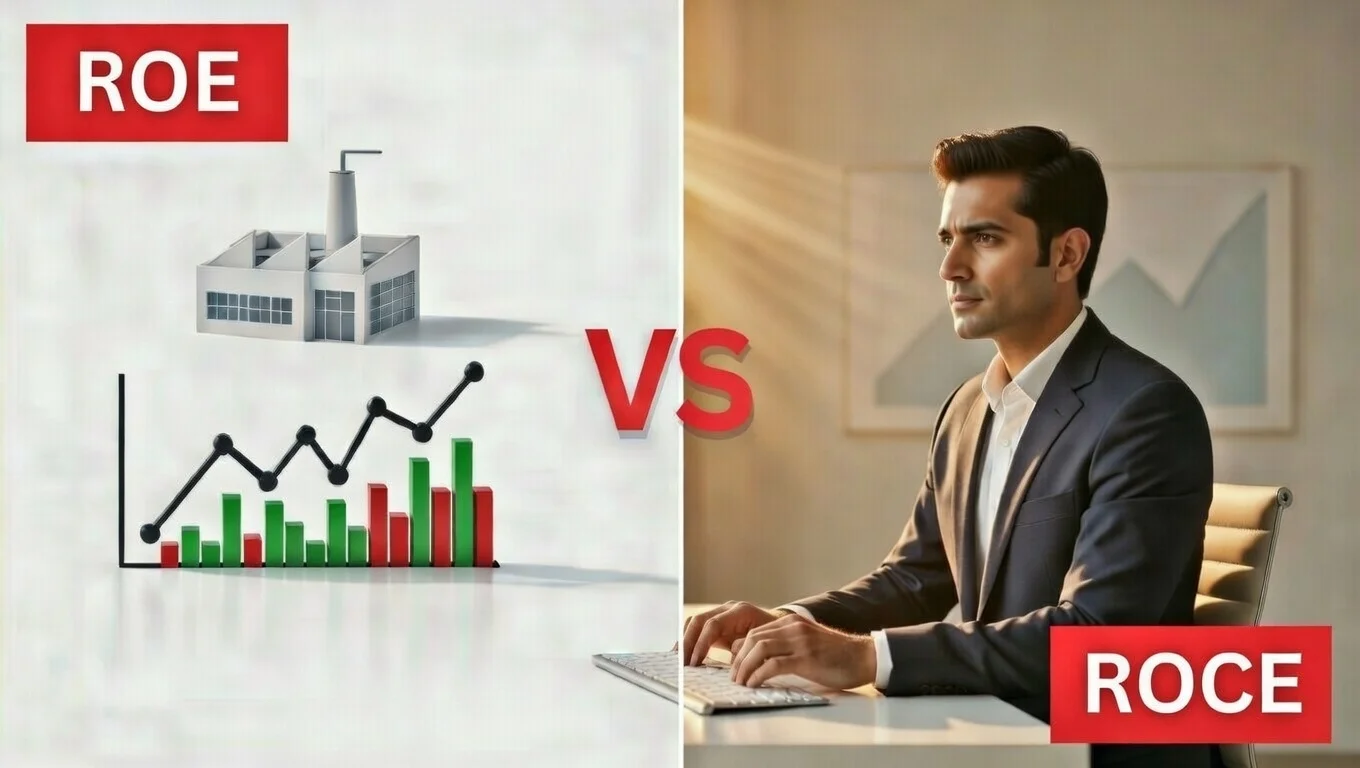
The ultimate goal of stock investing is to find out how to invest in multibaggers. The big question is how to multiply your investment more than a few times over. A major challenge is how to do this in a market filled with hype and vicissitude. The essence of this conundrum lies in a comparison of two powerful financial metrics.
The arriving numbers are not just white numbers on an accounting paper; they are financial metrics that aid in assessing a company's efficiency and profitability. This is an in-depth analysis of return on equity versus return on capital employed. We will examine the intricacies of their meanings, how they differ, and what multibagger analysis entails. Irrespective of your level of investing experience, knowing what ROE and ROCE mean will unlock your potential in investing in multibaggers.
What is ROE, Unpacking the ROE Meaning
Let's start with the basics. ROE, or Return on Equity, is a profitability ratio that shows the effectiveness used on the company's shareholders' equity to generate profits. In layman's terms, it is the overall profit that the company has generated per dollar of equity of the owners.
The formula for ROE is straightforward:

Likewise, shareholders' equity is what's left after the net liabilities of a company have been paid. It is the book value of a company after its assets and liabilities have been netted out. Keep all of this in mind in order to understand ROE when analyzing a stock, and in this case, a multibagger.
The higher the ROE, the higher or faster the growth can be; also, the more efficient the company is in producing earnings as the equity gets put in. It is at this point where it can be determined if the company is reinvesting the dividends, expanding the company, or if the company is just being innovative and pushing other stockholders out by driving the other stock prices up. An example under company ROE would be greater than 20% and it would also be a multibagger stock company to more than 2.5 and 5 billion dollars.
The greater the use of borrowed funds to place on the income statement, the easier it is to improve. Because the total equitable debt level decreases as you increase the amount of debt invested, contrary to the overall performance of the company. When weighted debt and equity are being compared to each other, the case of the ROE and the ROCE focuses on the more equitable state.

Understanding ROCE
Let us move to ROCE, which means Return on Capital Employed. This measurement looks at aspects other than solely equity. While other measurements look at one part of the capital, ROCE looks at both parts of capital, equity and debt. This measurement is important in industries that use large amounts of capital, like manufacturing or utilities, where debt financing is common.
The formula to calculate ROCE is as follows:

In this formula, EBIT means Earnings Before Interest and Taxes, which is the profit made from the operation of the business, excluding the costs of financing. Capital Employed means total assets of the company, excluding current liabilities. In other words, this is equally the total of shareholders' equity plus the long-term debt.
The meaning of ROCE goes beyond just measuring the operational efficiency of the business. A company with a strong ROCE means that the company is intelligent enough to use every rupee or dollar invested in the company, whether from the shareholders or from the lenders. In the analysis of multibagger stocks, ROCE is extremely useful in analyzing companies with leverage.
A company with a ROCE of 25% or more is likely to have the ability to grow significantly in terms of profit, because this value indicates that the company has the ability to sustain profit and, as a result, sustain profit reinvestment without the need to excessively dilute the equity.
ROCE also shows a fairer perspective since taking on too much debt without gaining higher positive cash flows punishes businesses. This without a doubt, creates a fairer measure of how much value a business is deriving over a longer horizon. But is it fair to assume ROCE is better? Not always. So, let's engage in a comparison.
ROE vs ROCE [Comparison of Differences and Similarities]
Comparing return on equity to return on capital employed comes down to the finer details. Both measure profitability in terms of how much was invested. However, it all depends on how they measure “invested resources”.
- Range of Capital: ROE examines cash equity, which means all liabilities and obligations are assumed to be zero. This is most useful for leverage-free firms, like most tech firms, where all funding is in the form of debt. On the contrary, ROCE examines cash equity along with liabilities, similar to how leverage firms like McKinsey perform.
- Impact of Leverage: Under high leverage, ROE is likely to be high. It will likely be low for all equity and cash berthed. McKinsey analysis suggests that high-leverage firms (where most equity is debt) are over-indebted, and low ROCE is over-reliant on leverage.
- Measure of Profit: Since net income is used in ROE, which subtracts interest and taxes, and because ROCE uses EBIT, which is pre-financing, it makes ROCE less susceptible to tax and interest strategies.
There is a lot of common ground. Both are presented as percentages, and in most cases, the higher the better (15-20%+ is the target at a minimum in most competitive industries). Predictive estimates are necessary for investors to identify future outlier stocks, as both metrics are based on historical data.
Most investors use both metrics together. For example, Warren Buffett targets companies with a high ROE, but also considers capital efficiency, similar to ROCE. It's not a matter of determining the better metric but rather of using both appropriately.
The Advantage of ROE in Identifying Multibaggers
When identifying multibagger stocks, the metric that attracts the most attention is always ROE due to its ability to capture shareholder value. For multibaggers, the primary driver of success is the compounding effect of the business, which is generated by reinvesting the earnings of the business. During a multi-year period, if a company's ROE is consistently above 25%, it is a strong signal that the company possesses a competitive advantage through proprietary technology, a strong brand, or dominant network effects.
Examples of Indian multibaggers would include HDFC Bank and Asian Paints. Over the last few decades, their ROE has been in the region of 15-20%, and as a result, their share prices have grown from mere pennies to a significant amount. In this context, ROE is indicative of the ability of the company's management to deploy equity efficiently.
Understanding the Pros and Cons of ROE
Pros
-
Simple calculations and straightforward comparisons across peers.
-
ROE shows how efficiently the equity is used, which is critical for growth companies.
-
Stock performance is highly correlated to ROE in industries with minimal debt.
Cons
-
When it comes to debt, ROE is blind
-
Share buybacks and one-off 'gains' can distort
In order to identify multibaggers, a value investor must examine ROE trends over a 5-10 year period. If you see a consistent increase in ROE alongside an increase in revenue, it is a positive indication.
Tracking ROCE for Multibagger Investors
In multibagger scenarios, ROCE outshines others, especially in sectors with heavy capital requirements. Unlike others, ROCE considers debt and therefore filters out firms that are simply improving performance using debt. In terms of sustainability in return on equity and return on capital employed, ROCE is superior.
Example: Indian heavyweights Reliance Industries and Tata Steel. Improved ROCE for Reliance and Tata signalled a positive bounce-back that resulted in them becoming multibaggers. In this situation, ROCE signifies the real economic value added after accounting for the cost of capital.
Pros
-
Better for comparing companies across industries.
-
Predicts long-term viability in debt-prone sectors.
Cons
-
Requires consideration of capital employed and EBIT, which are difficult to obtain
-
In sectors with temporarily low ROCE and high growth, it can lose value.
In multibagger stock analysis, a return on capital employed (ROCE) that exceeds the weighted average cost of capital (WACC) by 5-10% is regarded as a robust buy signal. A company is able to create value in excess of its funding costs.
Real World Example Comparisons of ROE vs ROCE
Now, to exemplify the contest of ROE vs ROCE, consider the two hypothetical multibagger candidates below.
Company A: Tech Start Up (Low Debt)
- ROE: 30%
- ROCE: 28%
- No Company Tech clearly has multibagger potential as the RC spreads on the software industry are likely to be very high.
Company B: Manufacturing Behemoth (High Debt)
- ROE: 25%
- ROCE: 12%
- Analysis suggests that the large debt is simply a result of ROE being overstated by the large debt, as well as the small RC, suggesting that the company is highly inefficient. Avoid the company until the debt is reduced.
Real-life examples of this phenomenon include Apple, which had an ROE of 150% + once during the boom of the iPhone; however, Apple had an RC of about 30%, which suggested that Apple was excellent at managing its operations. Likewise, during boom times, many airlines have high ROE; however, once the fuel debt is taken into account, the airlines show a very low ROE.

Conclusion
In the Indian markets, Page Industries (which is the owner of the Jockey brand) has an ROE of >40% as well as an ROCE of >50%. Page Industries is a marvellous case of a multibagger. On the other hand, a heavily indebted firm such as Vodafone Idea showed poor ROCE, which was a signal that the company was going to decline.

DISCLAIMER: This blog is NOT any buy or sell recommendation. No investment or trading advice is given. The content is purely for educational and information purposes only. Always consult your eligible financial advisor for investment-related decisions.


.webp)