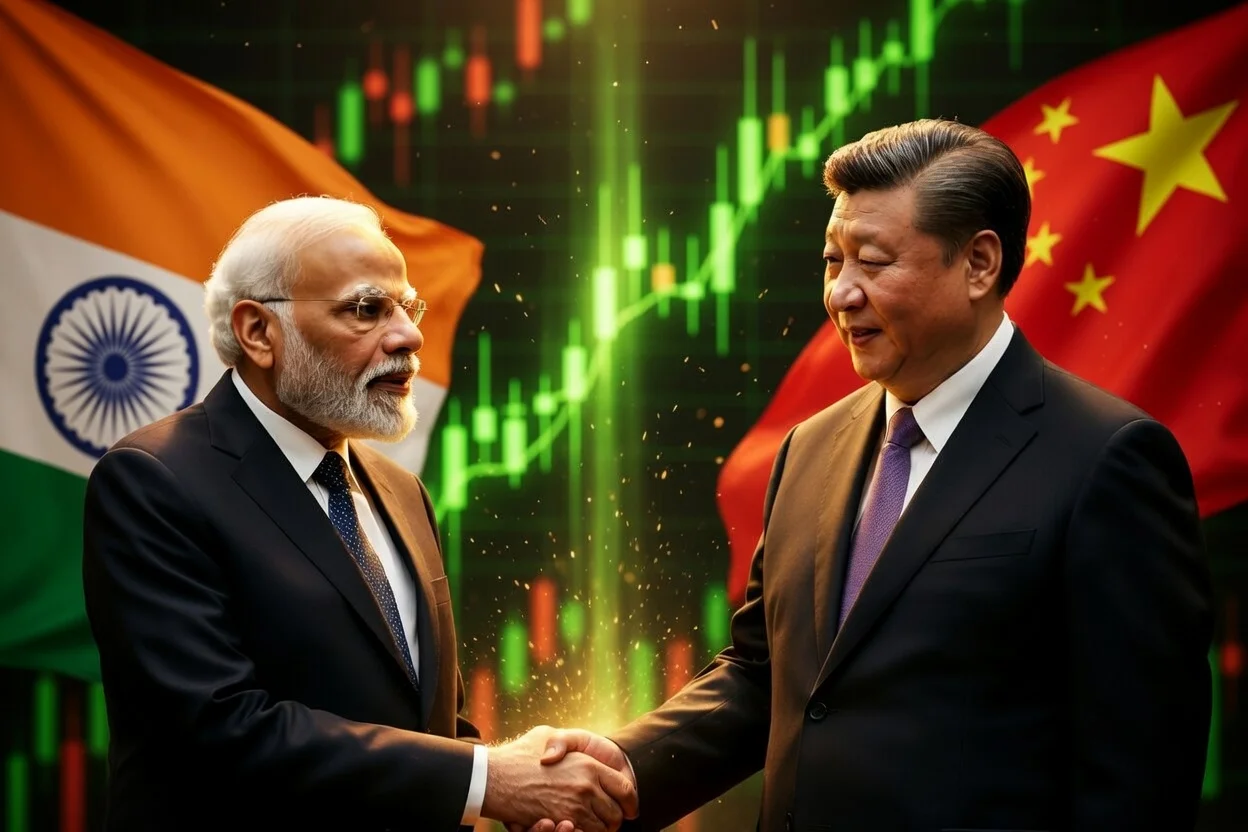
In a historical first, India has simplified foreign investment rules for border-sharing nations, including China. This move, announced in early March, will allow China to participate in the country's manufacturing ecosystem for the first time. This change to Press Note 3, for the first time in six revisions, shows a practical pivot in economic relations. Initially, China will be able to participate in electronic manufacturing and solar component manufacturing. This poses a great opportunity for investors in India-China investment.
However, the bigger question on Dalal Street is, will EMS stocks India and the wider electronics manufacturing stocks India be the most to gain from this new opening? Yes, is the answer from early reactions in the market, with a 5-15% gain in some EMS stocks in India(2026) in the days after the announcement. This paper takes a look at the policy, its implications on the EMS sector growth, its key players, and the risks involved. This, along with the others, will be one of the factors for the potential turning of the wheel for India's manufacturing aspirations.
Policy Shift: Opening the Door to China FDI India
Following the 2020 Galwan Valley clash, India introduced a new regulation, Press Note 3, which required all investments from China and neighbouring countries to be routed through government approval. This essentially stopped all Chinese FDI in India, forcing businesses to invest elsewhere in search of capital and technology.

Fast forward to March 11, 2026, the Union Cabinet made a significant policy change:
- An automatic route investment (meaning prior government approval is not required) is available if there is less than 10% beneficial ownership from countries sharing land borders with India (China included).
- Proposals for majority Indian stakeholder ownership in the following manufacturing sectors will be approved in 60 days: electronic components, electronic capital goods, polysilicon/wafer production, and solar cell and battery production.
- Security reviews continue for significant/controlling interests to be reviewed.
These changes do not provide full access; instead, the government is attempting to lure technology and capital with minimal loss to strategic control. Analysts have dubbed this reverse “China + 1” for India controlling investment in China to reduce its electronics import bill (>$100 billion a year) while developing its own ecosystem to meet the targets of the PLI scheme.
The Electronics Manufacturing Services (EMS) sector crossed ₹2 lakh crore in FY25, but increasing component imports from China is problematic. The US easing its China FDI India restrictions could increase local value addition from the current 15-20% to 35-40% by FY28.
What is the EMS Sector and why is it Important for Electronics Manufacturing Stocks in India
The EMS sector includes contract manufacturing, where Indian companies assemble components for companies like Apple, Samsung, HP, and Dell. In addition to assembly, other services may also be included in EMS, such as design, development, and testing. EMS also has many other high-margin services, such as display manufacturing, development and testing of printed circuit boards (PCBs), and semiconductor packaging.
In India, the EMS sector has seen tremendous growth since the 2020 PLI scheme launch and is expected to reach ₹27.7 lakh crore by FY28, of which 30-35% is projected to be from exports. Smartphone production, IT hardware, and EV/battery ecosystems are the main growth drivers. India has also recently become the 2nd largest manufacturer of smartphones.
Stocks in electronics manufacturing in India have shown multibagger profits for the last five years. There are still problems in the sector, such as a lack of expertise in manufacturing components, big working capital needs, and dependency on Chinese suppliers for essential materials such as displays, capacitors, and rare-earth magnets.
Here is where India-China investments come in. Minority Chinese stakes provide manufacturing experience, supply chain construction and verticals, as well as proven capital for control of pesky bet-heavy expansions — all while Indian promoters stay in control.
How China's FDI India is Fueling the Growth of the EMS Sector
Chinese companies control between 60 to 70% of the world’s electronics components market. Enabling China's FDI in India to some extent allows Indian EMS companies to create JVs for the domestic manufacturing of displays, camera modules, batteries, and PCBs, which are currently being imported in large quantities.
Look at the facts:
- In FY25, India imported electronic components worth over ₹1.5 lakh crores, and most of them were imported from China.
- If the approvals are faster, the growth of the EMS sector will be 25 to 30% CAGR through FY30.
- With the implementation of this policy, CRISIL is of the view that India will be able to move up the value chain from assembly to sub-components, thereby enhancing domestic value addition and export competitiveness.
The early movers are beginning to experience traction. Vendors, including Dixon Technologies, have cleared their joint ventures with Chinese display manufacturers, HKC. After months of waiting, with this overhang resolved, factories are prepared to skyrocket. More of the same is expected in solar modules, EV batteries, and consumer electronics.
The India-China investments are happening at the perfect time, with the global supply chain being reconfigured. As Western Brands opt to de-risk and move away from China, the EMS ecosystem in India, now supercharged with Chinese selective investments, becomes the natural beneficiary.

Top EMS Stocks in India Emerging As The Biggest Winners
Not all electronics manufacturing stocks in India(2026) will benefit to the same degree. The stocks with active Chinese partnerships, robust order books, and the potential to absorb new joint ventures will win. The top stocks are:
1. Dixon Technologies (India) Ltd
This is the undisputed leader of India’s EMS sector. Dixon contract manufactures smartphones, TVs, wearables, and lighting for global giants. Analysts see his proposed HKC Joint Venture for display manufacturing as a “here-and-now” catalyst. Regulatory policies and China's FDI India have provided Dixon stock with strong post-policy announcement buy interest. Dixon has a return potential of 30%+ CAGR due to PLI incentives and new China FDI Indiaaccess.
2. Kaynes Technology (India) Ltd
Kaynes specializes in offering automotive, aerospace, and industrial solutions for high-complexity electronic systems and semiconductor packaging. Its vertical integration strategy offers a competitive advantage for future collaborations with Chinese firms for PCB and subsystem solutions. Brokerages expect Kaynes to achieve a revenue of ₹5,000+ crores in FY28, driven by tailwinds from the EMS sector growth.
3. Syrma SGS Technology Ltd
Syrma has diversified expertise in areas such as IT hardware, automotive, and consumer electronics. It has already begun aggressive capacity expansion. Chinese minority stakes may allow Syrma to enter lucrative segments such as medical electronics and renewables faster than its peers.
4. Amber Enterprises India Ltd
Mainly known for air conditioners and components, Amber is also venturing into EV thermal management and electronics. Amber’s component manufacturing is well-positioned to capitalize on the India-China investments in electronics and capital goods components.
The first reaction to the markets has been robust. Following the cabinet decision, the electronics manufacturing stocks India have seen a 7 to 20 percent increase in investor confidence over anticipated joint ventures and margin growth.
Risks and Safeguards: Not Open to Everyone
The policy is welcomed; however, the safeguards are:
- No exception to Indian majority ownership.
- The automatic route is set at a 10% stake limit.
- Security screening for the comprehensive proposals.
- Sensitive sectors like defense or telecom infra will have no relaxation.
Geopolitical risks persist- any new border tensions could halt momentum. Valuation multiples of EMS stocks in India 2026 have already become expensive (40-60x forward earnings for leaders). Investors will need to pay attention to execution, raw material inflation, and a slowdown in demand.

Conclusion
Yes, with a few caveats. India’s recent policy shift concerning China investments removes a critical bottleneck that has been constraining EMS sector growth. The combination of technology access, quicker capital expenditure, and enhanced supply chain integration provides the Indian electronics manufacturing sector a robust foundation for multiple years of substantial growth.
Dixon Technologies is very likely to benefit in the near term, but the entire ecosystem, from Tier 1 players to component suppliers, will benefit as well. This is not speculation. It is supported by policy intent, global tailwinds, and manufacturing momentum in India.
If you have a positive outlook on the Make in India initiative and the Atmanirbhar Electronics initiative, you should start monitoring EMS stocks India closely. Please talk to your financial advisor, conduct your own research, and consider a gradual entry into stocks with a strong fundamental outlook.

DISCLAIMER: This blog is NOT any buy or sell recommendation. No investment or trading advice is given. The content is purely for educational and information purposes only. Always consult your eligible financial advisor for investment-related decisions.