Imagine you want to buy a second-hand car. Would you hand over your money just because the seller says it’s “great”? Of course not! You’d check the service history, test drive it, look for scratches, and understand the full picture before deciding.
Investing in an Initial Public Offering (IPO) is similar. Before a company invites the public to buy its shares, it must disclose everything transparently. Two important documents — DRHP and RHP— act as the company’s “full disclosure report.”
Understanding DRHP vs RHP in IPOs can help you move from emotional FOMO investing to smart, informed decisions. Let’s walk through this journey like a story — from the company’s first confidential filing to the final offer you can actually apply for.
The Story of a Company Going Public
A growing company needs capital to expand. Instead of taking expensive bank loans, it chooses the IPO route to raise money from ordinary investors like you and me. But India’s market regulator, SEBI (Securities and Exchange Board of India), has strict rules to protect retail investors.
This is where the SEBI IPO process in India begins. The company, along with its merchant bankers, prepares a detailed document. The first version filed with SEBI is called the Draft Red Herring Prospectus (DRHP).

What is DRHP in IPO?
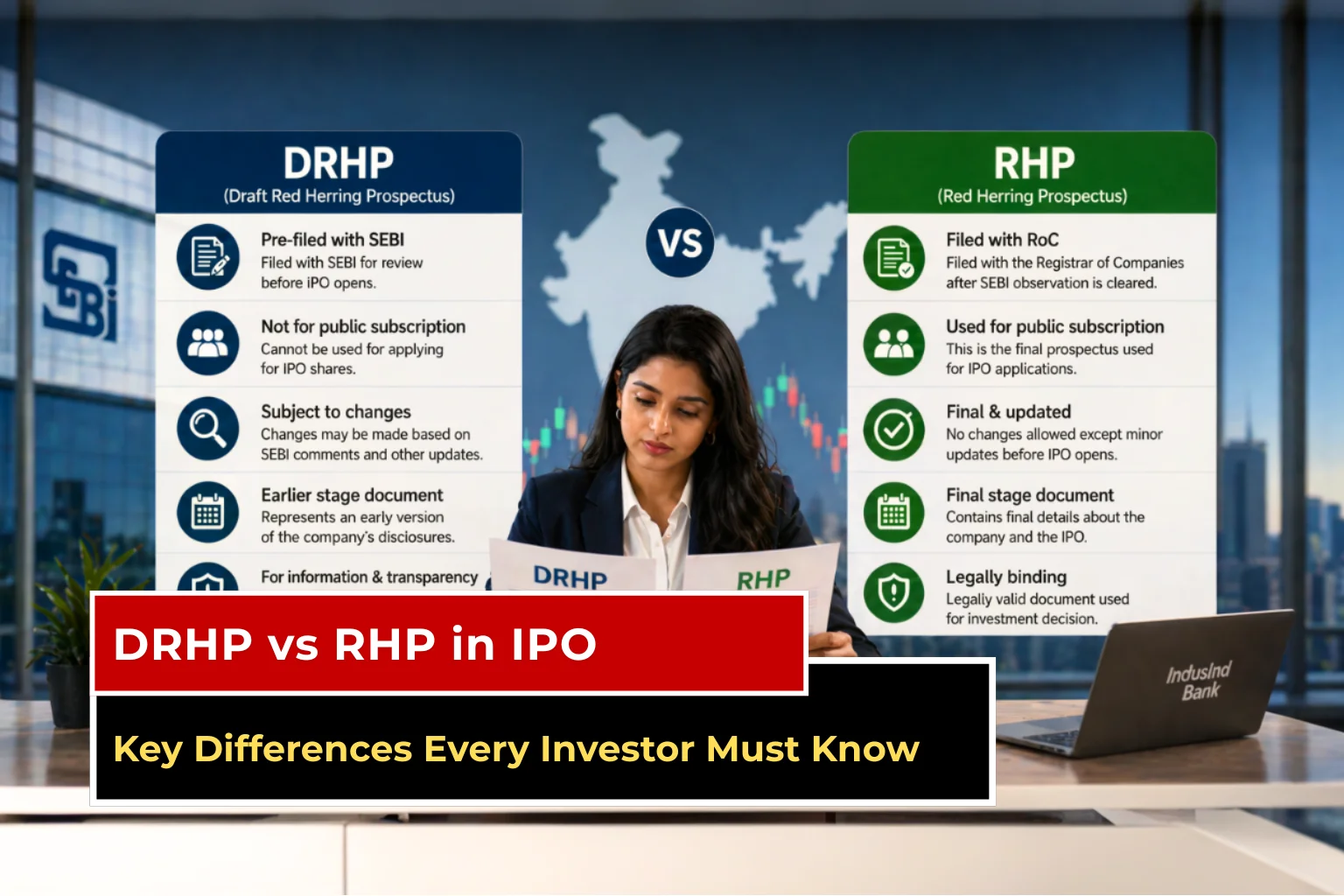
DRHP stands for Draft Red Herring Prospectus. It is the preliminary offer document filed with SEBI at the start of the IPO filing process. The word “Draft” means it is not final, and “Red Herring” indicates that the exact price is not yet decided (a historical term for a misleading clue — here, it honestly signals incompleteness).
Legal Importance of DRHP:
It is a statutory requirement under the SEBI (Issue of Capital and Disclosure Requirements) Regulations, 2018 (SEBI ICDR Regulations). No company can proceed with an IPO without filing a DRHP. It allows SEBI to review disclosures, suggest changes, and invite public comments. False information in the DRHP can attract serious legal penalties.
Key contents usually include business model, financial statements, risk factors, objects of the issue (how money will be used), promoters’ details, and industry overview.
What is RHP in IPO?
Once SEBI reviews the DRHP, raises observations, and the company makes necessary changes (sometimes after public feedback), it files the updated version called the Red Herring Prospectus (RHP).
RHP is the near-final document made available to the public. It includes the price band, IPO dates, and more finalized details, but the exact final price is still determined through the book-building process.
Before you apply to any IPO after reading the RHP, it’s important to understand how pricing actually works. Concepts like issue price, face value, and lot size play a crucial role in deciding your investment amount. You can explore these fundamentals in detail in our guide on IPO Basics Explained in Simple Terms.
Legal Importance of RHP:
The RHP is a legally binding offer document. Any misstatement or omission here carries higher liability because it is meant for actual investors. It is filed with the Registrar of Companies at least 3 working days before the IPO opens.
SEBI IPO Process India: Official Flow
According to SEBI’s guidelines:
- The company appoints Book Running Lead Managers (BRLMs).
- Prepares and files DRHP with SEBI and stock exchanges.
- SEBI reviews and issues observations (can take weeks to months).
- Company revises and resubmits if needed. DRHP is often open for public comments for 21 days.
- After SEBI approval and in-principle listing approval from exchanges, the company files the RHP with the RoC.
- IPO opens for bidding.
- After bidding closes and the price is finalized, the Final Prospectus is filed with the RoC.
- Shares are allotted and listed.
This entire IPO filing process ensures full transparency and investor protection.
DRHP vs RHP in IPO: Key Differences
|
Parameter |
DRHP (Draft Red Herring Prospectus) |
RHP (Red Herring Prospectus) |
|
Stage |
Early stage (months before IPO) |
Later stage (days before IPO opens) |
|
Audience |
Mainly SEBI, analysts, public for comments |
Public investors & institutions |
|
Price Information |
No price band |
Includes price band and offer dates |
|
Legal Status |
Draft for regulatory review |
Legally binding offer document |
|
Changes Possible |
Major revisions based on SEBI observations |
Limited changes; more finalized |
|
Filing With |
SEBI & Stock Exchanges |
RoC, SEBI & Stock Exchanges |
|
Confidential Option |
Possible in some cases |
Must be public |
Final Prospectus vs RHP
Many beginners mix these up. Here’s the clear difference:
- RHP: Filed before the IPO opens. Contains price band but not the final price.
- Final Prospectus: Filed after the IPO closes and the final offer price is decided through bidding. It includes the exact issue price, total shares allotted, and updated details. This is the ultimate record submitted to RoC.
In short: DRHP → RHP (with price band) → Final Prospectus (with final price).
The RHP also includes the “Basis for Offer Price” section, which explains how the company has decided its valuation. If you want a deeper understanding with practical examples, check out our detailed guide on IPO Pricing Explained.

Where to Download DRHP and RHP: Step-by-Step Guide
Follow these simple steps:
- SEBI Website (Most Authentic):
- Visit (www.sebi.gov.in) → Filings → Public Issues. Filter by company name or document type (Draft Offer Documents / Red Herring Documents).
- NSE Website:
- Go to (https://www.nseindia.com) → Market → IPOs → Issue Summary / Offer Documents.
- BSE Website:
- Visit (https://www.bseindia.com) → Markets → Public Issues / IPOs.
- The company’s official investor relations page also hosts these documents.
Always download from official sources to avoid fake or outdated versions.
Sample RHP Reading Checklist for Beginners
Don’t get overwhelmed by 400–600 page documents. Use this practical checklist:
- Summary Section— Quick overview of the offer.
- Risk Factors— Read the most material risks first.
- Objects of the Issue— Where will your money actually go? (Growth, debt repayment, or promoter exit?)
- Financial Information— Revenue, profit, and debt trends for the last 3–5 years.
- Management & Promoters— Background and any red flags.
- Basis for Offer Price— How they justified the valuation.
- Industry Overview & Competition— Is the business future-ready?
Focus on these 7 sections first — they give 80% of the insight you need.
Real IPO Example: Learning from Hyundai Motor India
Take the Hyundai Motor India IPO (one of the largest in recent years). The company filed its DRHP in mid-2024, which SEBI reviewed. Later, it filed the RHP in October 2024 with the price band and other finalized details.
Investors who studied the RHP carefully noted strong brand presence but also risks related to competition and raw material costs. This real-world case shows how moving from DRHP to RHP brings more clarity for decision-making.
Swiggy IPO followed a similar transparent journey, with detailed disclosures on its quick-commerce business model in the RHP.
Why This Knowledge Matters for Beginner Investors
Reading IPO documents explained properly helps you avoid hype-driven mistakes. Many IPOs list with gains, but long-term performance depends on the underlying business quality revealed in these documents.
Pro Tip: After reading the RHP, compare key ratios with listed peers in the same industry.

Conclusion
Mastering DRHP vs RHP in IPOs is one of the smartest steps you can take as a beginner investor in India. These documents turn IPO investing from gambling to a thoughtful process.
Next time any IPO launches, don’t just check the GMP or news headlines. Spend 30–45 minutes on the RHP using the checklist. Over time, this habit will help you build a stronger portfolio.
Stay curious, invest responsibly, and let knowledge be your biggest edge in the market!
Sources: SEBI - Official Public Issues

DISCLAIMER: This blog is NOT any buy or sell recommendation. No investment or trading advice is given. The content is only for educational purposes. Always discuss with your SEBI-registered financial advisor for investment-related decisions.