Imagine waking up excited in Lucknow one morning. You’ve researched a promising company’s IPO for days. You open your broker app, select the lot size, pay through UPI, and see your money get blocked safely. The subscription closes, and now the big question hits you: “Will I get the shares or not?”
This excitement and nervousness are common for every new investor. Welcome to the IPO allotment process— the crucial stage where a company fairly distributes its limited shares among thousands of applicants. Understanding how IPO shares are allotted can remove your confusion and help you invest smarter. Let’s walk through this journey like a simple story, step by step.
The Beginning: What is an IPO and Why Allotment Matters?
An Initial Public Offering (IPO) is when a private company offers its shares to the public for the first time to raise money for expansion, debt repayment, or new projects. It’s like the company saying, “We are now open for public investment!”
However, companies cannot give shares to everyone who applies. The number of shares is limited. That’s why SEBI (Securities and Exchange Board of India) has created a transparent IPO allotment process. This system ensures fairness, prevents manipulation, and gives small investors a fair chance.
The whole IPO subscription and allotment cycle is quick. Subscription usually lasts 3-5 days, and allotment is finalized shortly after. In 2026, SEBI has made the process even faster — listing now often happens within T+3 working days from the issue close.
If you’re new to the stock market, it’s important to first understand the basics of an IPO. You can read our beginner-friendly guide on What is an IPO & How It Works to build a strong foundation.
Act 1: The Subscription Phase – How You Apply
Your IPO story starts when the issue opens for subscription. You log into your demat-linked broker app or internet banking, choose the IPO, decide the number of lots, and apply at the “cut-off” price (for retail investors).
Key points every beginner must know:-
- You need a Demat account and a linked bank account.
- Money is blocked via ASBA or UPI— it is not debited until allotment.
- Retail Individual Investors (RII) can apply up to ₹2 lakh.
- Applications must be in multiples of the lot size decided by the company.
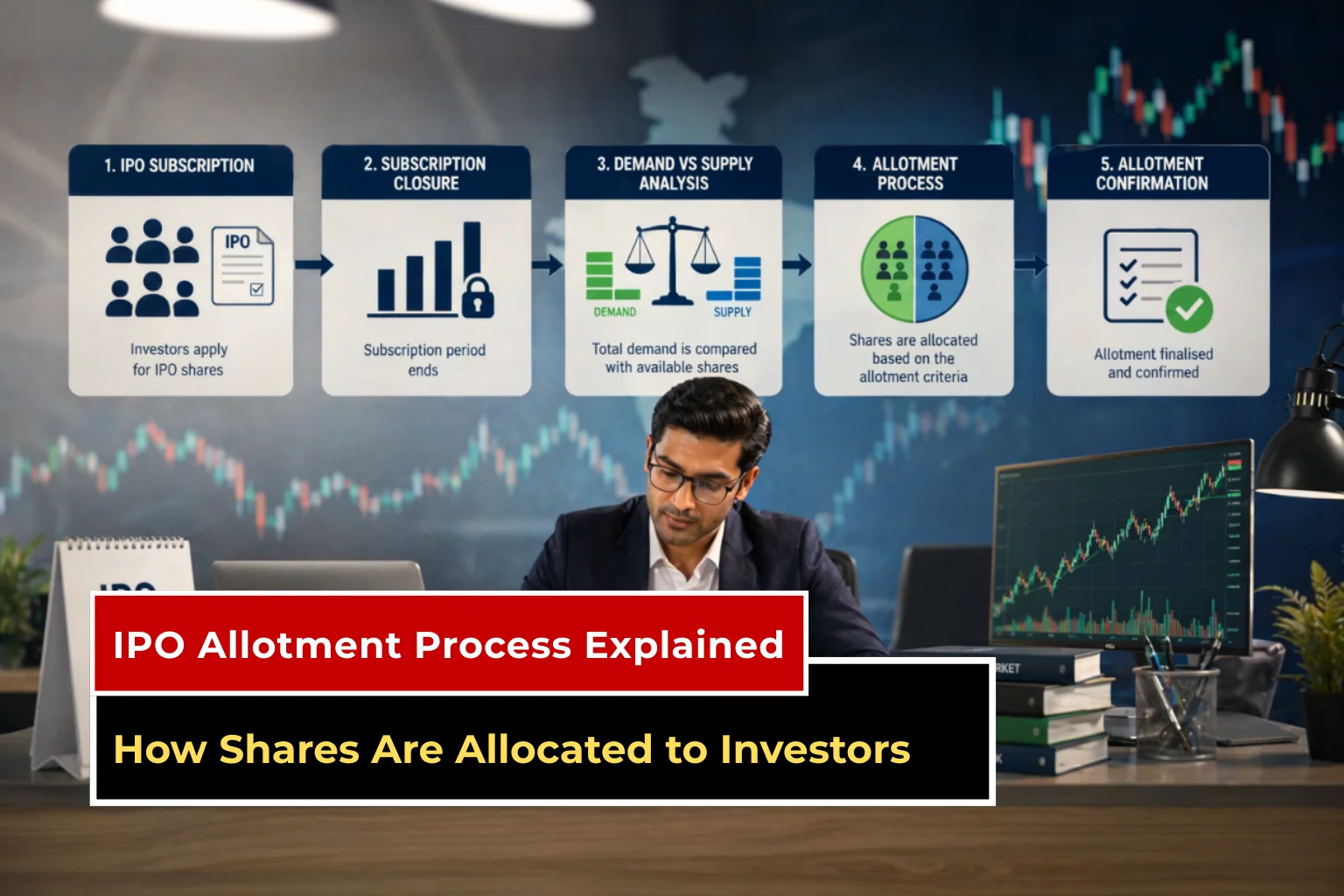
During these days, everyone watches the IPO subscription status. If applications exceed available shares, the IPO becomes “oversubscribed.” High oversubscription means tougher competition for shares.
Beginner Tip: Apply early (preferably on Day 1) and use only one PAN. Multiple applications from the same PAN get rejected.
Act 2: Verification – What Happens After Subscription Closes?
Once the IPO subscription window closes, the Registrar (companies like KFintech, Link Intime, or Bigshare) starts working with the stock exchanges.
They perform these important steps:
1. Collect all bids from NSE and BSE.
2. Reject invalid applications (wrong details, duplicate PAN, insufficient funds, etc.).
3. Categorize valid applications into three main groups:
- Retail Individual Investors (RII)– 35% of shares reserved
- Non-Institutional Investors (NII or HNI)– 15% of shares
- Qualified Institutional Buyers (QIB)– 50% of shares (mutual funds, banks, insurance companies).
This division, as per SEBI rules, protects small investors and maintains market balance
Since IPO allotment is strictly regulated, it’s also useful to know how the system stays fair and transparent. Read our guide on Who Regulates IPOs in India? to understand the authority behind the process.
Act 3: The Main Event – How IPO Shares Are Allotted
This is the most interesting part of the IPO allotment process. The method depends on how many people applied versus the shares available.
- Undersubscribed IPO: If demand is low, almost all valid applicants usually get the shares they applied for.
- Oversubscribed IPO: This is the common case. Different rules apply for each category.
Retail IPO Allotment in India – Mostly a Lottery
For retail investors, SEBI follows a simple and fair approach. When the retail portion is heavily oversubscribed:
- A computerized lottery is conducted.
- Each valid retail application gets an equal chance.
- In most cases, a selected applicant gets only 1 lot (even if they applied for more).
- If shares remain after giving one lot to as many as possible, the rest may be given proportionately.
Simple Real-Life Example (from standard SEBI guidelines):
Suppose 1,00,000 shares are reserved for retail investors, and the lot size is 200 shares (500 lots available).
- 2,000 people apply for 1 lot each.
- Only 500 lots available → Computer randomly selects 500 lucky investors. Each gets 1 lot. The rest get a full refund.
This lottery system makes retail IPO allotment in India exciting and democratic for beginners.
Before diving into allotment, it’s important to understand the complete journey of an IPO—from filing the DRHP to SEBI approval and listing. You can read our detailed guide on IPO Filing Process in India to get the full picture.
How Other Categories Get Shares
- NII (HNI): Allotment is usually done on a proportionate basis according to the size of their application.
- QIB: Allocation is more flexible but still regulated.
Here is a clear comparison table for a typical Mainboard IPO:-
|
Investor Category |
Share Reservation |
Application Limit |
Allotment Method (if oversubscribed) |
|
Retail Individual Investors (RII) |
35% |
Up to ₹2 lakh |
Computerized Lottery (usually 1 lot) |
|
Non-Institutional Investors (NII) |
15% |
Above ₹2 lakh |
Proportionate basis |
|
Qualified Institutional Buyers (QIB) |
50% |
No upper limit |
Regulated discretionary |
SME IPO Allotment – How It Is Different
SME IPO allotment (on NSE Emerge or BSE SME platforms) works slightly differently because these are for smaller companies:-
- Minimum application amount is generally higher.
- Reservation is often 50% for QIBs and the rest combined for Retail + NII.
- Fewer minimum allottees are required.
- The process is faster, but shares tend to be more volatile after listing.
If you are a beginner exploring smaller companies, SME IPOs can be a starting point — but always remember they carry higher risk compared to mainboard IPOs.
Ever wondered why companies actually come to the market with an IPO? To understand their real motives, benefits, and risks, check out our detailed article on Why Do Companies Launch an IPO?.
Act 4: The Result Day – Checking Your IPO Allotment Status
After the subscription closes, the registrar finalises the “Basis of Allotment.” This usually happens within 1-3 working days (T+1 in the current fast timeline).
Here’s how to easily check your IPO allotment status:-
- Visit the Registrar’s website (example: ipostatus.kfintech.com, Link Intime, or Bigshare).
- Go to BSE India (bseindia.com → Investors → Status of Issue Application) or the NSE India IPO section.
- Enter your PAN, Application Number, or Demat Account details.
- See whether your status shows “Allotted”, “Partially Allotted”, or “Not Allotted”.
If you get shares, they are credited to your Demat account. Excess blocked money is automatically unblocked or refunded within 1-2 days. Listing usually happens within T+3 days from issue close.
Updated Timeline Table (2026 Rules)
|
Stage |
Activity |
Approximate Timeline |
|
Day 0 (T) |
IPO Subscription Closes |
5 PM on the last day |
|
T+1 |
Basis of Allotment Finalized |
By evening |
|
T+2 |
Refund / Unblocking of Funds |
Same or next day |
|
T+3 |
Shares Credited + Listing on Exchanges |
Trading begins |
(Note: Timelines have become faster after SEBI’s T+3 listing mandate.)
Smart Tips to Increase Your IPO Allotment Chances
While retail allotment is largely luck-based due to the lottery:-
- Apply on the first day.
- Never make multiple applications with the same PAN.
- Consider applying to less crowded IPOs.
- Keep your bank, Demat, and KYC details updated.
- Family members with different PANs can apply separately.
Read our detailed blog on how to increase IPO Allotment Chances.
What Happens After You Get (or Don’t Get) Allotment?
- Allotted: Shares appear in your Demat. Decide whether to hold long-term or sell on listing day.
- Not Allotted: Money returns automatically. No tension!
- Always treat IPOs as long-term investments rather than chasing quick listing gains.
Conclusion
The IPO allotment process may feel mysterious at first, but it is actually a well-designed, transparent system meant to give every investor, whether in Lucknow or anywhere in India, a fair opportunity.
By learning how IPO shares are allotted, regularly checking your IPO allotment status, and understanding the difference between retail IPO allotment in India and SME IPO allotment, you move from a nervous beginner to a confident investor.
Next time an IPO opens, apply with understanding instead of blind hope. Investing is a long journey. Learn from every experience, stay patient, and let time and good decisions grow your wealth.
If you are a beginner and want to know how you can apply online for an IPO, read our beginner’s guide on this.
Sources: Bajajfinserv, Zerodha, bseindia.com, nseindia.com