Picture a young woman in a Surat textile factory carefully packing colourful kurtas and dresses. A few months ago, sending these to shops in Auckland meant paying extra duties that made her products too expensive for Kiwi customers.
Today, thanks to the India-New Zealand FTA 2026, those same clothes can reach New Zealand without any import duty. This small change can bring more orders, steady jobs, and better salaries for thousands like her.
The India-New Zealand trade deal 2026 is not just paperwork signed by ministers. It is a practical agreement that can quietly touch the daily lives of common Indians, from garment workers and software engineers to farmers using better technology and students dreaming of global opportunities.
Let's explore this India-NZ free trade agreement in simple, beginner-friendly language and see the real India trade agreement impact.
What is India-New Zealand FTA 2026?
The India–New Zealand FTA 2026 is a free trade agreement that removes or reduces tariffs on goods and services between both countries, making trade easier and cheaper.
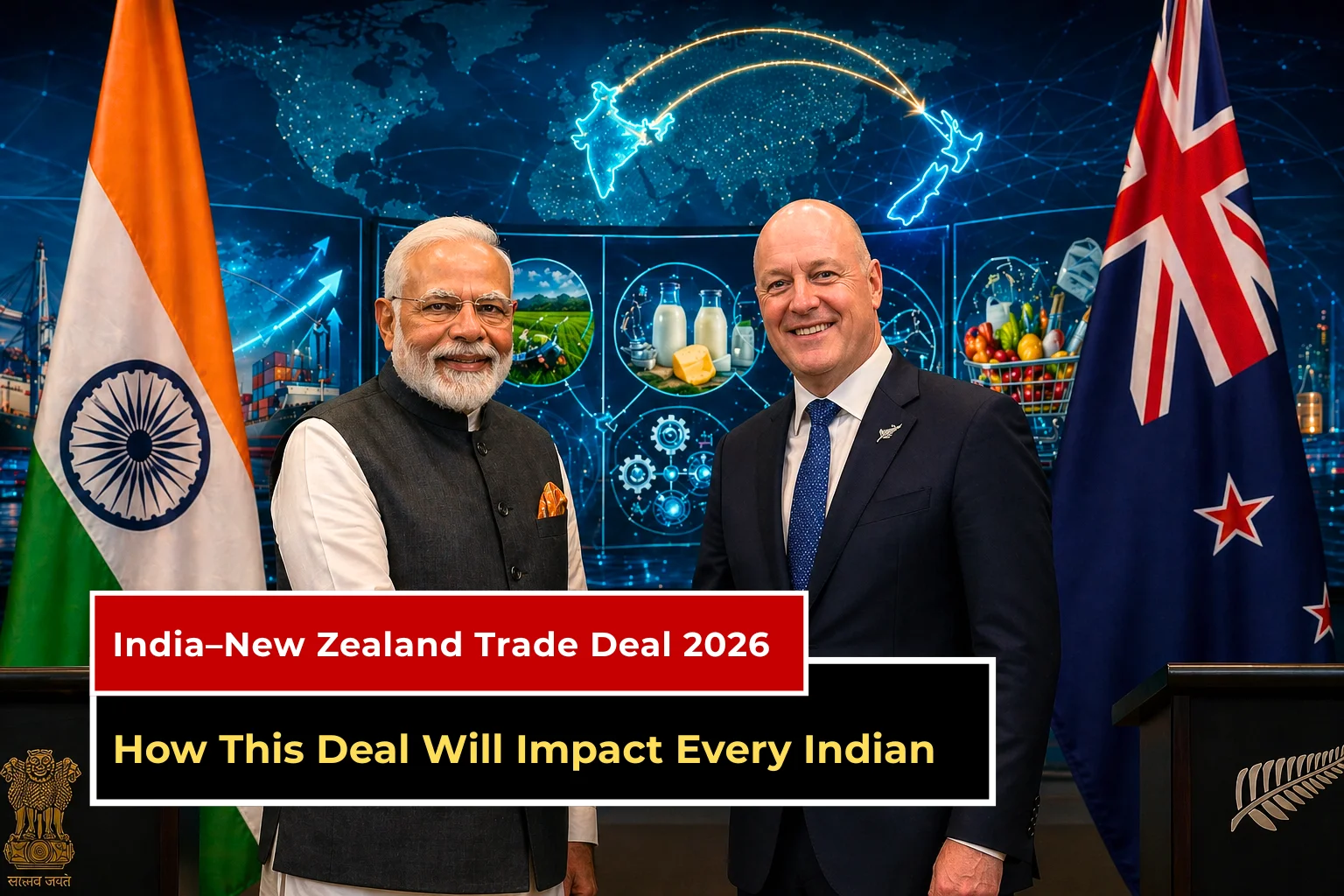
On 27 April 2026, India and New Zealand signed a comprehensive Free Trade Agreement (FTA) in New Delhi. Negotiations started in March 2025 and wrapped up in just nine months - making it one of the fastest trade deals India has completed with a developed country.
The deal covers trade in goods, services, investment rules, and the easier movement of skilled professionals. Both nations aim to nearly double the current bilateral trade and attract significant new investment.
Signed vs Effective Date: The agreement was formally signed on 27 April 2026. However, it will come into force only after both countries complete their domestic ratification processes - likely later in 2026 or early 2027. Until then, current tariffs and rules continue.
The current two-way trade stands at around $2.1–2.4 billion. The target is to take it closer to $5 billion in the coming years.

India–New Zealand Trade Snapshot (Approximate 2024-25 figures)
|
Category |
Value (USD) |
Share / Notes |
|
Total Bilateral Trade |
$2.1 – 2.4 billion |
Goods + Services |
|
India's Exports to NZ |
~$700–800 million |
Textiles, pharma, engineering goods, garments |
|
India's Imports from NZ |
~$500–600 million |
Wood, wool, machinery, and some horticulture |
|
Target Trade Volume |
~$5 billion |
Expected in 4–5 years |
This table gives a clear picture before and after the India-NZ free trade agreement kicks in.
Key Highlights of the Deal – Simple Breakdown
The India-New Zealand trade deal 2026 offers clear and balanced benefits:
- For Indian Exporters: 100% duty-free access to New Zealand for all 8,284 tariff lines. This means zero duty on textiles, apparel, leather, footwear, gems & jewellery, plastics, engineering goods, pharmaceuticals, and processed foods right from day one.
- For New Zealand Exports to India: Tariffs reduced or eliminated on about 95% of New Zealand’s current exports to India. Around 57% will become duty-free immediately, rising to 82% when fully implemented.
- Protected Sectors in India (Excluded): Sensitive items like dairy products (milk, cheese, yoghurt, whey), certain vegetables (onions, peas, chana), sugar, edible oils, almonds, arms & ammunition, and some metals (copper, aluminium) are kept out of concessions to safeguard Indian farmers and local industries.
- Investment Push: New Zealand has committed to promoting $20 billion in investments into India over the next 15 years, especially in manufacturing, food processing, education, tourism, and technology.
- People Movement: A new pathway for up to 5,000 skilled Indian professionals with temporary employment visas (up to 3 years). It also includes better student mobility and post-study work options in select fields.
- Services & Cooperation: Improved access for Indian IT, healthcare, education, and traditional medicine services.
India–New Zealand FTA Benefits for India
The biggest winners from the New Zealand FTA benefits for India will be labour-intensive export sectors and MSMEs.
Textile and Garment Workers
Clusters in Tiruppur, Surat, and Ludhiana can now compete better. Earlier average tariffs of 2–10% on clothing and leather items are gone. More orders can mean more shifts, higher wages, and new jobs, especially for women workers.
Pharma and Engineering Companies
Indian medicines and auto components/machinery will enter New Zealand more easily. This can help mid-sized firms grow and create stable employment in places like Hyderabad, Ahmedabad, and Pune.
MSMEs and Women-Led Enterprises
The deal puts special focus on small businesses. Lower trade barriers and regulatory clarity will help micro and small exporters join global supply chains. Many women-led units in apparel and handicrafts stand to gain.
IT and Skilled Professionals
Easier mobility and service access can bring more projects to Indian companies. Young engineers and healthcare workers may get short-term opportunities in New Zealand without heavy visa hurdles.
Farmers and Food Processors
Core dairy and sensitive crops are fully protected. At the same time, Indian processors can import certain New Zealand ingredients duty-free for re-export, supporting India’s goal to become a global food processing hub. Joint work on advanced farming techniques can also improve productivity.
Who May Face Mild Impact?
Most Indian sectors are either gaining or protected. However, some manufacturers using imported inputs (like certain machinery or wool) may see small changes in costs. Overall, the government has built in safeguards and phased reductions to prevent sudden shocks. No major “losers” are expected in the domestic market because sensitive agriculture and dairy remain shielded.

Trade Deal Impact on the Indian Economy
This India trade agreement fits into India’s bigger strategy of its global trade updates. By signing modern FTAs, India is integrating deeper into world supply chains while protecting vulnerable areas.
Expected gains include:
- Higher export earnings and foreign exchange.
- Job creation in manufacturing and services.
- Technology transfer and better skills.
- Increased investment leading to new factories.
- Stronger “Make in India” push through better market access.
Increased foreign investments (understand FII DII data impact on market) can further support capital inflows and strengthen investor sentiment.
For investors and stock market watchers, sectors like textiles, leather, pharma, IT services, and engineering goods could see positive sentiment once the deal becomes effective. Companies with a strong export focus on developed markets may attract more attention.
MSME Action Plan – What Small Businesses Should Do
- Study the detailed tariff schedules (once fully published by the commerce ministry).
- Register with export promotion councils (AEPC for apparel, CLE for leather, etc.).
- Improve quality and certifications to meet New Zealand standards.
- Explore the New Zealand Investment Desk for any partnership queries.
- Use government schemes like RoDTEP and duty drawback effectively during transition.
Small businesses entering global markets can also explore how to start export business in India to fully benefit from this agreement.
Data Table: Sector-wise Expected Impact
|
Sector |
Key Benefits of the India-NZ FTA 2026 |
Likely Impact on Common Indians |
|
Textiles & Apparel |
100% duty-free access |
More factory jobs, higher wages for workers |
|
Leather & Footwear |
Zero duty on exports |
Growth in MSME clusters, employment for artisans |
|
Pharmaceuticals |
Easier market entry |
Boost to pharma hubs, stable jobs |
|
Engineering Goods |
Better competitiveness |
New orders, skill development |
|
IT & Professional Services |
Mobility + service access |
Opportunities for skilled youth |
|
Agriculture & Food |
Protection for sensitive items + tech cooperation |
Better productivity without import threat |
|
Overall Investment |
$20 billion commitment |
New factories, modern technology, more jobs |
This table makes the India-NZ FTA benefits easy to understand at a glance.
Increased global capital inflows through foreign portfolio investment (FPI) can strengthen India’s position in the foreign exchange market and support currency stability. As trade expands under the agreement, consistent FPI inflows may play a key role in maintaining healthy foreign exchange reserves and boosting investor confidence.
Investor and Stock Watchlist Angle
Investors should keep an eye on the listed companies in:-
- Textile exporters (e.g., companies with a strong garment or home textile focus).
- Pharma and specialty chemicals.
- Auto components and engineering.
- IT firms with global delivery models.
This sectoral growth can also influence IPO impact on sectors, especially for export-driven companies planning to go public.
Long-term, the deal signals India’s seriousness about expanding trade ties with developed economies, which can improve overall investor confidence.

Final Thoughts
The India-New Zealand FTA 2026, or India-New Zealand free trade agreement, is a balanced, practical step forward. It gives Indian exporters, especially in labour-intensive sectors, a real competitive edge while carefully guarding the interests of Indian farmers and sensitive industries.
For every Indian, this deal carries the promise of more jobs, new skills, fresh technology, and stronger economic ties with a friendly developed nation. As India continues its journey of India global trade updates, agreements like this show growing confidence on the world stage.
Watch how implementation unfolds. Small changes in tariffs can slowly create big opportunities, whether you stitch clothes, write software code, run a small workshop, or work on a farm.
The India–New Zealand story is just beginning. It is a story of two democracies working together for mutual growth and in the process, improving lives back home, one order, one job, and one opportunity at a time.
Sources: Reuters, ToI, The Hindu

DISCLAIMER: This blog is NOT any buy or sell recommendation. No investment or trading advice is given. The content is only for educational purposes. Always discuss with your SEBI-registered financial advisor for investment-related decisions.