Imagine this: It’s evening. Your phone rings with an urgent call. A voice claiming to be from your bank says your account is under threat and you must transfer ₹22,000 right now to a “secure” account. In panic, you quickly open Google Pay or PhonePe and send the money. Within seconds, it’s gone and you later realise it was a clever scam.
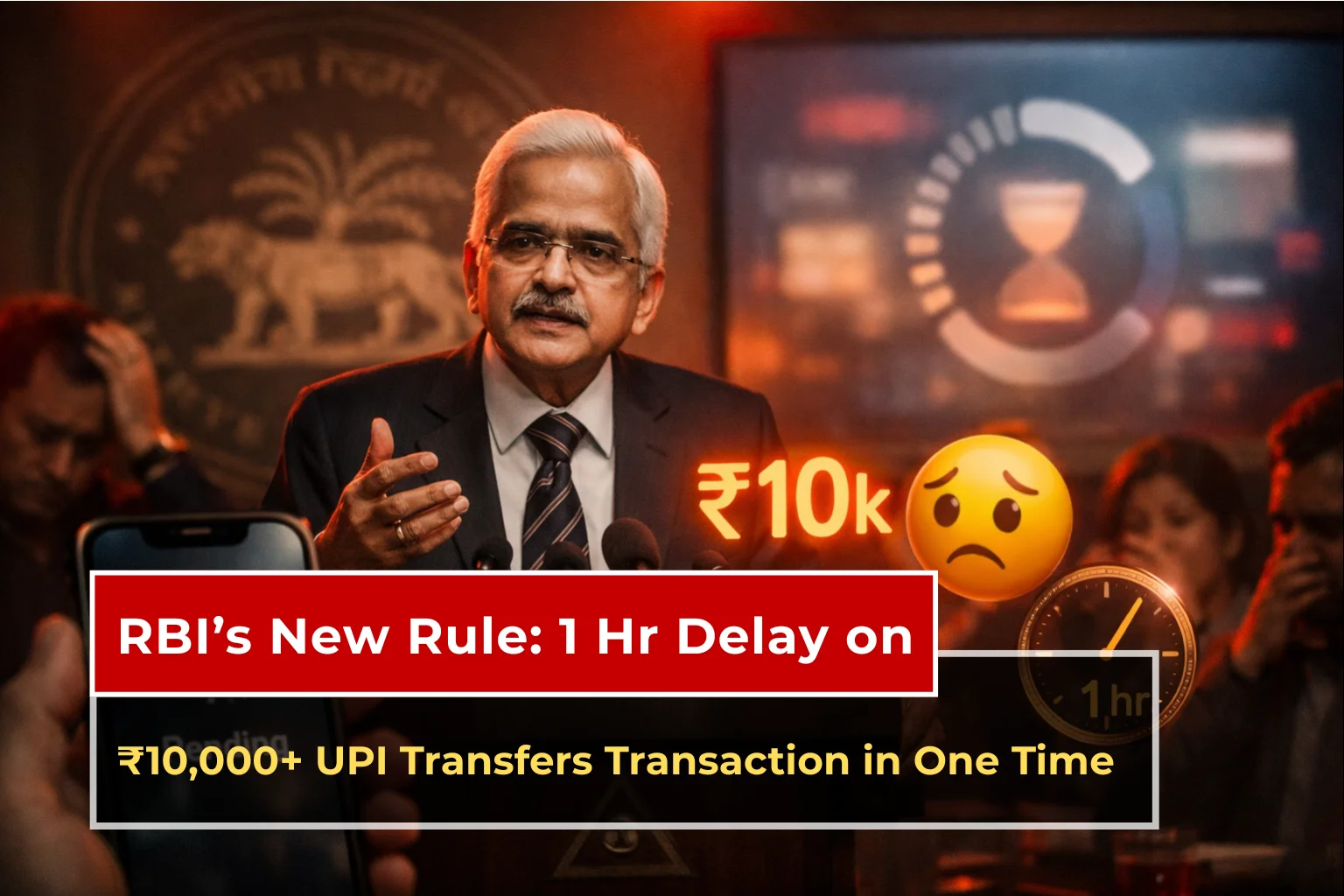
Now picture a better scenario: The money leaves your account, but it doesn’t reach the receiver immediately. You get up to one hour to think, double-check, or cancel the transfer calmly. This is the core idea behind RBI’s recent proposal — a short safety pause for bigger personal transfers.
This 1-hour delay for UPI above ₹10,000 aims to protect millions from online scams while keeping everyday digital payments fast and convenient. In this easy-to-understand blog (written in simple language for beginners), we’ll explain the proposal step by step, compare the old vs. the new process, show who needs to worry, include a clear data table, and answer practical questions.
The Story of Priya: How a Fast Transfer Led to Heartbreak
Priya, a school teacher in Lucknow, got a WhatsApp message from someone pretending to be a bank officer. “Madam, suspicious activity detected. Transfer ₹12,000 to this account to secure your savings.” Scared, she sent the money instantly via UPI. The next day, she discovered it was fraud. Recovering the money became a long battle with the police and banks.
Such stories are becoming common. Fraudsters create panic, so people act fast without thinking. The Reserve Bank of India (RBI) has released a discussion paper called “Exploring safeguards in digital payments to curb frauds” to fight this problem with practical ideas, including a UPI high-value transfer delay.
Source: [Economic Times - RBI proposes one-hour delay on high-value digital transfers]
Source: [India Today - RBI wants a 1-hour pause on some UPI payments]

Current UPI Process vs Proposed Process – Simple Comparison
Here’s a clear side-by-side look at how things work today and how they may change for high-value transfers:
|
Feature |
Current UPI Process (Instant) |
Proposed Process (With 1-Hour Pause) |
|
Transfer Above ₹10,000 (P2P) |
Money is debited and credited instantly |
Money is debited instantly, but held for up to 1 hour |
|
Small Transfers (< ₹10,000) |
Remains instant |
Remains instant |
|
Merchant/Shop QR Payments |
Instant |
No change – still instant |
|
Cancellation Option |
Very difficult after completion |
Easy cancellation during the 1-hour window |
|
Alert to User |
Basic notification |
Extra alert + confirmation prompt |
|
Trusted Contacts |
No special treatment |
Option to whitelist (skip delay) |
|
Emergency Use |
Fast but risky if tricked |
Whitelisting or smaller transfers can help |
This table shows that the change adds a safety layer only where fraud risk is high, without disturbing normal daily use.
Source: [Financial Express - RBI proposes 1-hour cooling-off period for UPI/IMPS]
Who Should Worry and Who Need Not Worry?
Here’s a quick mini-guide to help you understand if this proposal affects you:
You may notice the change (should be aware):
- People sending large personal amounts (₹10,001+) to friends, family, or new contacts.
- Senior citizens making big transfers.
- Anyone receiving urgent scam-like calls asking for quick money.
- Business owners or freelancers handling occasional high-value P2P payments.
You need not worry (almost no impact):
- Daily shopping at kirana stores or malls via UPI QR code.
- Paying small amounts like ₹500–₹5,000 to family.
- Electricity bills, school fees, or recurring payments.
- Students sending pocket money below ₹10,000.
- Most merchant transactions.
In short, 99% of regular UPI use stays fast and unchanged. Only risky high-value person-to-person transfers get the extra safety pause.
Shocking Data: Why RBI Is Acting Now
Fraud in digital payments has grown rapidly. Look at these numbers from the National Cyber Crime Reporting Portal:
|
Year |
Fraud Cases Reported |
Total Money Lost (₹ Crore) |
|
2021 |
2.6 lakh |
551 |
|
2025 |
28 lakh |
22,931 |
High-value transfers (above ₹10,000) make up a small percentage of cases by number but account for over 92–98% of the money lost. That’s why the ₹10,000 threshold is smart; it targets expensive scams effectively.
The 1-hour cooling period gives you time to break the scammer’s pressure and verify.
Source: [Reuters - India mulls payment lags to curb fraud]
How Will the Proposed 1-Hour Delay Actually Work?
1. You start a transfer of ₹18,000 to someone’s UPI ID.
2. Money is debited from your account right away (you see it gone).
3. Your bank holds it for up to 60 minutes.
4. You get a clear notification: “Your transfer is on hold. Confirm or Cancel?”
5. If you cancel, money returns to your account.
6. If you do nothing or confirm, it goes to the receiver after 1 hour.
7. You can pre-approve (whitelist) trusted people so their transfers skip the pause.
This applies to UPI and IMPS for account-to-account personal transfers. Merchant payments and small amounts are instant.
What Should You Do Now?
- Continue using UPI normally — nothing changes yet.
- Start whitelisting important contacts in your apps (PhonePe, GPay, Paytm, etc.).
- Share scam awareness with family, especially seniors.
- Give feedback to RBI on their discussion paper before 8 May 2026 via the Connect 2 Regulate portal.
- Enable all transaction alerts and review your bank statements regularly.
As the RBI continues to strengthen digital payment safety, another major idea under discussion is the concept of a single universal bank account number across all banks. You can explore this in detail here: RBI’s New Plan: One Universal Bank Account Number for All Banks?

Final Thoughts
RBI’s proposal for a 1-hour delay on high-value UPI transfers is a thoughtful step to make digital payments safer in India. It doesn’t slow you down for daily use — it simply adds protection where scams hurt most.
Whether you are a busy professional, a senior citizen, a student, or a small business owner, this change puts more control in your hands. Stay alert, verify before sending large amounts, and use the whitelisting feature smartly.
What do you think about this safety pause? Have you ever faced a UPI scam call? Share your experience or opinion in the comments below.
Stay safe, transact wisely, and keep enjoying the convenience of UPI with extra peace of mind!
(Sources:
- RBI Discussion Paper (April 2026) via official coverage
- Economic Times, India Today, Financial Express, Reuters (April 2026 reports).

DISCLAIMER: This blog is NOT any buy or sell recommendation. No investment or trading advice is given. The content is purely for educational and information purposes only. Always consult your eligible financial advisor for investment-related decisions.