
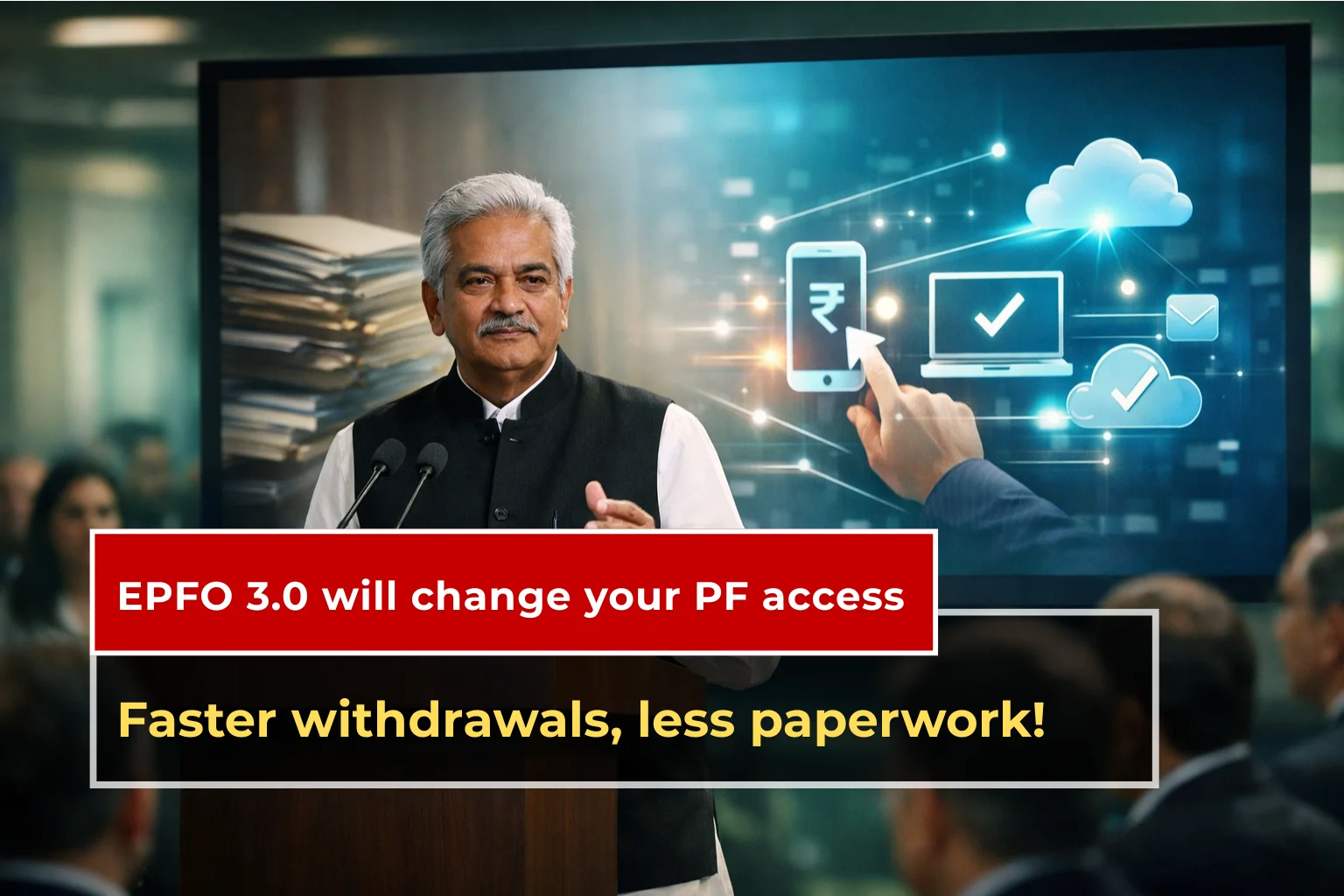
The Employees' Provident Fund Organisation (EPFO) is becoming digitalised one step at a time. The EPFO has streamlined processes like KYC and Claim Tracking and continues to evolve.
Now, the EPFO has yet another service that has people talking. This time, it is the possibility of PF Withdrawal Via UPI.
Once fully implemented, this service will allow Indians to easily access funds from their retirement accounts. This article will explain EPFO 3.0, its EPFO Digital Service Integration, the Withdrawal Process, and the Significance of this Update.
What is EPFO 3.0?
The company's technology infrastructure has been completely redesigned and reset with EPFO. The goal is to switch to a core banking system from Pathwork, with improvements and small adjustments.
Who Is Eligible for EPFO 3.0 Benefits?
-
- All EPFO members with an active Universal Account Number (UAN).
-
- KYC must be updated: Aadhaar, PAN, and bank account linked.
-
- Minimum service: Just 12 months(1 year) of EPF membership for most partial withdrawals (reduced from up to 7 years earlier).
-
- Unemployment: Anyone who has lost their job can withdraw immediately (no waiting period).
-
- Full withdrawal: Allowed at retirement (age 55+), permanent disability, retrenchment, VRS, or permanent exit from India.

EPFO Withdrawal Rules: A Comparison Between The Old And New Changes
|
Parameter |
Earlier Framework |
Revised Framework (Now Active) |
|
Withdrawal categories |
13 different provisions |
Merged into 3 simple categories: Essential needs, Housing needs, and Special circumstances |
|
Minimum service period |
Up to 7 years (varied) |
12 months for all categories |
|
What you can withdraw |
Only employee contribution + interest |
Employee + employer contribution + interest |
|
Maximum withdrawal limit |
Purpose-based restrictions |
Up to 75% of balance anytime (no docs needed in most cases) |
|
Documentation |
Often required |
75% withdrawal without paperwork in many cases |
|
Unemployment withdrawal |
Partial, with restrictions |
75% immediately; the remaining 25% after 12 months of unemployment |
|
Remaining balance protection |
No structured safeguard |
25% always retained to protect the retirement corpus |
|
EPS Pension withdrawal |
After 2 months |
After 36 months (encourages long-term pension eligibility) |
|
Full withdrawal |
Retirement or select cases |
Same + easier access under new rules |
(Source: EPF India)
A significant step toward quicker, easier, and more flexible fund access, EPFO 3.0 reduces paperwork while enhancing retirement security and arranging provident fund services with a contemporary, tech-first workforce.
What Has Changed in PF Withdrawal Rules After EPFO?
UPI integration will let you transfer approved PF money directly to your bank account via UPI (like BHIM or any UPI app) – no waiting for bank transfers that take 3–10 days.
Once live, expect near-instant or same-day credit(similar to government refunds). This is part of the bigger EPFO 3.0 digital upgrade (new core banking system + dedicated mobile app).
If you are planning to maximize your EPF returns, it’s important to understand whether increasing your contribution through VPF or investing in SIPs can deliver better long-term results.
To get a clear comparison, you can read our detailed guide — “8.25% EPF Confirmed — Is VPF Still Better Than SIPs for Investors?”, where we break down EPF, VPF, and SIP strategies with practical examples.
What is EPFO 3.0 Looking into UPI-based Withdrawals?
-
Managing retirement savings for over 27 crore members is the EPFO. Thus, an increment in processing time, no matter how small, is likely to have an outsized effect. The time of processing is made up of various layers of PF withdrawal claims: verifications, approvals, settlements in banking, and reconciliation.
-
UPI eliminates each of these layers.
-
UPI is not an interbank settlement system, and is thus far faster. Once a claim is approved, money flows in. Banking hours are no longer a concern. Settlement reconciliation worries are gone. Employees who need money access also have a better experience.
-
From the EPFO's view, this is a convenience upgrade and also an essential structural reform.
How to Withdraw PF – Step by Step (Current + Future UPI) After EPFO3.0?
Current Process (Online – Takes 3–10 days)
1. Log in to [unifiedportal-mem.epfindia.gov.in](https://unifiedportal-mem.epfindia.gov.in) or the UMANG app with UAN + password.
2. Complete KYC (Aadhaar + PAN + bank).
3. Go to “Online Services” → “Claim (Form-31, 19, 10C)”.
4. Select reason (now under 3 categories), enter amount (max 75%).
5. Submit → EPFO verifies → Money credited to bank (3–10 days).
Challenges
-
The most significant challenges are not obstacles, but rather the EPFO's implementation of UPI, which will certainly present challenges.
-
For the first time, EPFO must combine the new UPI technology with its legacy systems, all while providing seamless service. Given the size of the operation, it will be especially challenging to manage failed transactions and informal disputes.
-
Digital literacy is a factor to consider. Since UPI penetration is high, EPFO must consider other options to ensure all members remain included.
-
This is EPFO’s stepwise approach; it is likely to run pilot programmes before a country-wide one.
Read our detailed blog on IEPF if you want to know how to claim your unclaimed investments in India.
How Employees Should Get Ready
Despite UPI PF withdrawals not being fully functional yet, employees should prepare by ensuring their EPFO documents are clear.
This includes linking Aadhaar and PAN to UAN, confirming bank information, and ensuring the EPFO portal has current information.
Members with updated records will benefit most from UPI integration to EPFO.
The EPFO and India’s Digital Future
Like other public entities in India, EPFO started simple, obtaining only basic online functionality, to eventually become part of the complex system of digital identity, payments, and public services interconnected in India’s digital public service ecosystem.
The EPFO UPI withdrawal feature is an innovative service that demonstrates how public social security services can combine high scale and speed with security. Other countries can study the service for best practices.
This helps build trust in the EPFO’s digital services and proves that public entities can successfully use contemporary financial technology.

Conclusion
PF withdrawal via UPI is more than simply a function; it's a fundamental change in the way retirement funds are accessed in India. The system gets closer to being really citizen-centric by fusing UPI's real-time capabilities with EPFO's extensive reach.
Employees should remain knowledgeable, compliant, and prepared to accept quicker, more transparent services as EPFO continues to implement digital reforms. With careful implementation, EPFO UPI withdrawal has the potential to be one of the most significant improvements to India's social security system. In the years to come, standing in long lines may seem as antiquated as waiting days for PF credit.
Additionally, you can visit EPFO's official website at: https://www.epfindia.gov.in/ to learn more about the organization's regulations, recent advancements, and impending changes.

DISCLAIMER: This blog is NOT any buy or sell recommendation. No investment or trading advice is given. The content is purely for educational and information purposes only. Always consult your eligible financial advisor for investment-related decisions.










.jpeg)
.jpeg)
.jpeg)


