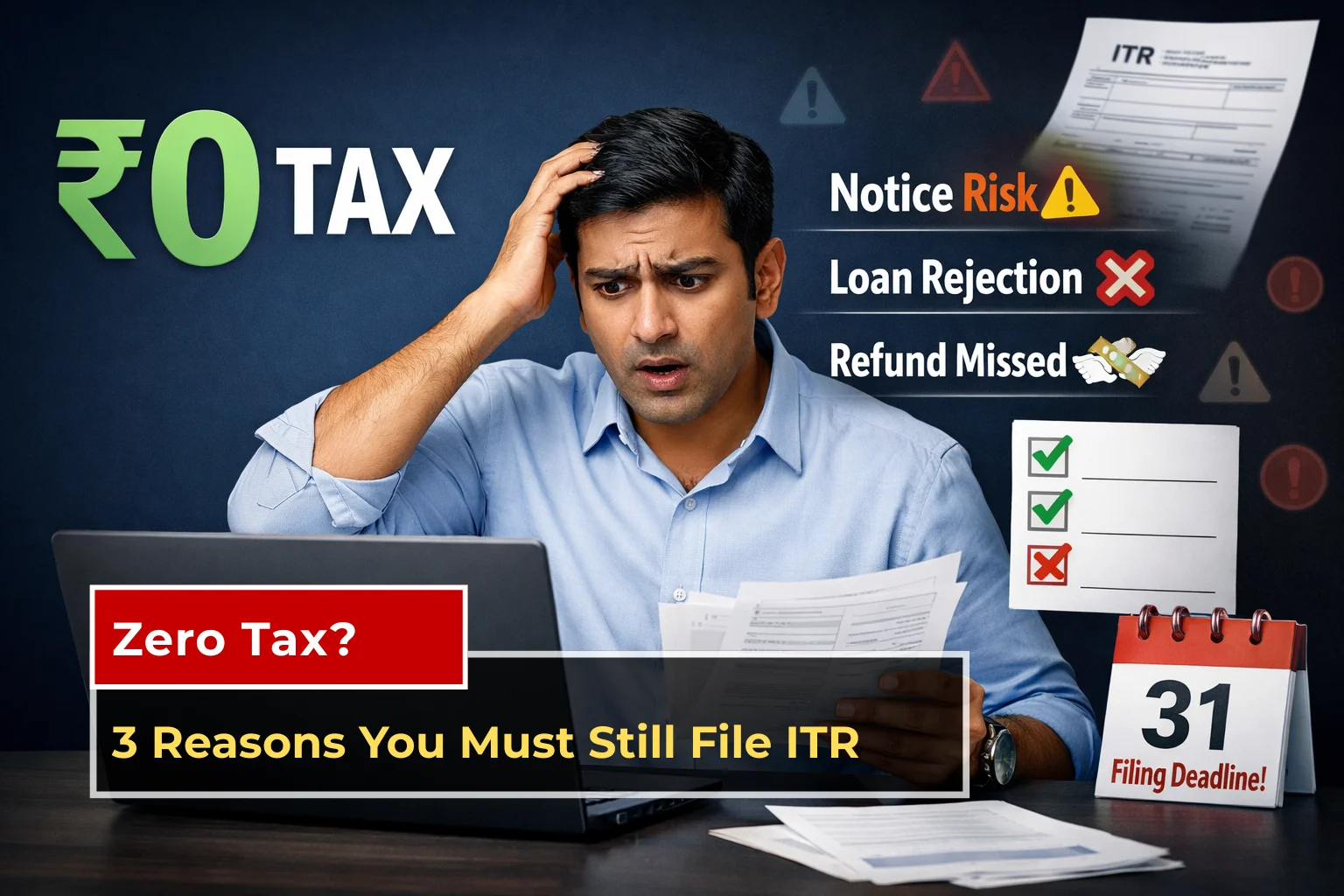
It’s April 2026 in Lucknow. Rahul, a 29-year-old software tester, opens his Form 16. His total income for FY 2025-26 is ₹3.8 lakh well below the point where tax kicks in under the new rules. His company deducted ₹7,500 as TDS anyway. “Tax is zero, so why file ITR?” he wonders and skips it.
Six months later, Rahul applies for his first home loan. The bank asks for his last two years’ ITRs. No record means delays and extra paperwork. He also misses getting his ₹7,500 back as a refund. Rahul’s one small skip created bigger headaches later.
This story repeats for lakhs of people every year. Many think if there is no tax to pay, there is no need to file. But under current income tax rules, filing a zero tax return (also called nil ITR) is often the smart move - and in some cases, it is actually required.
In this simple, beginner-friendly guide, we explain why file ITR even when your tax bill is zero. We use easy words, real examples, clear tables, and official guidelines. You will discover the 3 main reasons, who really needs to file, exact documents, step-by-step process, and mistakes to avoid. By the end, you will know exactly when a nil ITR makes sense for you.
What Does “Zero Tax Return” (Nil ITR) Actually Mean?
A zero tax return or nil ITR means you file your Income Tax Return, but after all calculations, your final tax payable comes to ₹0. This usually happens when:
- Your income stays below the basic exemption limit (₹4 lakh in the new tax regime for AY 2026-27), OR
- Rebates (like Section 87A) bring the tax down to zero — even if your income goes up to ₹12 lakh in some cases.
The good news? Filing is free, fully online, and takes just 15-30 minutes if your papers are ready. The not-so-good news? Skipping it can close doors later.
Source: https://cleartax.in/s/income-tax-slabs

Mandatory vs Recommended: Precise Rules for AY 2026-27
Many people ask: Is filing compulsory or just a good idea? Here is a clear table based on official income tax rules for AY 2026-27:
|
Situation |
Is Filing Mandatory? |
Strongly Recommended? |
What Happens if You Skip |
|
Income below ₹4 lakh (new regime) + no other triggers |
No |
Yes, for refunds and record |
Miss refund, weak proof for loans/visas |
|
TDS or TCS deducted ₹25,000 or more (₹50,000 for seniors) |
Yes |
- |
No refund possible |
|
Want to carry forward losses (shares, business) |
Yes (on time) |
- |
Lose chance to save tax in future years |
|
High-value transactions (electricity bill > ₹1 lakh, foreign travel > ₹2 lakh, etc.) |
Yes |
- |
Possible notice from department |
|
Need income proof (loan, visa, credit card) |
No |
Yes |
Application delays or rejection |
Key point: Even if your tax is zero, check these triggers first. The rules focus on your total picture, not just the final tax amount.
Source: https://www.relakhs.com/itr-filing-ay-2026-27-nil-tax-low-income-cases/
3 Clear Reasons You Should Still File a Nil ITR
Reason 1: Claim Your TDS Refund Easily
Even when tax is zero, many banks and employers deduct TDS. Filing your return is the only way to get that money back into your account.
Take Priya, a part-time designer. She earned ₹3.5 lakh and clients deducted ₹3,800 TDS. She filed her nil ITRand received the full amount in 3-4 weeks. Without filing, the money would have stayed with the government. This is one of the most common and practical reasons to file even with zero tax return.
Source: Livemint
Reason 2: Carry Forward Losses and Save Tax Later
If you had a loss in shares, mutual funds, or a small business, income tax rules let you adjust it against future profits - but only if you file your return on time.
Example: Amit lost ₹60,000 in the market this year. Next year he makes ₹1.5 lakh profit. Because he filed his nil ITR before the deadline, he pays tax only on ₹90,000. Skipping the filing means losing this benefit completely.
Source: ClearTax
Reason 3: Build Strong Proof for Loans, Visas, and More
Banks, embassies, and even landlords treat your filed ITR as official government proof of income and responsibility.
- Home or car loan? Banks usually ask for 2-3 years of ITRs.
- Visa for Canada or Australia? Most require recent ITRs.
- Credit card or rental? Easier approval with a clean record.
A regular nil ITR creates that trustworthy paper trail without costing you anything.
Source: LinkedIn
Documents You Need for a Simple Zero Tax Return
Keep these ready before you start:-
- PAN card (linked with Aadhaar).
- Aadhaar card.
- Form 16 (if salaried) or Form 16A.
- Bank statements and interest certificates.
- Annual Information Statement (AIS) and Form 26AS (auto-available on portal).
- Investment or deduction proofs (if using old regime).
- Details of any foreign travel or high-value transactions (if applicable).
Having these makes the process smooth and error-free.
Source: Clear Tax

How to File Your Nil ITR – Simple 5-Step Guide
1. Visit the official portal— Go to incometax.gov.in and log in with PAN and password (or Aadhaar OTP).
2. Choose the right year and form— Select AY 2026-27 → Online → ITR-1 (Sahaj) for most simple salary or pension cases.
3. Check pre-filled data— Review AIS and 26AS. Correct any mismatches.
4. Fill and verify— Add any extra income, deductions, or bank details for refund. Click “Validate” and preview.
5. Submit and e-verify— Use Aadhaar OTP, net banking, or DSC. You will get an acknowledgment instantly.
The whole process usually takes under 30 minutes.
Source: Clear Tax - How to e-file ITR
Before you start filing, it’s important to choose the correct ITR form based on your income type. If you’re confused between ITR-1, ITR-2, or ITR-3, you can read our detailed guide on Which ITR to File? Understanding ITR Forms (AY 2025-26).
Common Mistakes to Avoid When Filing a Nil ITR
- Picking the wrong form (ITR-1 instead of ITR-2 if you have capital gains).
- Missing the due date (31 July 2026 for most people) and losing loss carry-forward benefit.
- Ignoring AIS mismatch — always verify before submitting.
- Forgetting to pre-validate your bank account for refund.
- Not claiming carry-forward losses even when you have them.
A quick double-check saves future notices and headaches.
Source: Clear Tax - Return Filing Mistake
Quick Benefits Table: Why a Nil ITR Matters
|
Situation |
Without Filing |
With Nil ITR Filed |
Real Benefit You Gain |
|
TDS deducted on salary/FD |
Money stays with government |
Full refund in weeks |
Cash back |
|
Loss in stocks or funds |
Cannot use next year |
Carry forward up to 8 years |
Future tax savings |
|
Applying for home loan |
Delay or extra documents |
Faster approval |
Smoother process |
|
Visa or immigration |
Possible rejection |
Strong income proof |
Quicker approval |
|
Overall financial record |
Weak proof |
Official government record |
Easier life for loans and more |
Who Should Consider Filing? Quick User Guide
- Salaried person: File to get TDS refund and show steady income for loans.
- Freelancer or gig worker: Mandatory if receipts cross limits or you have losses.
- FD interest earner: Banks deduct TDS - filing gets your money back.
- Stock market investor: Must file to carry forward any losses.
- Student or intern: Even small income with TDS? Build your early record.
- Homemaker: Small interest income with TDS? Simple filing keeps everything clean.

Conclusion
Rahul’s story could have ended without stress if he had filed his nil ITR. Yours still can. Is it necessary to file ITR if tax is zero? Not always compulsory - but in many practical cases it is the smartest choice for refunds, future savings, and life-proof documents.
This July 2026, take 20 minutes, gather your documents, and file on the official portal. Your bank account, loan officer, and future self will thank you.
File once. Benefit for years.

DISCLAIMER: This blog is NOT any buy or sell recommendation. No investment or trading advice is given. The content is purely for educational and information purposes only. Always consult your eligible financial advisor for investment-related decisions.









 72.jpg)