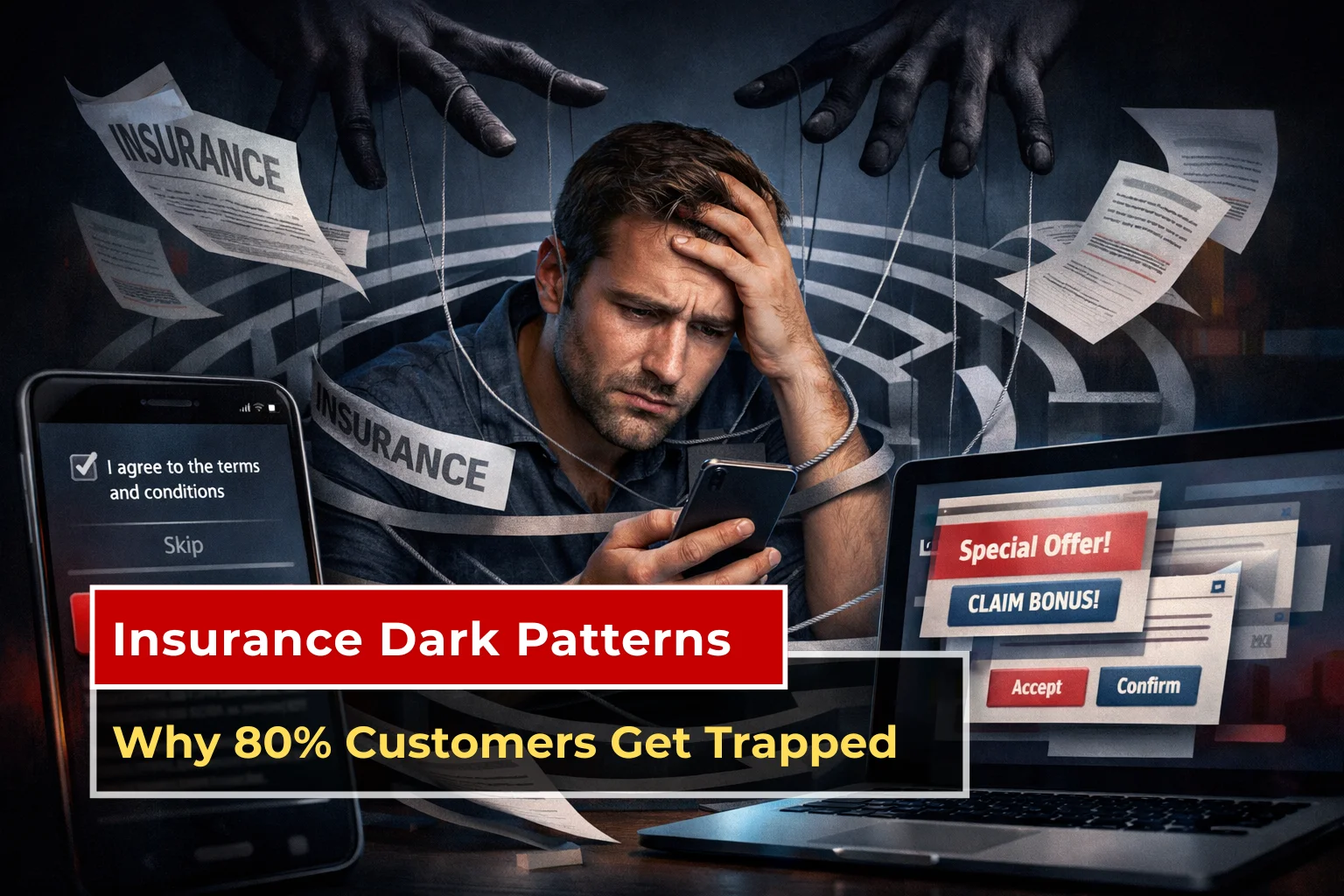
Imagine this: It’s evening. You’re tired after work and need quick health cover for your family. An ad says “Just ₹499/month for ₹10 lakh protection.” You click, enter a few details, and the price looks perfect. But when you reach the payment page, extra fees pop up. Can you try to cancel the next day? The button is nowhere to be found.
This isn’t bad luck. This is how insurance dark patterns in India work – clever website tricks that push regular people into buying policies they don’t fully understand.
A March 2026 Local Circles survey of over 87,000 people across 341 districts found that 80% of online insurance buyers faced these traps. The number has jumped sharply in just two years. Many feel stuck with higher costs, wrong coverage, or impossible cancellations.
In this clear, beginner-friendly guide, you’ll learn exactly what these tricks are, see real examples from popular apps, spot the difference between fair and sneaky designs, and get simple tools to stay safe. By the end, you’ll buy insurance smarter and help spread real awareness about fair buying practices in India.
What Are Insurance Dark Patterns?
Dark patterns are sneaky design tricks on apps and websites that make you click “Buy,” add extras, or stay locked in – without you realising it. In insurance, they turn a simple purchase into a costly mistake.
The Central Consumer Protection Authority (CCPA) has listed 13 such tricks. The most common ones include:-
- Hard-to-find cancel buttons (subscription trap).
- Low price shown first, then a higher price later (bait and switch).
- Extra fees that appear only at the last step (hidden charges or drip pricing).
- Forced sharing of extra personal details.
- Annoying pop-ups that keep nagging you.
These are now called misleading insurance practices and are under the scanner of regulators.

Real Examples from Popular Indian Insurance Platforms
The same survey examined major platforms such as Policybazaar, Acko, ICICI Lombard, Tata AIG, Bajaj Allianz, HDFC Ergo, Star Health, and Go Digit. Each had 2 to 4 dark patterns.
Users reported:
- “Zero depreciation” or “roadside assistance” is already ticked in motor insurance.
- Low premium on the first screen, then GST and rider fees are added suddenly.
- Fake urgency messages like “Only 2 slots left at this price!”
- The cancel option is hidden behind many clicks or available only by email.
These manipulative designs are common across Indian insurance websites and apps.
(Above: Clear visual difference between dark patterns that trick you and fair, ethical designs that respect your choice.)
Fair Insurance UX vs Dark Pattern UX – Side-by-Side Comparison
Good websites make buying easy and transparent. Dark patterns do the opposite. Here’s how they differ:
Fair UX (What you should expect):
- All prices shown upfront, including every fee
- Every add-on is unticked by default
- Big, easy “Cancel” button
- The full policy document is easy to read before payment
- No pop-ups that block your screen.
Dark Pattern UX (What traps most people):
- Base price only at first, surprise charges later
- Add-ons pre-ticked so you “forget” to remove them
- Cancel button hidden or missing
- Urgent countdown timers that aren’t real
- Pop-ups that interrupt every step.
Spotting this difference helps you choose the right platform instantly.
How Dark Patterns Differ Across Insurance Types
The tricks change depending on the policy:
Health Insurance
Auto-selected higher coverage or extra riders like cancer cover. Pop-ups keep pushing you during renewal. You often pay 20-30% more without noticing waiting periods or exclusions.
Term Life Insurance
Bait-and-switch is common. Ultra-low premiums appear first, then the price jumps after you enter your age or health details. Critical illness riders are pre-ticked.
In term life insurance, the biggest confusion is often between low premiums and actual coverage. If you’re still unsure which option is right for you, take a look at the Term Plan or Traditional Insurance. It will help you make a clear and informed decision.
Motor Insurance
Hidden charges and pre-ticked add-ons (zero depreciation, consumables) are the most frequent. Cancellation feels almost impossible after renewal.
Knowing these differences lets you watch out for the right trap at the right time.
Exact IRDAI and CCPA Rules – What the Law Says Now
In April 2026, IRDAI took strong action. It told all insurers and online platforms to:
1. Follow CCPA’s 2023 Guidelines on Prevention and Regulation of Dark Patterns.
2. Complete a self-audit and submit a compliance report within 15 days.
3. If any problem is found, submit a time-bound action plan within one month to remove it.
CCPA rules clearly ban false urgency, hidden charges, confirm shaming, forced actions, and subscription traps. IRDAI has called these unfair trade practices. Penalties apply for non-compliance.
This is a big win for fair insurance buying in India.
Data Table: How Common Are These Traps?
|
Dark Pattern |
% of Users Affected |
Change in 2 Years |
Most Seen In |
|
Subscription Trap |
80% |
+19% |
Motor & Health |
|
Forced Action |
85% |
+28% |
All types |
|
Bait & Switch |
82% |
Rising |
Term Life |
|
Nagging & Pop-ups |
90% |
Rising |
Health Renewal |
|
Hidden Charges (Drip Pricing) |
65% |
Rising |
Motor |
Key takeaway: These numbers show the problem affects most people buying online. The situation has clearly worsened, but regulators are now forcing change.
Red Flags – Stop and Check These Immediately
Watch for these clear warning signs:
- Any add-on already ticked when you didn’t choose it
- Price that changes between the first quote and the final payment
- Pop-ups that won’t let you proceed without clicking “Buy more.”
- Cancel option that’s hard to find or requires calling many times
- Fake urgency messages like “Limited slots left.”
If you see even one, close the tab and try another platform.

Common Mistakes While Buying Insurance Online
Many people make these simple errors:
1. Rushing through without reading the full document.
2. Trusting the first “best price” without comparing.
3. Ignoring pre-ticked boxes.
4. Not taking screenshots of every price and promise.
5. Buying from random WhatsApp links or unverified sites.
Avoiding these mistakes alone can save you thousands.
Before You Buy: 7-Point Checklist
1. Untick every add-on yourself.
2. Take screenshots of every price shown.
3. Read the full policy document (not just the summary).
4. Check waiting periods, exclusions, and co-pay.
5. Compare quotes on at least 3 different trusted sites.
6. Verify the company on irdai.gov.in
7. Ask a family member to review with you.
How to Verify Policy Summary vs Final Policy Wording
Always download the PDF right after purchase.
- First, read the summary page
- Then check “Coverage”, “Exclusions,” and “Terms & Conditions.”
- Search for words like “waiting period” or “co-pay.”
If anything differs from what the website showed, you still have time to cancel (see free-look period below).
Free-Look Period – Your Safety Window
You get a free-look period to change your mind:
-
- 15 days for policies bought offline
-
- 30 days for online or distance-mode policies (most digital purchases).
Simply email the insurer saying you want to cancel under the free-look period. You get almost full refund (minus small medical or stamp duty charges if any). No questions asked if you haven’t made a claim.
What Proof to Keep for Any Complaint
Always save these:
- Screenshots of every price shown before payment.
- Email confirmations and quotes.
- Full policy PDF (summary + complete wording).
- Payment receipts.
- Chat or call records with customer care.
- Notes of dates and times when you tried to cancel.
These proofs strengthen and speed up your complaint.
Step-by-Step: How to File a Complaint If Trapped
1. Write to the insurer’s Grievance Redressal Officer (they must reply in 2 weeks)
2. If unhappy, go to IRDAI’s Bima Bharosa Portal at https://bimabharosa.irdai.gov.in/
- Register → Enter policy details → Upload proofs → Submit
3. Still not resolved? Approach the Insurance Ombudsman (free and quick) within 1 year at https://www.cioins.co.in/
(Above: Bima Bharosa portal – simple registration page for filing your complaint directly.)
5 Simple Tips to Stay Protected Forever
- Never rush the “Buy Now” button
- Always read the full document before paying
- Say “No” to every pre-ticked box
- Share this guide with family and friends.
- Bookmark irdai.gov.in and the Bima Bharosa portal

Conclusion
Insurance dark patterns in India have trapped too many families, but the rules are finally changing. With IRDAI and CCPA cracking down, platforms must clean up their designs. Use the checklist, watch the red flags, keep your proofs ready, and choose fair websites that respect your choice.
Insurance should protect your loved ones – not surprise you with extra costs or hidden tricks. Share this article to help more people buy with confidence and build stronger awareness about fair insurance practices across India.
Sources: LocalCircles Survey & IRDAI Directive, Free-Look Period Rules, Bima Bharosa Portal

DISCLAIMER: This blog is NOT any buy or sell recommendation. No investment or trading advice is given. The content is purely for educational and information purposes only. Always consult your eligible financial advisor for investment-related decisions.










.jpeg)
.jpeg)