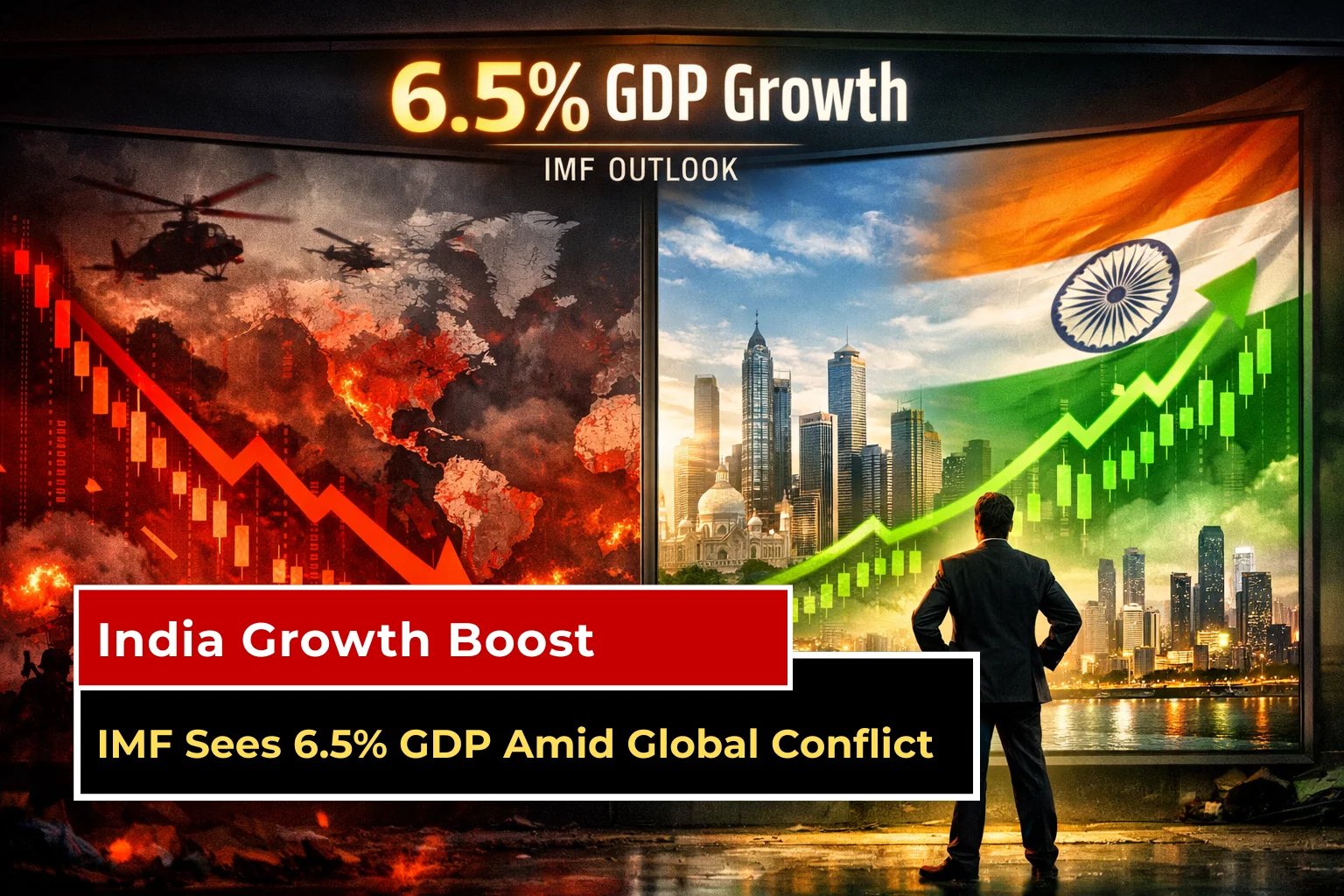
Imagine India as a strong young athlete running a marathon while the rest of the world faces strong headwinds and unexpected storms. Wars in the Middle East are pushing up oil prices, global growth is slowing, yet India is speeding ahead. The latest IMF GDP forecast for India 2026 brings exciting news: the economy is set to grow at a solid 6.5% in FY27 (2026-27). This makes India the fastest-growing major economy on the planet.
In simple words, this IMF report on India shows strong economic growth in India in 2026, even when global problems try to slow us down. This blog tells the full story in easy language – like a friendly chat over tea.
We will cover what the forecast really means, why it was revised upward, how it compares with others, the risks ahead, which sectors will shine, and what smart investors should watch next. Perfect for beginners who want clear, useful insights without complicated jargon.
What is the Latest IMF GDP Forecast for India (2026)?
The International Monetary Fund (IMF) releases its World Economic Outlook report every few months. In the April 2026 update, the IMF GDP forecast for India 2026 stands at 6.5% for FY27. This is the same level expected for FY28. India’s growth for the current year (FY26) has also been revised up to 7.6%.
Why does this matter? GDP growth means more factories producing goods, more shops selling products, more jobs, and higher incomes for families. At 6.5%, India leaves behind big economies like China (around 4.4%) and the USA (around 2.3%). Global growth is only 3.1% in 2026. India is truly running faster than the pack.
(Source: IMF)

Previous IMF Forecast vs Revised: A Clear Comparison
The IMF didn’t pull this number out of thin air. Here’s a simple table showing how the forecast changed:
|
Period |
Previous Forecast (January 2026) |
Revised Forecast (April 2026) |
Change |
|
FY26 (2025-26) |
Around 6.6% |
7.6% |
+1.0% |
|
FY27 (2026-27) |
6.4% |
6.5% |
+0.1% |
|
FY28 (2027-28) |
6.4% |
6.5% |
+0.1% |
This upward shift is small but important. It shows the IMF now sees stronger momentum carrying forward.
(Source: ET)
Why Did the IMF Revise India’s GDP Forecast Upward?
The IMF report on India gives two big reasons for the positive revision:
1. Strong carryover from 2025: India’s economy surprised everyone with better-than-expected performance in the second half of FY26. Factories kept humming, people spent more, and government projects moved fast.
2. Lower US tariffs on Indian goods: Extra taxes on Indian exports dropped sharply from 50% to 10%. This makes it easier and cheaper for India to sell clothes, gems, medicines, and more to America. These gains outweigh the negative effects of the Middle East conflict.
In short, domestic strength plus better trade conditions are powering GDP growth in India, higher than expected.
The improvement in India’s growth outlook is also supported by recent trade developments—especially after the India-US Trade Deal to 18%, which could significantly boost exports and key sectors.
How the Global Economy's Impact on India Plays Out – And the RBI-Oil-Inflation Link
The world is tense because of conflicts in West Asia. Oil prices could rise, making transport and cooking gas costlier. The IMF links this directly to India:
- Baseline assumption: Oil around $82 per barrel → India’s growth stays at 6.5%.
- If conflict drags on and oil hits $120 per barrel → Growth may dip slightly to 6.1-6.2%, and inflation could rise.
The Reserve Bank of India (RBI) is watching closely, too. RBI’s own forecast for FY27 is higher at 6.9%. It expects inflation around 4.6%. The IMF sees CPI inflation at 4.7% in FY27, moving back toward the RBI’s 4% target by FY28. Higher oil means costlier imports, but India’s shift to solar power and diversified oil buying helps cushion the blow.
At the same time, rising geopolitical tensions can impact energy costs—understanding the LPG Gas Shortage in India 2026 and the PNG shift amid the Iran-Israel conflict gives a clearer picture of how global events affect India’s economy.
Risks Scenario Table: What Could Go Wrong?
Here’s a clear table of three possible scenarios from the IMF and experts:
|
Scenario |
Global Growth (2026) |
India’s GDP Growth (FY27) |
Inflation Impact |
|
Baseline (limited conflict) |
3.1% |
6.5% |
Moderate rise (4.7%) |
|
Adverse (longer war) |
2.5% |
6.1–6.2% |
Higher (oil-driven) |
|
Severely Adverse |
2.0% |
Below 6% |
Sharp spike |
Even in tough times, India’s growth stays more than double the world average. That’s real resilience!
(Source: TOI)
Which Sectors Will Benefit Most from This Growth?
Not all parts of the economy grow equally. The IMF GDP forecast for India 2026 points to these clear winners:
- Manufacturing & Exports: Lower US tariffs boost sectors like electronics, pharmaceuticals, textiles, and gems. “Make in India” factories will create more jobs.
- Services (IT, Finance, Tourism): Digital payments and global demand keep this engine strong.
- Infrastructure & Construction: Government spending on roads, railways, and airports creates ripple effects.
- Consumer Goods & Retail: Rising incomes mean more spending on bikes, phones, food, and homes.
- Renewable Energy: Less dependence on costly oil pushes solar and green projects forward.
These sectors will drive India's economic growth in 2026 and create opportunities for young Indians.

How Does India Compare with World Bank and OECD Forecasts?
The IMF is not alone. Other global experts also see India shining:
- IMF: 6.5% for FY27.
- RBI: 6.9% (more optimistic on domestic demand).
- World Bank (recent updates): Slightly lower than RBI but still sees strong momentum around 6.3-6.5%.
- OECD: India leads major economies with similar optimism on long-term growth.
India consistently comes out on top. While China slows to around 4.4% and advanced countries hover near 2%, India’s young population, huge domestic market, and smart policies make it the global growth champion.
Expert View: What Economists Are Saying
DK Srivastava, Chief Policy Advisor at EY India, explains it well: “The IMF in its April 2026 World Economic Outlook refers to three scenarios… For India, the baseline scenario projects a growth of 6.5% for 2026-27 and CPI inflation of 4.7%. Even in a longer conflict, India’s growth may reach 6.1% to 6.2% – still more than double global growth under the adverse scenario,” as noted by TOI.
This quote shows experts' trust in India’s fundamentals.
What Investors Should Track Next – Practical Tips
This IMF GDP forecast for India 2026 is great news, but smart investors stay alert. Here’s your simple watch-list:
- Oil prices (watch Brent crude – above $100 could hurt).
- RBI’s next policy meeting (rate cuts or holds?).
- Quarterly GDP numbers (April-June 2026 will show early trends).
- US-India trade updates (more tariff relief?).
- Monsoon and food inflation (affects daily life and RBI decisions).
Beginners: Start small with SIPs in index funds or diversified mutual funds. Focus on long-term growth rather than daily news.

Wrapping Up: India’s Strong and Steady Path Ahead
The IMF GDP forecast for India in 2026 at 6.5% is more than just a number – it’s proof that India is built to grow even when the world faces conflicts. Strong domestic demand, better trade deals, and smart policies are turning challenges into opportunities. This IMF report on India confirms what millions of Indians already feel: the future is bright.
Of course, risks like oil shocks exist. But with careful planning by the government and RBI, GDP growth in India can stay strong and reach every corner of the country. Whether you are a student dreaming of a job, a parent saving for education, or a small investor, this growth story affects you positively.
Keep learning, save regularly, and invest wisely. India is not just surviving global storms – it is leading the race.

DISCLAIMER: This blog is NOT any buy or sell recommendation. No investment or trading advice is given. The content is purely for educational and information purposes only. Always consult your eligible financial advisor for investment-related decisions.










.png)