Introduction
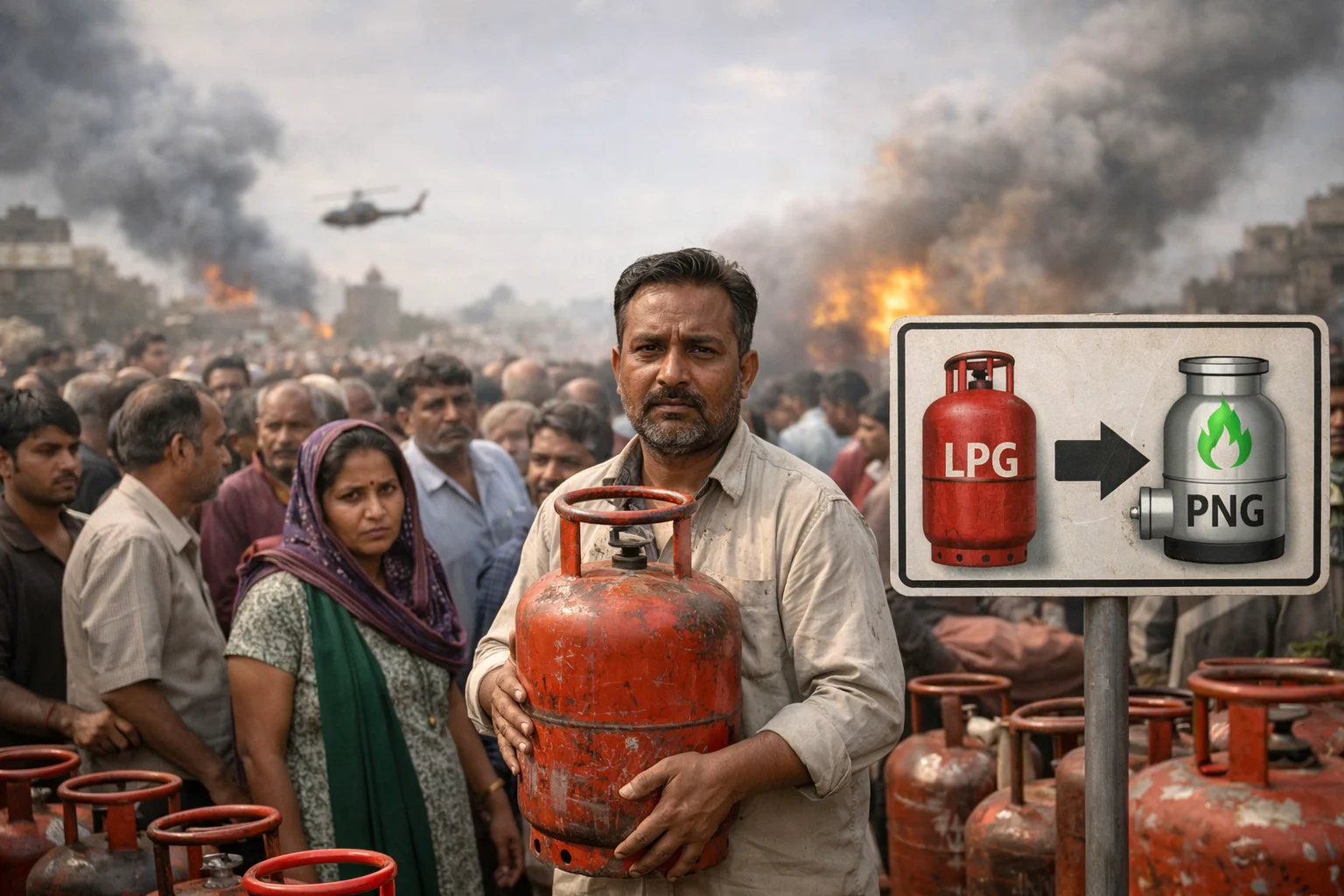
Due to geopolitical conflicts and import limitations, India is experiencing an LPG gas shortage in 2026. LPG is used for cooking, and millions of households depend on LPG cylinders. LPG shortages affect both rural and urban areas. Millions of households now face uncertainty as this supply disruption is on the rise. Due to this issue, the government has come up with a new policy called LPG to PNG rule India.
The ongoing geopolitical tensions and energy supply disruptions are not only affecting LPG availability but also creating volatility across crude oil and precious metal markets. Investors tracking commodity uncertainty should also understand the recent MCX gold price crash and why gold prices can suddenly correct even during global crises.
LPG Latest News Today & What Consumers Should Know
Starting March 26, 2026, notifications for the LPG supply rule will be sent out via SMS and distributors. Gas cylinder rule 2026 gives preference to domestic users and partially allows (up to 50% in some states) commercial users. The LPG supply phase-out is only targeted where PNG is in place rural India is safe.
Customers who need PNG in their cities should act quickly. For those who do not have access to PNG, switching to cylinders is the only option, but booking will be more difficult.
This policy will make an infrastructure shift to piped natural gas PNG if there is available infrastructure. This initiative is to assist with the ongoing crisis, while also providing us with a clean energy solution, consisting of the new gas policy India 2026.
The ongoing Iran-Israel War has impacted the entire world of energy, including the Strait of Hormuz, where India receives over 90% of its LPG supply. Due to this issue, the frequency of imported LPG has decreased weekly by 30%. This reveals the numerous weaknesses of the LPG supply. Currently, domestic production supports only 35-40% of the total demand, so the LPG supply problem has become a national problem.
In this blog, I will explain the causes, the new government LPG rule 2026, a comparison of PNG and LPG in India, and the overall impact on the economy.

What is Causing the LPG Gas Shortage in India 2026?
LPG consumption in India is around 31.3 million metric tonnes (MT) in the 2024-2025 fiscal year. There are 32.94 crore active domestic connections, of which over 10 crore are under the Pradhan Mantri Ujjwala Yojana (PMUY). While the domestic production is 1.158 MT per month (which is approximately 13.9 MT per year) the country has to import 60 - 65 % of its LPG consumption needs from mainly West Asia.
Due to the Iran - Israel war, which has the US involved, there is a disruption to the movement of tankers at the Strait of Hormuz, which is a major chokepoint for 20% of the global LPG trade. This has caused a significant drop in LPG imports from Qatar and Saudi Arabia, which are India’s primary LPG suppliers.
Strategic commercial LPG storage capacity is critically low, at approximately 140,000 tonnes (5 days of national consumption) which gives India no buffer against demand shocks. Commercial users are facing cuts to their allocations, and households are experiencing delays to their deliveries and are additionally facing booking requirements. There is a rising demand for LPG and low availability.
This shortage in the availability of LPG has caused the price of LPG to increase. A 14.2 kg non-subsidized domestic cylinder is selling for approximately ₹913 in major Indian cities (an increase of ₹60 since the beginning of March 2026), and 19 kg commercial LPG cylinders are selling for ₹1883. The India fuel crisis goes beyond availability; it also threatens their energy security.
Government’s New LPG Rule 2026: Mandatory Shift to Piped Natural Gas PNG
March 24, 2026, The Ministry of Petroleum and Natural Gas published the Natural Gas and Petroleum Products Distribution (Through Laying, Building, Operation and Expansion of Pipelines and Other Facilities) Order, 2026, with the Essential Commodities Act gas order.
In simple terms, this order concerning LPG supply stops requires households with gas pipelines in the vicinity to shift to PNG within 3 months of the notification, or they will face a complete supply restriction of LPG gas cylinders.
The main points of the 2026 Government LPG Rule are:
- Phasing out the supply of LPG to direct LPG gas cylinders to unpiped areas, particularly rural India.
- A 3-month timeframe within which customers are to apply for and receive a PNG connection in India.
- In cases termed technically unfeasible, the no-objection certificate will be provided.
- To provide rapid construction of City Gas Distribution (CGD) networks, reduced construction time, standardized and reduced operational costs (connected to land access) will be provided.
- PNGRB Guidelines place the Petroleum and Natural Gas Regulatory Board as the primary authority for compliance monitoring, approvals, and expansion of the PNGRB.
The order further extends to households already using PNG, banning the retaining and refilling of domestic LPG cylinders, effectively imposing an LPG ban PNG areas for dual users. Around 60 lakh households have access to PNG, using cylinders instead. If they are asked to leave, it will open up considerable LPG Supply.
The PNG mandatory rule is far from arbitrary it is aimed at addressing the immediate and short-term supply concerns. Less dependency on imported LPG will help India’s energy security, along with greater ease in the piped natural gas policy.

PNG vs LPG India: Why the Government is Prioritising the Shift
Piped natural gas (PNG) has benefits over LPG cylinders and is therefore advantageous for the consumer and the country.
|
Aspect |
LPG (Cylinders) |
PNG (Piped Natural Gas) |
Winner |
|
Cost (Monthly Equivalent) |
₹910–987 (14.2 kg cylinder) |
₹770–800 (15.5–16 SCM) |
PNG (12-15% cheaper) |
|
Safety |
Heavier than air; accumulates and risks explosion |
Lighter than air; disperses quickly |
PNG |
|
Convenience |
Booking, delivery delays, and storage are required |
Continuous metered supply, no refills |
PNG |
|
Supply Reliability |
Vulnerable to import shocks |
Domestic + diversified LNG sources |
PNG |
|
Environmental |
Imported fossil fuel |
Cleaner, supports India’s gas grid |
PNG |
PNG removes all of the logistical hassles associated with LPG cylinders, and it is also safer at home, with built-in regulators and shut-off valves. These are the factors the LPG to PNG rule India is using to abolish cylinder dependency in areas where pipes already exist.
How to Get a PNG Connection India: Step-by-Step Guide
1. Confirm eligibility from your local CGD company (e.g. Indraprastha Gas, Mahanagar Gas).
2. Submit an application online or at a centre along with proof of address and identification.
3. Pay your security deposit. Installation charges (which sometimes get subsidized or waived during promotions) also need to be paid.
4. Usually, pipeline placement and connection take between 1 and 3 months.
5. After activation, you may surrender your LPG cylinder to receive your refund or have the option of a transfer.
Those notified regarding the PNG connection rule will be given precedence. The PNGRB regulations require CGD companies to rapidly extend their networks and minimize the time taken to process requests.
Economic Impact: How the LPG Gas Shortage and PNG Shift Are Reshaping India’s Economy
The LPG gas shortage is directly affecting various sectors and indirectly influencing inflation, employment, and the fiscal situation.
Household Level: The LPG gas shortage affects over 33 crore connections and makes cooking more costly for the middle-class. It also increases pressure on the PMUY beneficiaries while subsidized LPG connections are given. In rural regions, the use of biomass fuels may become more common, leading to a worsening of indoor air pollution. Additionally, “time poverty” will become a more pronounced problem for women.
Commercial & Industrial Impact: The restaurant and hospitality industries are experiencing a 40-50% supply shortage in some regions, resulting in a large number of closures, with 10,000 having already occurred in Tamil Nadu alone. The food processing and dairy sectors have also been affected, which has increased food prices on menus and has caused food inflation.
Macroeconomic Strain: India’s foreign exchange reserves are impacted by the LPG import bill. Subsidies for FY 2025-2026 have been scaled up with OMC compensation at ₹30,000 crore, and support at ₹17,500 crore. PNG will ease the burden by reducing import dependency and replacing LPG.
Here’s a snapshot data table illustrating the scale:
|
Parameter |
2025 (Pre-Crisis) |
Early 2026 (Current) |
Projected Impact of PNG Shift |
|
Annual LPG Consumption |
31.3 MT |
~30 MT (declining due to shortages) |
Reduced by 5-7 MT in PNG areas |
|
Import Share |
60-65% |
55%+ (disrupted) |
Lowered via domestic PNG |
|
Domestic Connections |
32.94 crore |
Same |
60 lakh+ shift to PNG |
|
Strategic Storage (Days) |
~10-15 days |
~5 days |
Improved buffer for rural LPG |
|
Subsidy Burden (₹ crore) |
~15,121 |
Rising to ₹47,500+ (with packages) |
Savings through fuel diversification |
|
Commercial Sector Revenue Loss |
Minimal |
Significant (closures in multiple states) |
Stabilised via PNG priority |
The PNG gas transition will save the households in the urban areas 12-15% of their fuel bills. The government will be able to provide LPG for use in areas that are currently unserved. It will also improve energy security, diminish the vulnerability of the India fuel crisis, and meet the PNGRB guidelines for a gas grid. However, short-term disruptions, if not managed properly, will slow industrial output and raise the cost of living.

Conclusion: Towards a Resilient Gas Policy India 2026
The LPG gas shortage in India 2026, further worsened by the Iran-Israel war, has brought about a much-needed change. The LPG rule 2026 and PNG rule India are aimed at switching and eliminating the dependency on inefficient cylinders towards piped natural gas, which is more dependable. There will be more difficulties in infrastructure and adaptability from the consumers, but in the future, the benefits will outweigh the hurdles in cost, safety, and energy availability.

DISCLAIMER: This blog is NOT any buy or sell recommendation. No investment or trading advice is given. The content is purely for educational and information purposes only. Always consult your eligible financial advisor for investment-related decisions.

.webp)



.jpeg)