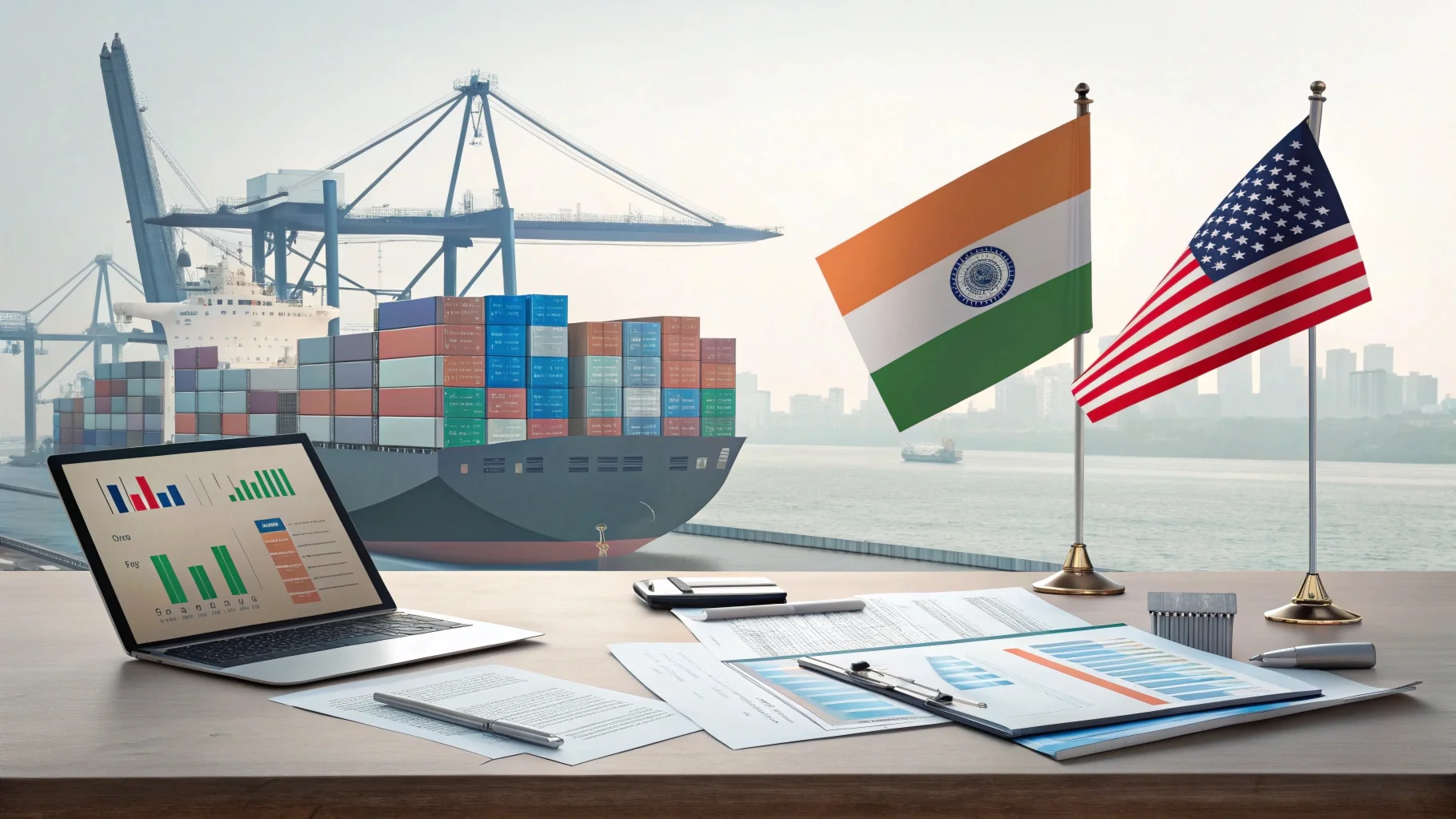
The announced India-US trade deal by President Trump signifies an important landmark in bilateral economic relations and will greatly enhance the partnership between the world’s two greatest democracies. The Trump tariff cut brings the 50% to 18% India-US tariff on Indian goods and will be effective immediately. This reduction came after months of trade tension, which included tariffed duties on India’s Russian oil purchases and reciprocal trade barriers, along with other trade sanctions.
Trump Cuts Tariffs From 50% to 18%
As a result of this deal, which came about on the heels of a Trump/Modi telephonic discussion, India has committed to a number of resolutions, including the suspension of Russian oil imports, reducing its trade protectionist barriers on US imports, and increasing the purchase of US energy, defence, agro, and tech products.
This new India-US trade deal removes some upcoming obstacles for Indian exporters and indicates a shift in bilateral trade relations. The US-India trade relations will likely be positively impacted through a renewed potential for export growth, foreign investment, and job creation.
Indian export-oriented companies saw a significant rise in stock. With a positive response from the Indian markets, the focus will be on the trade deal sectors. The trade deal will benefit the labour-intensive high-value sectors that will be able to pay lower duties to access the larger trade markets in the US.

Before The Shift
In 2025, the India-US tariff saga began to escalate when the US, for the first time, imposed 25% reciprocal tariffs, along with punitive duties on Indian imports, for an effective total of 50% tariff on Indian imports. The tariff was a direct response to India buying Russian Oil, going against the sanctions put on Russia internationally.
Indian exports to the United States, which constitute roughly 18% of the total exports, began to lose market access and competitiveness against its peers like Vietnam and Bangladesh.
The Trump tariff cut to 18% reduces punitive aspects and reduces the tariff counteraction, and brings India’s tariffs to the level of other Asian exporters. India will diversify its energy imports away from Russia, including the US and Venezuelan sources, and will commit to buying over $500 billion in US goods over time.
While the details will come in the final agreement, the immediate benefits to exporters are clear. This India-US trade dealis strategically beneficial to both parties. From the US perspective, it helps to stem the flow of revenue to Russia from oil. For India, it is of great significance to have better access to the USA, which is now its largest export market. Other aspects of the India-US trade arrangement will include the stabilisation of supply chains, increased confidence of investors, and the integration of both economies at a greater level.
Important Areas The Trade Deal Will Assist
With the receipt of new tariffs, this will help new export-oriented markets looking to expand into the US more easily. Below are the sectors that assist any trade deal:
1. Textile And Apparel
With the new trade tariffs, this will help India's large textiles and a major employer in the United States. There will be many job opportunities for the labour-intensive clusters, including Tamil Nadu, Gujarat, and Uttar Pradesh. The industry has welcomed the new changes and is looking to redevelop its lost sub-markets because of the higher tariffs.
They obtain needed job opportunities for millions. This also includes the women in the United States. The newly placed tariffs will allow the industry to invest in more advanced equipment and assist in the "Make in India" movement.
2. Pharmaceuticals
Indian export markets have reduced the new tariffs for the selling of generic drugs, and are distributed to the United States in large quantities, so India is often labelled "the world’s pharmacy". The new India-US trade deal has also reduced new tariffs for the country's export of generic drugs and active pharmaceutical ingredients (APIs).
The US is the world’s leading economic powerhouse, so because of this India’s new, reduced tariffs will be a large contributor to the United States market. The companies, Sun Pharma, Dr. Reddy's, and Cipla, will be the largest contributors.
The India US trade impact is about how US citizens’ access to affordable healthcare is being impacted, as well as how supply chain resilience is strengthening post-pandemic.
3. Gems and Jewellery
In Surat, Mumbai, and the rest of India, the jewellery industry is centred around the export of polished diamonds, gold jewellery, and coloured gemstones to the United States. Demand is the industry’s main hindrance, and that comes mainly as a result of high tariffs on the industry. With the tariff on gold jewellery now being reduced to 18%, that is a remedy to the industry’s main hindrance.
During peak festive seasons, it is likely to receive a greater volume of sales as it employs many skilled artisans and is a major contributor to the foreign exchange inflow to the country.
4. IT and Services (Indirect Boost)
The India-US trade deal has positively impacted the stock prices of major IT companies (such as Infosys, Wipro, etc.). This is because, although services are less tariffed, the overall impact of factors has a more positive impact on stock prices due to the stronger impact on trade and services overall. The overall services trade increased.
Labour-Intensive Industries that are also Likely to be Beneficial
- Engineering chemicals, leather, and footwear.
- Handicrafts and European carpets.
- Increased exportation of these labour-abundant industries will most likely result in employment growth.
Larger Impacts on Trade Between India & The U.S.
Increased bilateral trade can be an outcome of the cutting of tariffs in the India US trade deal. This can help the U.S. trade deficit problem and help India achieve a goal of $1 trillion in exports. The trade deal can also help gain foreign direct investment (FDI) in the manufacturing sector and can create millions of jobs. Although there are challenges of specific details on future implementation, non-tariff barriers, and agricultural access, the future seems bright.

Conclusion
These India US trade tariffs, unlocking potential in textiles, pharmaceuticals, gems and jewellery, help further the trade deficit problem and steer the economy in the right direction. All of these aspects of the trade deal can help define the future of India and the US trade relations.

DISCLAIMER: This blog is NOT any buy or sell recommendation. No investment or trading advice is given. The content is purely for educational and information purposes only. Always consult your eligible financial advisor for investment-related decisions.


.webp)










 (1).webp)