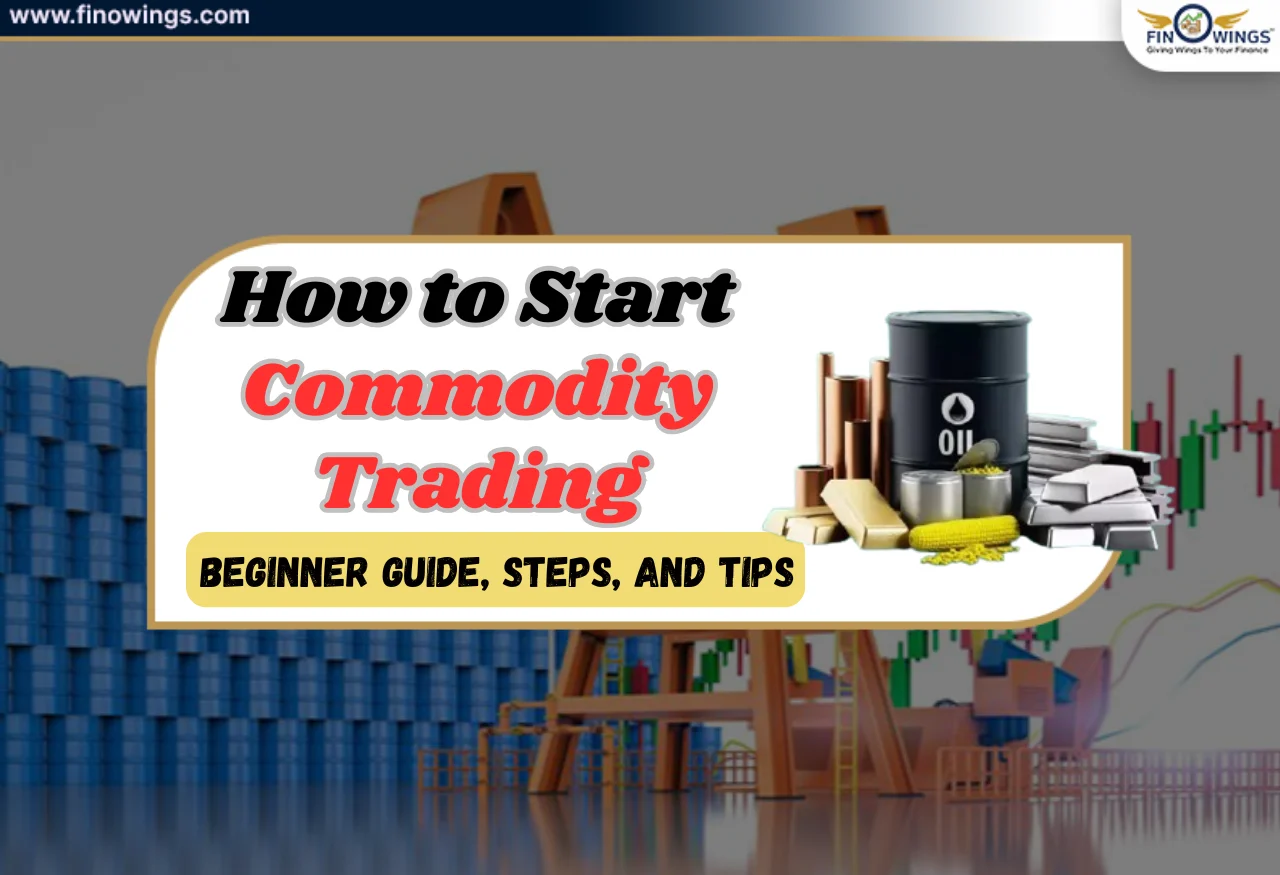
Most beginners think about stocks and mutual funds, and don’t recognise the power of markets beyond these options. Commodity trading is often misunderstood, and with the right knowledge, it is a very amazing tool in the financial markets. Trading in commodities such as gold, silver, crude oil, natural gas, and various agricultural products offers opportunities that are influenced by geopolitical tensions, inflation, and economic events that do not directly influence the market.
As a first-time investor, this guide to how to start commodity tradingis designed to give direction and clarity. A focus is given to gold trading as it remains the strongest commodity in India.
What is Commodity Trading?
Simply put, commodity trading in India and worldwide is about the sale and purchase of goods and contracts centred around those goods. Specifically, there are different classes of goods, namely precious metals, agricultural products, and energy resources (e.g. crude oil, natural gas, un/refined petroleum, and gas).
When you invest in the stock market, you purchase partial ownership of a specific company, known as a share. This process is distinct from commodity trading, where you purchase ownership of the price movement of basic raw materials. When demand increases or supply becomes scarce, prices increase. For these reasons, commodities can be sensitive to global events, including wars and inflation, along with interest rate and currency fluctuations.
In India, people participating in commodities trading do not take full ownership of the gold and oil. Most individuals trade through futures contractswhere the end goal is to profit from the price movement of the commodity and not the possession of the commodity itself.
Indian Commodity Market
The Indian commodity market is regulated with transparent policies in place. Trades occur on an exchange with a set contract size and duration, along with specific margins to be paid. This uniformity brings in more safety and fairness in the market for retail investors.
The MCX or the Multi-Commodity Exchange of India is the largest exchange where you can trade gold, silver, natural gas, crude oil, zinc, copper, and other selected agricultural products. All of the commodity brokers and exchanges are regulated by the Securities and Exchange Board of India, which is in place for the protection of the investors.
Prices of gold, silver, and crude oil on Indian commodity exchanges are directly connected to international markets like COMEX and NYMEX, with consideration to local taxes and currency changes.
Why Beginners Should Turn to Commodity Trading
It is a common misconception that commodity trading is only meant for seasoned professionals, but that is far from the truth. When executed with a proper understanding, commodity trading will help balance your portfolio and diversify it.
An asset class that is completely different from equities is commodities. When stock markets are dwindling, like during a rise in inflation or geopolitical uncertainty, gold and other commodities take the lead and perform best. An uncertain economy is the only time trading commodities is effective.
It is also this absence of uncertainty that is advantageous. It is global and has tangible aspects like demand, supply, import and export business, banking, and the economy that dictate the price of a commodity.
Gold Trading: The Best Starting Point for Beginners
Gold trading is the safest and most beginner-friendly commodity to start with. The liquidity is deep, and the spreads are tight.
Gold is an asset that is less expensive than gold, making it a great asset. Gold is an asset that also has cultural stability, making it a great asset.
Gold MCX futures contracts allow traders to engage with a lower investment than buying physical gold. Mini and micro contracts allow even smaller traders to engage and learn without taking large risks.
For those learning how to start commodity trading, gold is the easiest to start with and provides a good base to learn about how other commodity markets work.
Process to Start Trading Commodities in India
The first step is to assess and choose a registered broker who offers trading in commodities. Most stock brokers in India offer a segregated commodity segment account that is linked to MCX. These brokers should also be registered with SEBI and should offer a trading platform that is robust, and should offer research support and straightforward brokerage pricing.
Once you have selected a broker, you also need to open a commodity trading account and submit the standard set of KYC documents which include your PAN card, Aadhaar, and some bank and income details. Your account will subsequently be enabled for futures trading.
The next step is to learn the various contract specifications for your trading commodities. Each commodity has a different contract size, tick value, margin requirements and expiry dates. For gold contracts, they all expire at the end of the month and you will be restricted to trading in a specified lot size. Based on these details you will have to adjust your strategies to formulate your trading plans.
After activating your account, begin by monitoring relevant news and tracking changes in the price of gold, the US dollar, interest rates, and inflation. Beginners must learn how prices move and what factors influence price changes before they commit real money to any trades.
What Causes Changes in the Prices of Commodities
Local and worldwide events influence the price of all commodities, though changes in demand and supply are the most common reasons. Additionally, the state of the economy can amplify existing demand and supply changes, further compounding their influence.
Rising inflation causes the price of gold and other commodities to increase due to the corresponding decreased buying power of the consumer. When the interest rates are raised, buying power is restored, but the price of gold is held down as the currency's value rises. When interest rates are lowered, the price of gold tends to increase.
The price of metals and energy can increase suddenly due to war, trade embargoes, and other disruptions to supply. Changes in seasonal demand affect the price of farm commodities, and government trade policies can present or remove export and import privileges.
Comprehending all of the factors that influence the price of commodities is essential for anyone interested in beginner commodities trading.
Risk Management: The Most Important Rule in Commodity Trading
The markets are very volatile, and they are a world of their own. The price of a commodity can change by a large amount in a very short period of time. Because that is the nature of the markets, risk management is essential.
It is important as a beginner to always trade with less capital and always trade with less margin and never trade with full margin. Stop-loss orders must be executed for every trade to constrain any downside risk. Position sizing should be small, specifically, in the learning phase.
If you are less experienced, do not trade during large-scale global events as volatility becomes very unpredictable. Learn the behaviour of the price rather than rushing to make profits. Commodity trading requires a lot of discipline and patience rather than adrenaline.
Frequent Mistakes When Beginning in Commodity Trading
Overtrading is one of the biggest mistakes when partnering with trading vendors for the first time. Commodities are not about the constant buying and selling. In fact, not making a trade is often the best trade that you can make.
It is also a mistake to analyse the “cues,” meaning to analyse the commodities as if they are in a world of their own, as if the commodities are not in any pairs that can cause the commodities to lose their value. Ignoring the “International” and “macro” levels is a mistake that often leads to losing trades.
Trading vendors for the first time often make the mistake of thinking that commodity trading is a gamble. There is no reliance on data or charts with risk management. More like weaving social media into a gamble, or mere trade, by adding in the sophisticated risk management of weaving in social media to remove the “gamble.”
Hedging in Long Term and Short Term Commodity Trading
Commodity trading can be short term in speculation or long term in hedging. Short-term trading is a long or short position of a week’s daily price changes, but long-term specialists use the price of the commodity as a hedge against an economic phenomenon like inflation or the value of money.
Gold trading accommodates both strategies and includes capturing short term gaps and longer term protection via gold futures or ETFs.
It may be best for a beginner to start with positional trades rather than intraday trades, as it reduces emotional elements and allows for more clarity in decision-making.
Final Thoughts: Is Commodity Trading for you?
It's a fact that most will not become wealthy trading commodities, but with the right mindset and knowledge, they can be a valuable tool in your trading arsenal. This is especially true for beginners who learn how to properly start trading commodities, as the pathway that it opens up offers diversification, protection from inflation, and a way to participate in global markets.
In the Indian commodity market, gold trading, learning the basic contracts, and practising risk management and staying updated with global news are the ways to build a strong foundation for your trading prospects.
If you are disciplined and can embrace the learning curve, trading commodities can enrich your investment experience rather than be a large gamble.

DISCLAIMER: This blog is NOT any buy or sell recommendation. No investment or trading advice is given. The content is purely for educational and information purposes only. Always consult your eligible financial advisor for investment-related decisions.