Smart traders take volatility in the financial markets seriously. Hurst Cycle Trading and the Detrended Price Oscillator are lesser-known, powerful concepts for sophisticated traders who wish to gain the edge in finding hidden patterns within the marketplace. These approaches, based on Cycle Trading Analysis, are not your garden-variety indicators and are more complex.
They enable traders to anticipate turning points before the rest of the marketplace. Have you considered or wondered how seasoned professional traders hit the market dead on every time? This market timing duo may indeed have its hidden secret.
By the end of this guide, you will gain the depth of comprehension necessary to utilize Hurst Cycle Trading, understand the Detrended Price Oscillator, and how the two combine to form an Advanced Cycle Trading Strategy. Advanced Trading Strategies apply to all markets, whether you are a day trader, swing trader, or position trader. It is time to get to work, and in the end, you will have the newly acquired knowledge to implement this cycle trading strategy into your trading portfolio.
Foundation of Market Rhythms and Hurst Cycles
The analysis of market rhythms and the Hurst cycle trading methods are based on the techniques of J.M. Hurst. Hurst was an aeronautical engineer who applied his craft to the study of financial markets in the 1970s. His seminal work, The Profit Magic of Stock Transaction Timing, was the first to describe how the prices of a stock are not random; they move in what could be described as a mechanistic cycle. These cycles are a product of the economic and psychological influences that underlie the market.

What is a Hurst cycle?
A Hurst cycle can be described as a repetitive cycle of price movements of stocks in the market. J. M. Hurst described these cycles as harmonic, as the smaller cycles are the components of the greater cycle. These components exhibit a market data structure. For example, the daily cycle will be part of a greater weekly cycle that is aligned to a monthly or yearly cycle.
What does this mean for Hurst cycle trading?
Markets never move upward or downward in straight lines; they move in cycles. When a trader understands these cycles in price movements, he or she can foresee the likely peaks and valleys, or high and low prices. Hurst created a technique called the Hurst Exponent (H), which measures persistence or anti-persistence (meaning fluctuations either way) in a given time series. A value of H between .5 and 1 shows a trending market with cycles, whereas H < .5 suggests the market is reverting back to the mean (average).
Hurst cycle trading can be accomplished using many tools a trader can employ, such as moving averages or the spectral (tick) analysis technique to establish filters, which will help him or her isolate market price cycles. Price cycle trading and analysis can be challenging because the price trends and/or the cycle move adopted and identifying the cycles within. A Detrended Price Oscillator is used with Hurst cycle trading to isolate these trends.
Detrended Price Oscillator: Detrends Price to Remove Noise
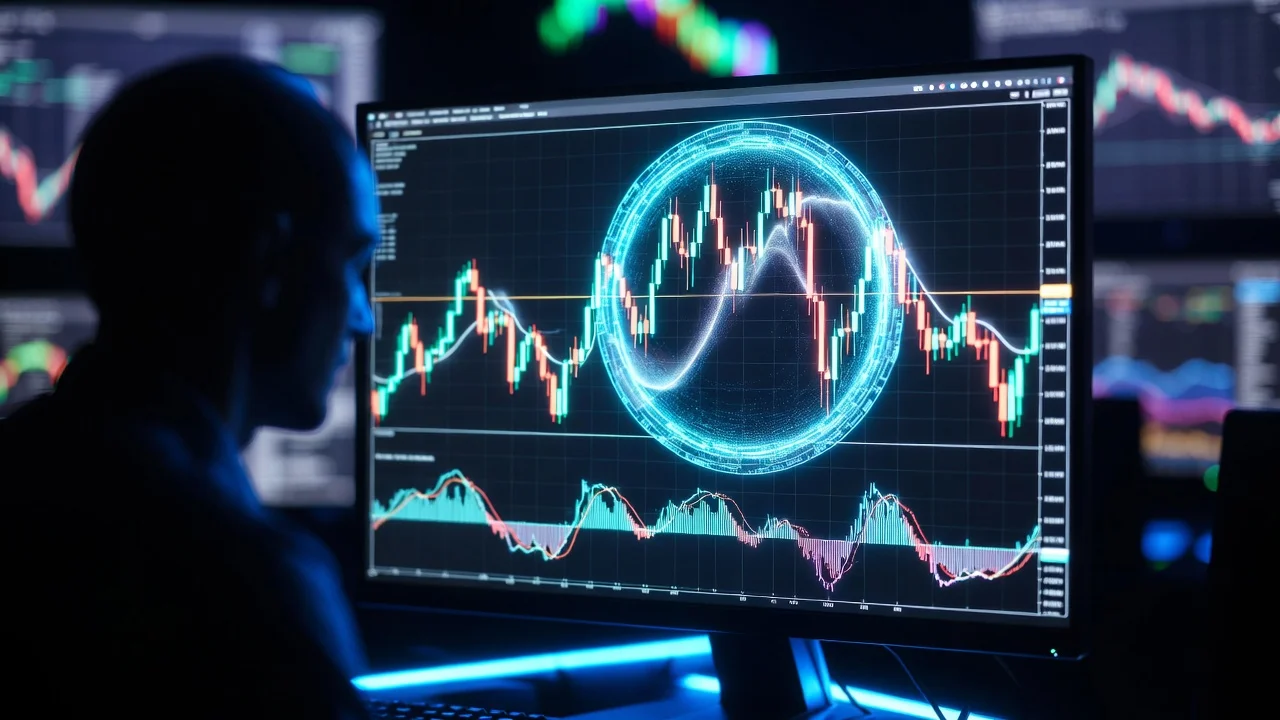
The Detrended Price Oscillator (DPO) is a technical indicator that removes long-term trends to highlight short-term price cycles. It compares a shifted Simple Moving Average (SMA) with past price data to isolate cyclical movements. The DPO oscillates around a zero line and is mainly used in cycle-based trading strategies such as Hurst analysis.
If the Hurst cycle is the blueprint, the Detrended Price Oscillator is the clear lens. Price cycles of all durations are formed and focused by using the Detrended Price Oscillator to eliminate long-term trends in price movements. The Detrended Price Oscillator helps traders identify shorter cycles, which are sometimes hidden.
The DPO's formula is simple but it is effective.
This is most commonly set to 20 or a number near where the cycle length is believed to reside. Essentially, DPO removes the main trend by detrending the price. DPO allows the user to capture the oscillatory price changes. This creates a very useful market timing tool for cycle-based methods.
The DPO is very different from momentum oscillators like the MACD or the RSI as they incorporate the trend. The DPO is solely based on cycles. The DPO oscillates around the centre line or neutral line. When the DPO is positive, it means the price is above the detrended average and this indicates that the market is overbought.
If the DPO is negative, it means the price is below the average and indicates the market is underbought. Therefore, prices crossing over the centre line is an important indicator to traders, as is the peak and the trough.
Following the example illustrated, a bullish market with a DPO just below the zero line means that the cycles have reached a low; this indicates a strong buy signal. On the other hand, when the DPO is just above the zero line, it means the cycles are about to pull back, signalling a sell. This is the reason the detrended price oscillators are incredibly efficient to use for cycle-based methods, in particular, working with Hurst cycle trading.
Combining Hurst Cycles and Detrended Price Oscillator
Now, what do these two create? How can they be used to create an advanced trading strategy? The strength comes from the DPO and how Hurst cycles can be validated and then timed. Hurst's method most often involves phasing, making the decision as to where you are within a cycle, but trends can distort this. The DPO acts as a filter, removing the trend to make it so that cycles can be seen more clearly.
Here is a cycle trading strategy using both of these methods.
1. Finding the most dominant cycles: Hurst’s methods (Fourier analysis, or other cycle analysis tools such as Sentient Trader or Market Cycle Analyzer) will allow you to find the lengths of the cycles of that asset. In equities, this is commonly seen at 20, 40, and 80 days.
2. Detrending: Input the cycle length that you suspect into the DPO. This will remove the trend and place the overbought and oversold areas within the cycle.
3. Phasing: With the DPO, attempt to chart out the phases of the cycles. If you find a place where a large number of cycles (short and long) are at the bottom or the top of the cycle, then you have a turning point that is very high in probability.
4. Long positions: can be taken when the DPO crosses at the zero level and is up and in the positive phase of the Hurst cycle, and a DPO reversal and down phase will trigger a short.
5. Risk Management: Use stops depending on cycle volatility. Use in conjunction with volume or other confirmations to prevent false signals.
This combination transforms Hurst cycle trading from a theoretical concept to a usable market timing indicator. It is seen being used most intelligently across all global affecting cycles; forex, commodities, and cryptocurrencies.

Practical Use and Examples
2020 was the pandemic crash and the S&P 500 experienced a whole lot of volatility. It was an excellent example to show the effectiveness of the advanced trading strategy. Hurst cycles at that time most notably could showcase the 4-year cycle that was bottoming out in March of 2020.
Multiple dominant bull run cycles before that time high masked a lot of those shorter bull cycles. When the detrended price oscillator is used with a setting of 20, there was an easily identifiable oversold trough, and thus a very clear bull entry point, leading many to profit from that.
Since the 2022 volatility spike was predominantly driven by geopolitical trends, many traders using classic Fibonacci retracements or Hurst cycles would have suffered from whipsaw stops. Conversely, those traders using Hurst cycles and a Detrended Price Oscillator (DPO) to identify 60-pip cycles within the daily dominant trends would have successfully captured all 60-pip cycles.
Bitcoin and altcoins have created an alternative playground for speculation. Bitcoin halvings create cycles every four years for trading, per Hurst. Hurst cycles can also be used in conjunction with the detrend periodic oscillators (DPO) to filter out transient moving averages and determine the best entry points to trade in Hurst cycle lows. During the bear market of 2022, DPO crossovers occurred within Hurst cycle troughs and presented entry signals just ahead of the 2023 market upturn.
Of course, no methodology can be considered perfect. The best practice with backtesting is to use TradingView to test this approach. The best practice is to incorporate and trade with fundamentals to strengthen your approach, given the influence economic news can have on your cycles.
Why Use This Method Over Current Indicators?
What is the benefit of this approach over using moving average current indicators and traditional cycle approaches? Current indicators are lagged and use averages based on the current price; Hurst cycle-based DPO is forward-looking. This gives the trader the ability to anticipate price movements and provides the trader with the market “timing” discretionary principle to trade on upcoming price movements without the market knowing the price movements are there.
This method using Hurst cycle trading has a greater high potential low drawdowns.
- Reduction of Lag: The cycle detrending process is based on the reduction of lag within the current cycle that is followed.
- Market Cycle Adjusted: Trading in small internals for day trade cycles and larger intervals for longer-term investment.
- High Winner Controlled Drawdown: Overall, in active channels, this methodology is based on active market cycles.
- Mathematical Definition: Analytical data support the use of this approach in advanced trading methodology.
This Advanced Trading Methodology approach should be considered from the outset. It is best to use practice accounts to start building your understanding based on one market asset to move forward.
Common Problems and How to Prevent Them
Although having a trading cycle strategy is useful, trading cycles offer a few pitfalls. Fitting cycles to the past can parallel with future failures, so always use out-of-sample testing. For the longer Hurst cycles, failing to consider them can cause big misses on turns. Use a multi-timeframe approach to avoid these misses.
In strong trending markets, the detrended price oscillator can give signal failures. You can reduce these failures through confirming with the volume or sentiment indicators. Lastly, cycles are a combination of the probability of the ultimate outcome. Therefore, Emotional Discipline is a necessity.
Tools & Resources to Get Started
Best of all, you can get started with the detrended price oscillators and cycle tools on TradingView, a free platform. For deeper Hurst cycle trading, you could use Hurst's original or modern adaptations. Automate cycle detection with MotiveWave or CycleTrader.

Conclusion
At its core, Hurst cycle trading and the detrended price oscillator are highly advanced trading strategies for those who want to easily improve their market timing. It is a duo that helps smart traders gain an advantage in all market conditions by revealing hidden cycles and detrending the noise. It can help you regardless of whether you are entering a position in cryptocurrency, forex, or stocks. This strategy, along with the market timing indicator, is likely the missing piece for you.

DISCLAIMER: This blog is NOT any buy or sell recommendation. No investment or trading advice is given. The content is purely for educational and information purposes only. Always consult your eligible financial advisor for investment-related decisions.


.webp)