The current silver market captivates investors and analysts across 2026 and demonstrates silver's volatility with prices increasing and decreasing rapidly. Many silver bull investors are asking if this year could be the year silver prices finally reach $500. Silver price prediction 2026 will analyse inflation and Robert Kiyosaki's extreme predictions will be considered and some will speculate on the extreme volatility. Here are the current silver price predictions, silver futures, and ultimately, the Peak Silver moment.
Recent Trends and Performance in the Silver Market
Silver prices are increasing, and from the impressive gains in 2025, surpassing an incredible 148% increase and a round $88 an ounce in 2026. Now, prices have pulled back from the $82-90 range around the start of February 2026 to remain floating. These prices now take into account the industrial demand's influence and some speculative trading.
The precious metals rally that started in 2024 has continued and strengthened through 2026. Silver outpaced gold in percentage gains, with gold prices exceeding $4,500 per ounce and silver hitting new rally highs. This was fuelled by demand outpacing supply, particularly in the industrial sector. There is also greater uncertainty in the global economy. Silver prices, along with gold, platinum, and palladium prices, are experiencing significant gains from previous highs.
There was a noticeable sell-off in silver prices late January 2026, with silver prices dropping over 30% in a matter of days after hitting $121. This was associated with profit-taking from previously established positions and the reduction of tariffs. There are signs of recovery as some people are still willing to invest in the global economic uncertainty.

Influences in the Silver Price Forecast for 2026
There are several core driving forces that influence the forecast of silver prices. Silver has a unique position in the commodity space due to its use as an industrial metal and its status as a safe-haven asset. This is why silver prices are influenced by several driving factors.
What Affects the Supply and Demand of Resources
According to the market, the demand for silver in 2026 will exceed 200 million ounces due to the constant scarcity of silver and industrial demand, which is about 60% of total demand for silver, exponentially increasing due to new technology and renewable energy sources in the EVs, and the electronics industry, which includes solar panels. Moreover, the demand for silver is expected to increase due to the rapid increase in industrial use.
Currently, the market for solar panels is growing due to the rapid use of renewable energy sources in industrial applications.
Over time, uncertainty and fear for the market tend to drive people to invest in ETFs and physical purchases in order to gain silver. Additionally, demand for silver is expected to increase with the weaker pound, lower interest rates, and fears of inflation.
Economic and Geopolitical Influences
The trends within the macro-economy play an important role when interest rates are lower, and non-yielding assets like silver tend to become more attractive. Expectations of inflation, changes in the value and circulation of money, and the actions of the Fed are direct determinants of the prices of silver. For the value of the pound, the price of silver is determined by confidence in the pound. Ultimately, trade and tariff wars with the pound are the reason for price increase predictions.
In times of war and disruption, the value of silver increases, and it is considered a highly safe investment, similar to gold. This is due to the disruptive nature of the silver supply and safe haven.
Ratio of Gold to Silver and How They Relate to Other Commodities
Due to being compressed, the gold-silver ratio eloquently states that if silver's historical norms prevail, further advancements may follow. Silver tends to follow gold, but is often amplified due to industrial exposure. Because of the correlated mining byproducts, it is reasonable to conclude that silver trades like copper and most other commodities.
When mining metals, regulatory control, and the advancements of technology wax and wane, the usage of silver in some instances drives the prices of silver up or down.

Silver Prices in 2026
The silver price forecast is the most unfathomable, being that it varies the most out of any precious metal, and is often conflated due to the regulators of the markets. Predictions are made by the analysts at the majority of the bigger institutions:
- Bank of America: Projected prices of silver will reach between $135 and $309/oz, in reference to the gold-silver ratio and the consistent losses.
- CoinCodex: Forecast of end of year $315.90, with potential highs of $351.31.
- Citigroup: Expected price of $100 by March and $110 by July due to shortages in the physical and the depletion of COMEX inventories.
- HSBC: Predicts $68.25 is the average due to the easing supply tightness.
- JP Morgan: Average of $81 but says there is industrial thrift to be had.
The overall ranges or base cases are $90-120. Bull markets or scenarios are expected to be from $170. After the 140% price increase or rally in 2026, a decrease or moderation is expected. Prices rally for structural supports.
Silver Futures Outlook: What the Markets Signal
The outlook for the silver futures market suggests that while there may be more volatility, there is likely to be more upside as well. Data from the CME Group shows silver futures pointing optimistically to the upside as a result of the market being out of balance between supply and demand. Investors have placed bets on prices being higher, as evidenced by the silver option markets, which could result in an increase in prices as a result of a gamma squeeze.
The silver futures market is overall in an overbought condition, which could result in short-term market corrections. Macquarie has recently moved the average in the 2026 forecast from $75 to $62, but this is entirely dependent on the Federal Reserve’s policies and industrial demand growth. Should the growth of industrial demand for silver expand as expected through Electric Vehicles (EVs) and solar futures, silver futures will be given additional upside.
Could Silver Reach 500 in 2026? Analyzing the Possibility
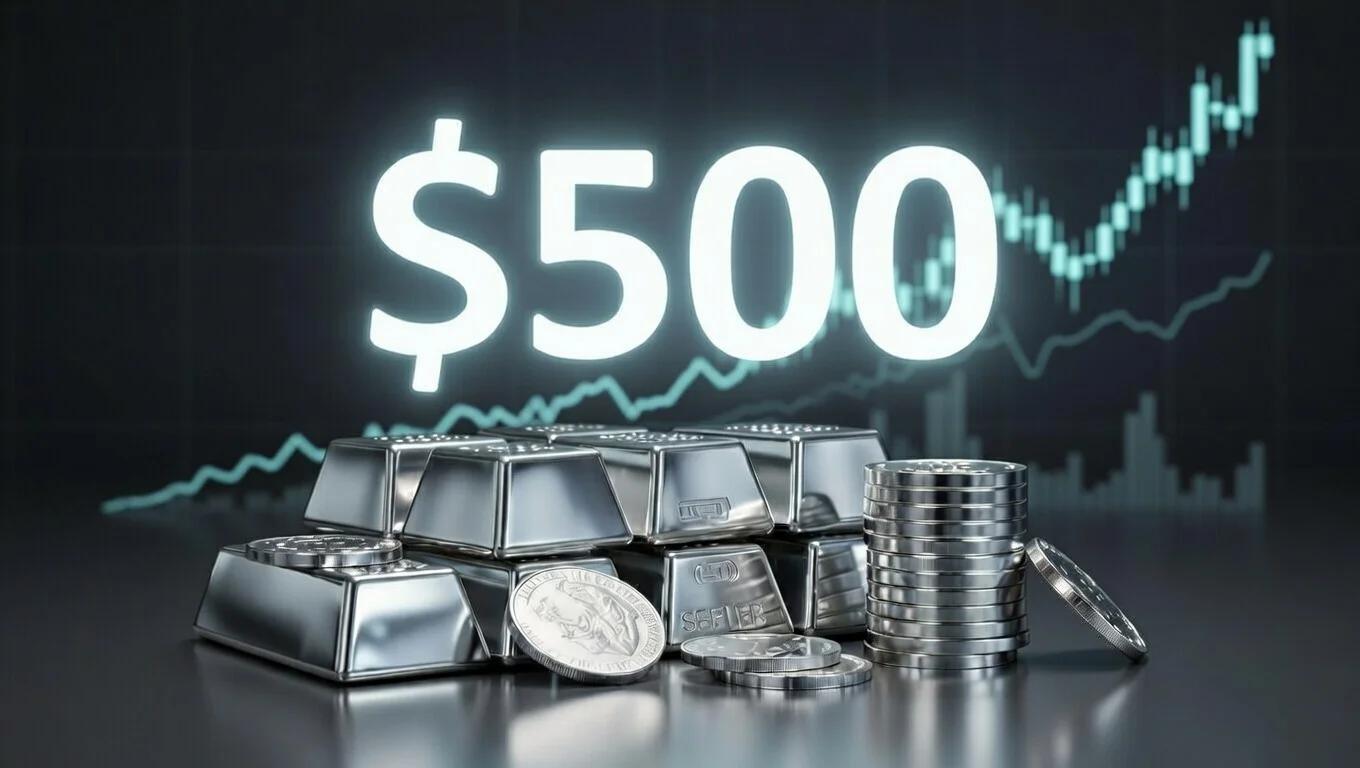
The most pressing question is, will silver reach $500? Most experts believe a positive answer to this question is highly unlikely without a set of extraordinary circumstances. Author Robert Kiyosaki estimates prices to be between $200 - $500 based on “FOMO mania” along with an eventual supply squeeze. In the range of $150 - $200, some YouTube analysts have stated this will be the case. However, $500 represents a greater than 500% increase from the current levels, which would be absolutely historic.
JP Morgan has placed a more skeptical viewpoint on the case for $500, saying that prices should crash back to $50, given the current highs are simply overvalued. Historical evidence exists that supports the view that extreme upward price movements are followed by a squeeze but price spikes from a squeeze event are equally followed by a price crash. In order for us to reach $500, extreme price movements based on a supply and demand forecast must occur, along with hyperinflation and a collapsing ratio to gold, which are far from the base forecast.
It's also possible that silver could price better than expected, especially if there is further instability regarding the world economy, and the dollar's position weakens. In fact, if it's stuck down at around $200, that may be justifiable enough.
Predictions for 2026
When it comes to silver, it is imperative to branch out. Because, whether it be silver physically, in exchange-traded funds, or in mining, there are multiple spots to consider. Although there is room for risk, especially regarding the economy and demand levels.
Even if the world was at an equal deficit, especially if the world was at an equal deficit, then there was a high chance that the economy would be subjected to an energy collapse.
|
Factor |
Bullish Impact |
Bearish Impact |
|
Industrial Demand |
High (Solar/EVs) |
Thrift/Substitution |
|
Economic Policy |
Low Rates/Inflation |
Strong USD |
|
Supply Deficits |
Persistent Shortages |
Increased Mining |
|
Geopolitics |
Safe-Haven Buying |
Resolution of Tensions |

Conclusion: Navigating the Silver Surge
To wrap up, silver's growth in 2026 appears to be positive, with forecasts estimating $100-$150 due to the precious metals rally. Although $500 is a stretch, the silver price prediction is still positive because of the solid fundamentals. If you are confident that silver will reach $500, you are looking at a future of extreme catalysts. The silver's story for 2026 is still developing, so keep looking as the market changes.

DISCLAIMER: This blog is NOT any buy or sell recommendation. No investment or trading advice is given. The content is purely for educational and information purposes only. Always consult your eligible financial advisor for investment-related decisions.