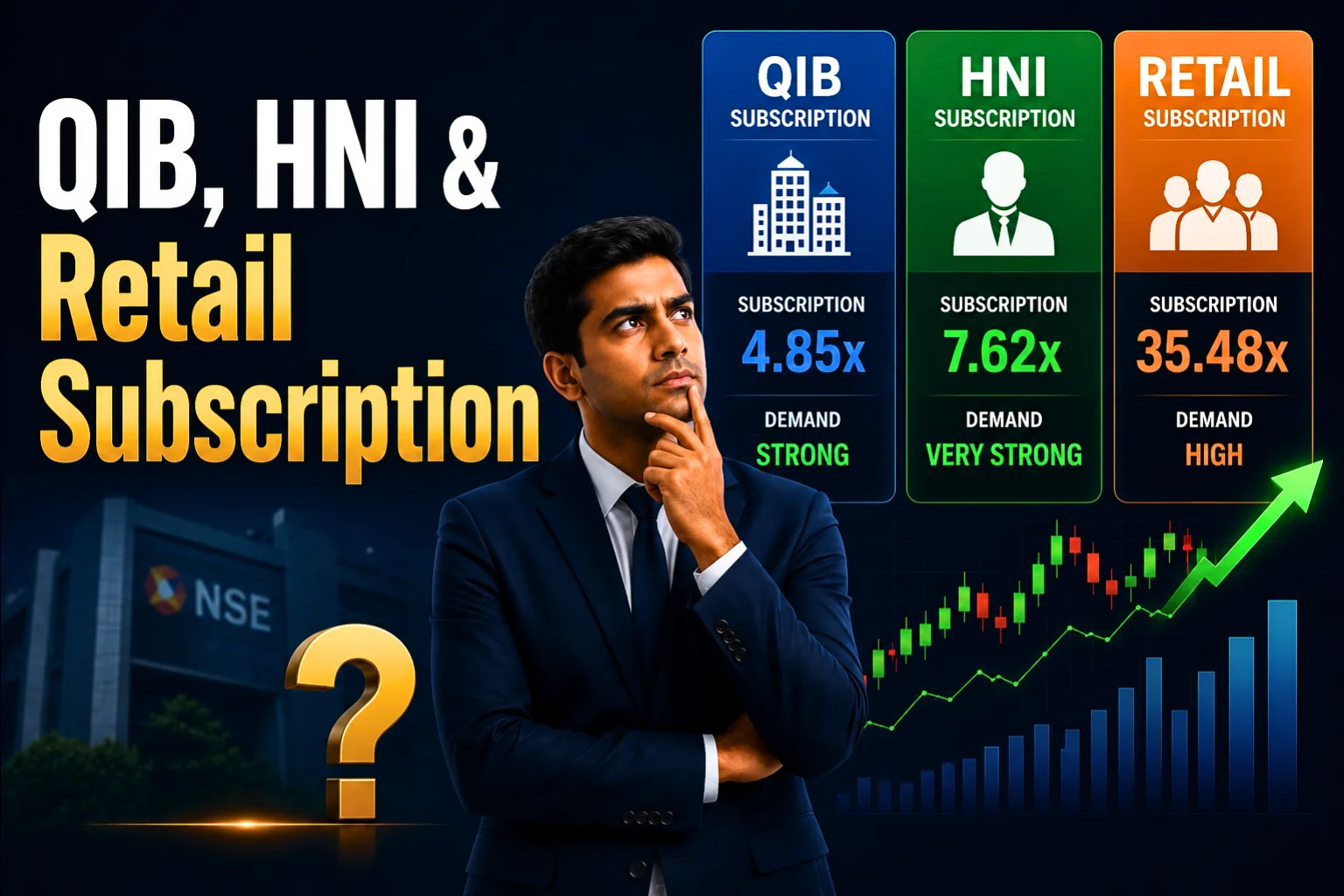
Strong QIB subscription trends are the most reliable signal for IPO success. Institutions (smart money) conduct deep due diligence before committing large sums. High institutional demand IPO often leads to better listing gains and long-term stability. While HNI and retail demand create excitement, they are secondary. Beginners should always check QIB numbers first.
Imagine you’re a first-time investor scrolling through your broker app. An IPO pops up with “Subscribed 100x!” headlines everywhere. Your heart races. This must be a multi-bagger, right? You apply eagerly, only to watch the stock list flat or even dip after a few weeks. What went wrong?
This is a story many new investors in India live through. The secret isn’t the total subscription figure — it’s who's subscribing. Today, we’ll explore the three key investor categories in Indian IPOs: QIBs, HNIs, and Retail investors. By the end, you’ll know exactly which IPO demand truly matters and how to make smarter decisions. No jargon, just clear insights for beginners.
Before comparing QIB, HNI, and retail demand, beginners should first understand IPO Subscription Status, IPO Price Band, and ASBA in IPO. These basics help investors know how IPO applications, bidding, and category-wise demand actually work.

The Three Players in Every IPO Story
Every IPO in India reserves shares for different investor groups:
- Retail Investors (Small Investor Demand): Every day, people like you and me apply for up to ₹2 lakh. We get about 35% reservation in book-built IPOs. Our retail participation brings energy and liquidity, but we often follow hype, news, or FOMO. Allotment is usually through lottery in oversubscribed issues.
- HNIs (High Networth Individuals): They apply above ₹2 lakh and fall under Non-Institutional Investors (NII, ~15% reservation). Many use leverage demand (borrowed funds) for bigger applications, chasing quick listing pops. HNI subscription analysis often shows short-term speculation.
- QIBs (Qualified Institutional Buyers): Big institutions like mutual funds, banks, insurance companies, and foreign portfolio investors. They get up to 50% reservation. These “smart money signals” do thorough research on financials, management, and growth potential before investing. The market closely watches the QIB subscription trend.
Real Case Studies: What the Numbers Reveal
Let’s look at actual examples from recent IPOs to see the difference.
Strong QIB Example – Bharat Coking Coal IPO (2026):
This PSU IPO saw massive institutional interest.
- QIB: ~310x
- HNI (NII): ~258x
- Retail: ~49x
- Total: ~147x
It is listed with ~96% gains. Strong institutional demand for IPO delivered excellent results.
Balanced but Solid – Lenskart IPO (2025):
- QIB: 40.35x
- HNI (NII): 18.23x
- Retail: 7.54x
- Total: 28.26x
Solid QIB backing helped despite moderate retail interest.
Warning Sign Example – Shree Ram Twistex:
- QIB: Only 3.94x
- HNI: 220x+
- Retail: 76x+
High hype from retail and HNI, but weak institutional support often leads to disappointing listings.
Comparison Table: Subscription vs Performance
Here’s a clear overview based on real patterns and studies:
|
IPO Type / Example |
QIB Subscription |
HNI Subscription |
Retail Subscription |
Listing Performance |
Key Insight |
|
Strong Institutional (Bharat Coking Coal) |
310x+ |
250x+ |
~49x |
~96% gains |
QIB leads to big pops |
|
Balanced Quality (Lenskart) |
40x |
18x |
7.5x |
Positive, stable |
Smart money confidence |
|
HNI/Retail Hype |
<5x |
200x+ |
50x+ |
Often flat or weak |
Speculation risk |
|
Average Strong Performer |
30-100x+ |
15-50x |
5-20x |
Better long-term stability |
QIB dominant |
(Data compiled from Chittorgarh, market reports, and analysis of 2025-2026 IPOs.)
Note: Analysis of hundreds of IPOs shows QIB subscription has one of the strongest correlations with listing gains (around 0.67+), higher than retail demand.
Investors should also check Grey Market Demand in IPO and IPO Valuation Explained to understand whether the IPO is fairly priced or only moving because of short-term hype.
Why QIB Subscription Trend Is the Real Signal
Institutions have research teams, access to management, and long-term horizons. A rising QIB subscription trend during the IPO period signals the issue is fairly priced with genuine potential. This “smart money” backing reduces risk and attracts more stable investors post-listing.
High net demand IPO, driven purely by retail or leveraged HNI, can create short-term buzz but often lead to volatility or corrections.
HNI Subscription Analysis: Power with Caution
HNIs bring significant firepower and leverage demand. Their interest can push overall numbers high, but they are often exit-oriented. HNI subscription analysis is useful for short-term momentum, but pair it with strong QIB numbers for better confidence.
Retail Participation: Your Role as a Small Investor
As a retail investor, your small investor demand and retail participation make the market democratic. High retail subscription analysis reflects public sentiment, but we tend to chase trends. The smartest strategy? Apply when the QIB interest is already strong.
Quick Decision Framework for Beginners
Use this simple table to evaluate any IPO:
|
Factor to Check |
Green Signal |
Red Signal |
Action |
|
QIB Subscription |
>20-30x and rising |
<5-10x |
Strong Buy filter |
|
HNI Subscription |
Moderate to high |
Extremely high (leverage) |
Check with QIB |
|
Retail Subscription |
Healthy but not extreme |
Extremely high alone |
Secondary |
|
Overall + GMP |
>30x total + positive GMP |
Low across the board |
Avoid or wait |
Tips to Read a Subscription Like a Pro
- Check live data on Day 2 and the final day (Chittorgarh or NSE/BSE).
- Prioritize QIB numbers.
- Combine with company fundamentals and Grey Market Premium (GMP).
- Don’t chase only total subscription.
- Start small and learn from each IPO.
After applying, knowing how to check IPO allotment status and how to modify or cancel IPO Application can help investors manage their IPO journey smoothly.
For deeper analysis, IPO Financial Metrics can also help evaluate revenue, profit, debt, margins, and overall company strength before making a decision.

Conclusion
While total subscription creates headlines, the QIB subscription trend and institutional demand IPO are what really matter for sustainable success. Next time you see an IPO, look beyond the hype — check who the smart money is backing. This approach turns IPO investing from gambling to a thoughtful strategy.
(Sources: Trendlyne, Groww, ICICI Direct, Moneycontrol, Livemint, Kotak Neo)

DISCLAIMER: This blog is NOT any buy or sell recommendation. No investment or trading advice is given. The content is only for educational purposes. Always discuss with your SEBI-registered financial advisor for investment-related decisions.

.webp)