Imagine you want to buy your first Bitcoin or Ethereum. You search for a crypto exchange and suddenly see two options:
One platform feels similar to a banking app — you create an account, deposit money, get customer support, and start trading.
The other connects directly to your wallet and gives you complete control over your funds — but also puts all responsibility in your hands.
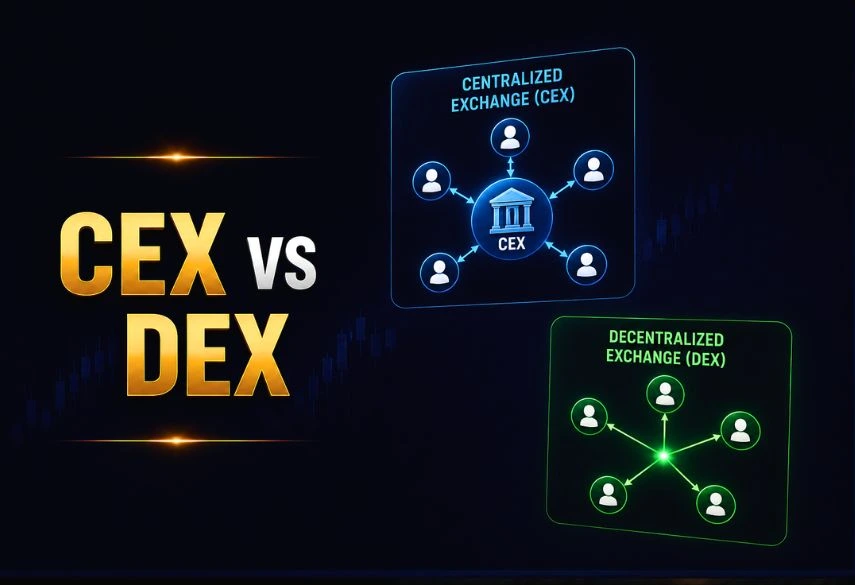
This is the core difference between a Centralized Exchange (CEX) and a Decentralized Exchange (DEX).
If you are new to crypto, choosing between these two can feel confusing. A CEX offers convenience and simplicity, while a DEX focuses on ownership, privacy, and decentralization.
In this guide, I’ll explain the CEX vs DEX difference, including fees, security, liquidity, advantages, risks, and which option may suit your goals.
CEX vs DEX — Which One Is Better?
There is no universal winner. A Centralized Exchange (CEX) is usually better if you:
- Are buying crypto for the first time
- Need fiat payments (bank/card deposits)
- Want customer support
- Prefer simple trading.
A Decentralized Exchange (DEX) may be better if you:
- Want complete control of your assets
- Prefer privacy
- Use DeFi applications
- Want access to newer tokens.
Many experienced crypto users combine both: using a CEX for convenience and a DEX for control.

What Is a Centralized Exchange (CEX)?
A Centralized Exchange (CEX) is a crypto trading platform operated by a company that manages transactions, user accounts, and custody of funds.
Examples include platforms like Binance, Coinbase, and Kraken.
When you use a CEX:
- You create an account
- Complete identity verification (KYC)
- Deposit money or crypto
- Trade through the exchange platform
The exchange manages your wallet keys and processes trades through its internal systems.
Think of it like a traditional stock brokerage. You do not manage the technical side — the platform handles it for you.
Why do people use CEXs?
Because they are easy. For beginners, buying crypto through a CEX feels familiar:
- Log in with email and password
- Connect a bank account
- Buy crypto instantly
- Contact support if something goes wrong.
This convenience is why centralized exchanges remain popular among new and experienced traders.
What Is a Decentralized Exchange (DEX)?
A Decentralized Exchange (DEX) allows users to trade cryptocurrencies directly through blockchain-based smart contracts.
Popular examples include Uniswap and PancakeSwap.
Unlike a CEX, a DEX does not hold your funds.
You connect your personal crypto wallet, approve transactions, and trades happen directly on the blockchain.
The basic idea is:
“Your keys, your crypto.”
You maintain ownership of your assets, but you also take responsibility for security.
CEX vs DEX: Key Differences Comparison
|
Feature |
Centralized Exchange (CEX) |
Decentralized Exchange (DEX) |
|
Control of funds |
Exchange controls custody |
User controls wallet |
|
Account required |
Yes |
Usually no |
|
KYC verification |
Usually required |
Usually not required |
|
Beginner friendly |
Very easy |
Requires crypto knowledge |
|
Fiat deposits |
Available |
Limited |
|
Liquidity |
Usually higher |
Depends on trading pair |
|
Privacy |
Lower |
Higher |
|
Customer support |
Available |
Limited |
|
Token availability |
Curated listings |
Wider token access |
|
Main risks |
Hacks, exchange failure |
Smart contract bugs, user mistakes |
CEX vs DEX Fees: Which Is Cheaper?
Fees depend on how you use the platform.
Centralized Exchange Fees
CEX platforms usually charge:
- Trading fees
- Withdrawal fees
- Deposit fees (sometimes).
The advantage is predictable pricing.
For example, if you regularly trade Bitcoin or Ethereum, a CEX often provides competitive costs because of high liquidity.
Decentralized Exchange Fees
DEX users usually pay:
- Swap fees
- Blockchain gas fees
- Slippage costs.
A trade may look cheap, but network congestion can increase costs.
For small trades, gas fees can sometimes become expensive.
CEX vs DEX Security: Which Is Safer?
Security depends on what type of risk you want to avoid.
CEX Security Risks
Because a CEX holds your funds, you face:
- Exchange hacks
- Company failure
- Account freezes
- Regulatory restrictions.
The biggest concern is trusting a third party with your assets.
DEX Security Risks
DEX platforms remove exchange custody risk, but introduce new challenges:
- Smart contract vulnerabilities
- Fake tokens
- Phishing attacks
- Losing your wallet recovery phrase
- Incorrect transactions.
With a DEX, you have more control — but fewer safety nets.
CEX vs DEX: Liquidity Difference
Liquidity means how easily you can buy or sell assets without affecting the price.
CEX Liquidity
Major centralized exchanges usually offer:
- Higher trading volume
- Faster transactions
- Lower price impact.
This makes CEX platforms attractive for professional traders.
DEX Liquidity
DEX liquidity depends on:
- Available liquidity pools
- Blockchain network
- Token popularity.
Large tokens may have strong liquidity, but smaller tokens can experience:
- Higher slippage
- Price fluctuations.
CEX vs DEX: Privacy and KYC
One of the major differences between CEXs and DEXs is how users interact with the platform.
Centralized exchanges commonly require users to create accounts and, depending on the jurisdiction and platform, complete identity verification.
A DEX generally allows users to interact through a blockchain wallet rather than creating a conventional exchange account.
However, DEX does not automatically mean anonymous.
Blockchain transactions can generally be viewed publicly, and wallet addresses can sometimes be linked to real-world identities through other information.
Therefore, it is more accurate to describe many DEX interactions as pseudonymous or wallet-based, rather than completely anonymous.
CEX vs DEX for Beginners: Which Should You Choose?
If you are entering crypto for the first time, a CEX is usually easier because you get:
- Simple interface
- Customer support
- Fiat purchase options
- Account recovery options
A DEX requires understanding:
- Wallet management
- Private keys
- Gas fees
- Blockchain transactions.
If you lose your wallet recovery phrase, nobody can reset it for you.
Advantages of Centralized Exchanges (CEX)
1. Easy for Beginners
CEX platforms provide a familiar experience similar to banking apps.
2. Better Liquidity
Large trading pairs usually have strong volume.
3. Fiat Support
You can often buy crypto directly using:
- Bank transfers
- Debit cards
- Payment methods.
4. Customer Support
If you face account issues, support teams can help.
Advantages of Decentralized Exchanges (DEX)
1. Full Ownership
You control your wallet and assets.
2. Better Privacy
Most DEX platforms do not require traditional account verification.
3. Access to More Tokens
New projects often appear on DEX platforms before major exchanges.
4. DeFi Integration
DEX platforms connect with:
- Lending platforms
- Yield farming
- Liquidity pools.
Real-Life Example: When Should You Use CEX or DEX?
Situation 1:
You are buying Bitcoin for the first time.
Better choice: CEX
Reason:
You need simplicity and fiat support.
Situation 2:
You already own crypto and want to explore DeFi.
Better choice: DEX
Reason:
You need wallet control and decentralized applications.
Situation 3:
You trade large amounts frequently.
Better choice: CEX
Reason:
Higher liquidity and advanced trading tools.
Situation 4:
You want access to new tokens.
Better choice: DEX
Reason:
DEX platforms often list emerging tokens earlier.
Should You Use Both CEX and DEX?
For many users, the best approach is a hybrid strategy. You can:
- Use a CEX to purchase crypto easily
- Move long-term holdings to your personal wallet
- Use a DEX for specific DeFi activities
This gives you a balance between:
- Convenience
- Security
- Control.

Conclusion
The choice between a centralized exchange and a decentralized exchange depends on what you value most. Choose a CEX if you want:
- Convenience
- Easy buying process
- Customer support
- High liquidity.
Choose a DEX if you want:
- Full ownership
- Privacy
- DeFi access
- More control
For most users, the smartest approach is not choosing one forever. Use a CEX when simplicity matters and a DEX when control matters. Understanding the difference between CEX and DEX helps you make better crypto decisions and avoid unnecessary risks.
(Sources: Wazirx, Binance, CoinMarketCap, CoinDesk, Bitcoin)

DISCLAIMER: This blog is NOT any buy or sell recommendation. No investment or trading advice is given. The content is only for educational purposes. Always discuss with your SEBI-registered financial advisor for investment-related decisions.












.webp)