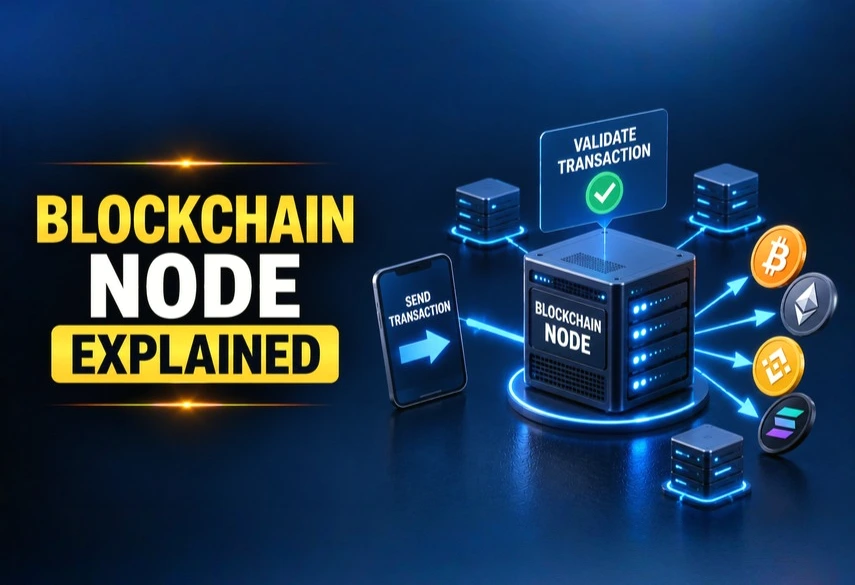
A node in a blockchain is a computer or device that connects to a blockchain network and runs software that follows the network’s rules. Depending on the type of node, it may store blockchain data, verify transactions and blocks, and share valid information with other nodes.
Blockchain nodes are essential because they allow thousands of independent computers to maintain and verify the same network without relying on a single company, bank, or central server.
In simple terms, nodes are the computers that help keep a blockchain running, synchronized, and trustworthy.
How Does a Blockchain Node Work?
Imagine a group of people who each maintain their own copy of the same financial notebook.
Whenever someone announces a new transaction, participants check whether it follows the agreed rules before updating their records. If someone submits an invalid transaction, participants following the rules reject it. Blockchain networks use a similar concept, but computers handle the process.
When you send cryptocurrency from a wallet, the transaction is typically broadcast to the network. Nodes receive the transaction and, depending on their role, check whether it follows the blockchain’s protocol rules.

For example, a validating node may check:
- Whether the transaction is correctly formatted
- Whether the required digital signatures are valid
- Whether the funds or spendable outputs exist
- Whether the transaction attempts to spend the same funds twice
- Whether other protocol-specific rules are satisfied
A valid transaction can then be relayed to other peers.
A miner on a Proof-of-Work network or a validator on a Proof-of-Stake network may later include transactions in a proposed block.
Other validating nodes independently check the block against the protocol rules. If the block is valid under the blockchain’s consensus rules, nodes can accept it as part of the blockchain state.
This ability to independently verify information is one of the foundations of decentralized blockchain networks.
Blockchain Node: Some Basics
|
Question |
Answer |
|
What is a blockchain node? |
A computer or device running blockchain software and connected to the network |
|
What does a node do? |
Stores, verifies, receives, and shares blockchain data depending on its type |
|
Does every node store the full blockchain? |
No, storage depends on the node type and configuration |
|
Can anyone run a blockchain node? |
On many public blockchains, yes |
|
Do all blockchain nodes earn rewards? |
No, ordinary full nodes usually do not earn protocol rewards |
|
Are nodes and validators the same? |
No, validators perform additional consensus-related functions on Proof-of-Stake networks |
What Does a Blockchain Node Do?
Although different blockchain nodes have different responsibilities, their main functions usually fall into four categories.
1. Validate Transactions and Blocks
Full validating nodes check transactions and blocks against the rules defined by the blockchain protocol. They do not simply trust data because another computer sent it. If information violates the protocol rules, a validating node can reject it.
2. Maintain Blockchain Data
Some nodes maintain a local copy of blockchain data. The amount of data stored varies significantly depending on whether the node is a full, pruned, light, or archive node.
3. Share Data With Other Nodes
Blockchain networks are generally peer-to-peer networks. Nodes communicate with peers to receive and relay transactions, blocks, and other network information. This communication helps keep the distributed network synchronized.
4. Provide Access to Blockchain Data
Nodes can also provide blockchain data to wallets, decentralized applications, developers, exchanges, block explorers, and other services.
For example, developers may connect applications to nodes through RPC interfaces to read blockchain data or submit transactions.
Types of Blockchain Nodes
Not every node performs the same work. The terminology also varies between blockchain protocols, but the following are some of the most common node categories.
1. Full Node
A full node independently checks blockchain data according to the network’s protocol rules. Full nodes provide users with a high level of independence because they do not have to rely entirely on a third party to tell them whether blockchain data is valid.
Depending on the blockchain and configuration, a full node may keep the complete historical blockchain or use pruning to remove some older data after verification. Full nodes are commonly used by:
- Developers
- Businesses
- Exchanges
- Infrastructure providers
- Privacy-focused users
- Blockchain enthusiasts
2. Light Node or Light Client
A light node, often called a light client, downloads and stores much less blockchain information than a full node.
Instead of independently storing and processing everything, light clients use limited blockchain data and cryptographic proofs or information supplied by full nodes, depending on the blockchain protocol.
This reduces hardware, bandwidth, and storage requirements. Light clients are useful for devices where resources are limited, such as mobile devices.
3. Archive Node
An archive node maintains significantly more historical blockchain state than a typical full node. Archive nodes are useful when an application needs detailed historical information that may no longer be maintained by a normal pruned or standard node.
They are commonly used by:
- Blockchain explorers
- Analytics companies
- Researchers
- Infrastructure providers
- Developers who need historical state data
Because of the additional data, archive nodes usually require considerably more storage.
4. Mining Node
A mining node participates in Proof-of-Work (PoW) blockchain mining. Mining involves attempting to create a valid new block under the network’s Proof-of-Work rules.
Bitcoin is the best-known example of a major Proof-of-Work blockchain. A miner and a full node should not automatically be treated as identical concepts.
A full node's core responsibility is independently enforcing network rules, while mining is related to proposing new blocks through Proof of Work.
5. Validator Node
Validator functionality exists on Proof-of-Stake (PoS) networks. Validators participate in the blockchain’s consensus process, such as proposing or attesting to blocks, according to the specific protocol.
Ethereum, for example, uses Proof of Stake.
Running a normal Ethereum node does not automatically mean that the operator is acting as a validator. Validator software and the appropriate staking requirements are needed to participate as a validator.
Full Node vs Light Node
The difference between a full node and a light node is important for understanding blockchain infrastructure.
|
Feature |
Full Node |
Light Node |
|
Independent validation |
High |
Limited compared with a full node |
|
Blockchain data stored |
More blockchain data |
Much less blockchain data |
|
Storage requirements |
Higher |
Lower |
|
Bandwidth requirements |
Higher |
Lower |
|
Reliance on other nodes |
Lower |
Higher |
|
Suitable for mobile devices |
Usually less practical |
More practical |
|
Security and independence |
Higher |
Lower than a full node |
|
Best for |
Developers, infrastructure providers, businesses, advanced users |
Mobile wallets and lightweight applications |
A full node provides greater independence because it can enforce blockchain rules itself. A light client reduces resource requirements by relying on a smaller amount of local data and information or proofs obtained from other network participants. The exact implementation depends on the blockchain.
Blockchain Node vs Miner vs Validator
A node, miner, and validator are related concepts, but they should not be used interchangeably.
|
Role |
Main Function |
Consensus Type |
Usually Earns Protocol Rewards? |
|
Full Node |
Independently validates blockchain data and protocol rules |
Various |
No |
|
Light Node |
Provides lightweight access to blockchain data |
Various |
No |
|
Miner |
Participates in producing blocks through computational work |
Proof of Work |
Yes |
|
Validator |
Participates in proposing or attesting to blocks |
Proof of Stake |
Yes, depending on the protocol |
|
Archive Node |
Stores extensive historical blockchain state |
Various |
Usually no |
The easiest way to understand the difference is:
Nodes verify and communicate blockchain data. Miners or validators participate in the mechanism used to produce or confirm new blocks. The precise responsibilities vary between networks.
Why Are Blockchain Nodes Important?
Blockchain nodes are essential to several properties associated with public blockchain networks.
Decentralization
If a blockchain depended on one central server, that server would become a single point of control and failure.
Distributed nodes allow blockchain data and rule enforcement to exist across many independent computers.
Independent Verification
A user running a full validating node can verify blockchain rules independently instead of relying entirely on a third-party service.
This is one reason people describe public blockchains as systems designed to reduce the need for trusted intermediaries.
Network Resilience
A distributed network does not normally stop functioning simply because one node disconnects. Other nodes can continue communicating and processing network information.
When an offline node reconnects, it can synchronize with its peers and catch up with the current blockchain state.
Censorship Resistance
A geographically and operationally diverse network of independent nodes makes it more difficult for one organization or infrastructure provider to control access to the entire network.
Data Availability
Nodes make blockchain information available to wallets, applications, exchanges, explorers, developers, and other network participants.
Example: How Bitcoin Nodes Work
Bitcoin full nodes run software that independently verifies Bitcoin transactions and blocks against Bitcoin’s consensus rules.
When a Bitcoin full node receives a transaction, it can check whether the transaction satisfies the rules required by the protocol. Full nodes can also receive blocks, validate them, and relay valid blockchain information to other peers.
Bitcoin miners perform a different function: they use Proof of Work to compete to produce new blocks. A Bitcoin user can therefore run a full node without becoming a miner.
Example: How Ethereum Nodes Work
Ethereum uses a different architecture. A modern Ethereum node uses both an execution client and a consensus client. The execution client handles tasks such as transaction execution and maintaining Ethereum's execution state. The consensus client follows Ethereum's Proof-of-Stake consensus layer.
An operator who wants to participate directly as an Ethereum validator also uses validator software and must meet the network's staking and protocol requirements. This example demonstrates why the term “blockchain node” cannot be applied identically to every blockchain.
Different networks can have different client architectures, consensus mechanisms, and node responsibilities.

Can Anyone Run a Blockchain Node?
On many public blockchain networks, ordinary users can run nodes. However, the requirements depend on the blockchain and the type of node.
You may need:
- A compatible computer or server
- Sufficient storage
- Enough RAM
- A stable internet connection
- Adequate bandwidth
- Official or trusted node software
- Time for the initial synchronization process
- Regular software and security updates
A light client usually requires fewer computing resources than a full or archive node. Before running a node, always check the latest official documentation for the specific blockchain because hardware, storage, software, and network requirements can change.
How to Run a Blockchain Node
The exact process differs between blockchains, but the general workflow is usually similar.
Step 1: Choose the Blockchain
First, decide which blockchain you want to support or access.
For example:
- Bitcoin
- Ethereum
- Solana
- Another public blockchain
Each network has different software and requirements.
Step 2: Review Official Requirements
Check the blockchain project's official documentation for:
- Supported operating systems
- CPU requirements
- RAM
- Storage
- Internet bandwidth
- Port requirements
- Security recommendations
Avoid relying on outdated third-party hardware requirements.
Step 3: Install the Appropriate Client
Download the recommended client software from an official or trusted source. Using unofficial or modified node software without verification can create security risks.
Step 4: Synchronize the Node
The node needs to synchronize with the blockchain network. Depending on the blockchain, node type, connection speed, hardware, and synchronization method, this process can require substantial time and bandwidth.
Step 5: Maintain and Secure the Node
Node software should be kept updated. Operators should also monitor:
- Disk space
- Internet connectivity
- Client updates
- System security
- Backups where appropriate
- Network configuration
Running a node is not simply a one-time installation; it requires ongoing maintenance.
Do Blockchain Nodes Make Money?
Not all blockchain nodes earn money. A standard full node usually does not receive protocol rewards simply for storing, validating, and relaying blockchain information. However, some network roles can earn rewards.
What Happens When a Blockchain Node Goes Offline?
If one node goes offline, the overall blockchain network can normally continue operating through other connected nodes. The offline node simply stops receiving new blockchain information.
Once it reconnects, it can communicate with peers, obtain the data it missed, verify the necessary information, and synchronize with the latest valid blockchain state.
This is an important advantage of distributed network architecture: the network does not depend on every individual node remaining online at all times.
Are All Blockchain Nodes the Same?
No. Bitcoin, Ethereum, Solana, and other blockchain networks use different:
- Consensus mechanisms
- Client software
- Hardware requirements
- Storage models
- Networking systems
- Validation rules
- Node roles
The general idea remains similar: nodes are computers participating in a blockchain network. However, you should always refer to the documentation of a specific blockchain before making assumptions about how its nodes operate.

Conclusion
A blockchain node is a computer or device running blockchain software that communicates with other network participants. Depending on its role, a node can validate transactions and blocks, maintain blockchain data, relay information, and provide access to the network.
Full nodes are especially important because they independently enforce blockchain protocol rules. Light clients provide a less resource-intensive way to interact with blockchain networks, while miners and validators perform additional consensus-related roles.
Understanding these differences makes blockchain technology much easier to understand. A blockchain is not simply a database stored in one location. It is a distributed network in which independent computers communicate, verify information according to common rules, and maintain a shared view of blockchain data.
(Sources: Yahoo Finance, CoinMarketCap, Forbes, Maketo)

DISCLAIMER: This blog is NOT any buy or sell recommendation. No investment or trading advice is given. The content is only for educational purposes. Always discuss with your SEBI-registered financial advisor for investment-related decisions.