Investing in an initial public offering (IPO) can be an exciting opportunity. Early investors often hope to benefit from the growth of companies entering the public market. However, IPO investments also carry significant risks that many investors underestimate.
A company may have strong growth potential, an attractive business model, and high market demand. Yet, its stock price can still decline due to broader industry issues, shifting investor sentiment, economic conditions, or valuation concerns.
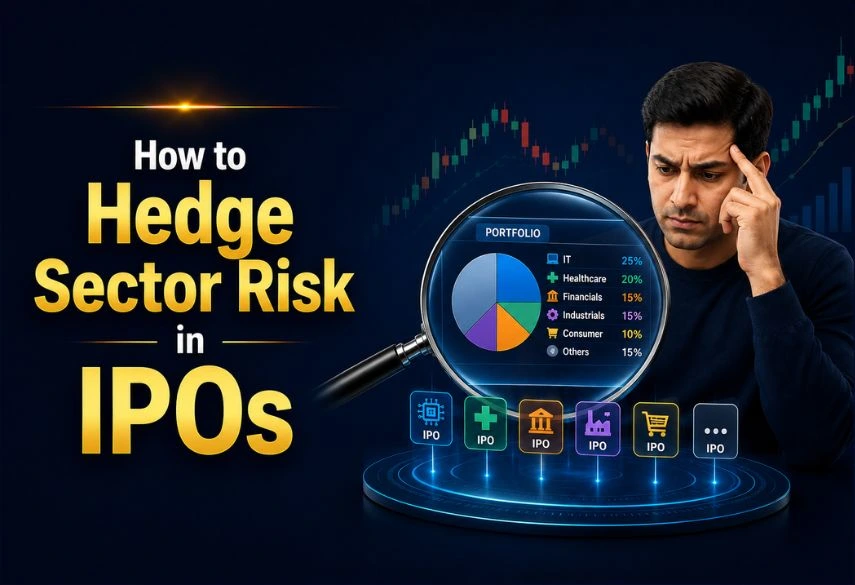
One of the biggest hidden risks for IPO investors is sector concentration risk. Investors often buy multiple companies from the same industry thinking they are diversified. However, if those companies are exposed to the same economic factors, they can all decline together during a sector downturn.
For example, an investor who buys several technology IPOs may believe they own different opportunities. But if interest rates rise or technology valuations fall, those investments may all experience pressure at the same time.
This is why learning how to hedge IPO risk is important. Hedging does not mean avoiding IPO investments. It means creating a strategy that protects capital while still allowing investors to participate in potential growth opportunities.
Understanding IPO Risk and Why It Matters
An IPO represents the transition of a private company into a publicly traded company. During this period, investors are often dealing with limited information compared with established public companies.

Newly listed companies usually have:
- Less historical trading data
- Limited analyst coverage
- Greater price volatility
- Uncertain market valuation
- Strong reactions to news and sentiment
Unlike mature companies with years of financial history, IPO stocks often experience large price movements as the market determines their true value.
A successful IPO investment strategy requires investors to evaluate both the opportunity and the risk. Many investors focus only on company growth potential but overlook questions such as:
- How much of my portfolio is exposed to this sector?
- What happens if the entire industry declines?
- How can I reduce losses without selling my position?
These questions form the foundation of IPO risk management.
The Hidden Problem: Sector Concentration Risk in IPO Investing
Diversification is one of the most important principles of investing. However, diversification is not simply about owning multiple stocks. True diversification means owning assets that do not all respond to the same market forces.
Consider an investor who owns IPO shares from several companies in:
- Artificial intelligence
- Semiconductor technology
- Cloud software
Although these are different businesses, they may all depend on similar factors such as technology spending, interest rates, and investor confidence.
- If the technology sector faces a downturn, all positions may decline together.
- This situation is known as sector concentration risk.
- For IPO investors, this risk can become especially dangerous because newly listed companies are often already experiencing high volatility.
- Managing sector exposure is therefore one of the most important parts of protecting an IPO portfolio.
How to Hedge IPO Risk Effectively
There is no single hedging strategy that works for every investor. The right approach depends on portfolio size, investment goals, risk tolerance, and the level of protection required.
The most common methods include options strategies, sector hedges, and broader portfolio diversification.
Protective Put Options: Direct Protection Against IPO Losses
A protective put is one of the most common strategies used to protect a stock position. The strategy involves owning IPO shares and purchasing a put option on the same stock. The put option gives the investor the right to sell shares at a predetermined price.
If the IPO price declines, the value of the put option may increase, helping reduce the impact of the loss.
For example, an investor buys IPO shares at $100 and purchases a put option that allows selling at $90. If the stock falls significantly below $90, the put option provides downside protection.
The advantage of protective puts is that investors can continue benefiting if the stock price increases.
The disadvantage is that buying options requires paying a premium, which reduces overall returns if the protection is not needed.
Protective puts are generally useful when investors believe in a company's long-term potential but want protection against short-term volatility.
Collar Strategy: Reducing Hedging Costs
A collar strategy combines two option positions:
- An investor buys a protective put while selling a covered call against the same stock.
- The premium received from selling the call can help offset the cost of buying the put.
- This creates a balance between protection and cost.
- A collar strategy can be useful for investors who have significant exposure to an IPO stock and want to protect against a major decline without completely exiting their position.
However, the trade-off is that the investor gives up some upside potential because the sold call limits gains beyond a certain price. This strategy is commonly considered by investors holding concentrated positions, including company employees or early investors after an IPO listing.
Using Sector ETFs to Hedge Industry Risk
Sometimes the biggest risk is not the individual company but the entire industry.
-
In such situations, investors may consider using sector-based exchange-traded funds (ETFs) to manage broader exposure.
For example, if an investor owns a technology IPO, the concern may not only be company performance but also a possible decline across the technology sector.
- A sector hedge aims to reduce the impact of industry-wide movements.
- Unlike stock-specific options, sector ETFs focus on broader market trends. This makes them useful for investors who want protection against an entire industry downturn.
However, sector hedges are not perfect because the IPO company may perform differently from the overall sector.
Portfolio Diversification: The Simplest IPO Risk Management Strategy
- Not every investor needs complex derivatives to manage IPO risk.
- One of the most effective strategies is building a properly diversified portfolio.
- After investing in an IPO, investors should evaluate whether they have excessive exposure to the same industry.
- A balanced portfolio may include exposure to different sectors, asset classes, and geographic markets.
- Diversification does not eliminate losses, but it reduces the chance that one company or industry can significantly damage the entire portfolio.
- For many long-term investors, diversification remains the most practical IPO risk management tool.
Managing IPO Position Size
- Many IPO losses happen because investors allocate too much capital to a single opportunity.
- Excitement around a popular IPO can lead investors to ignore risk limits.
- Before investing, investors should decide how much of their total portfolio they are comfortable allocating to one IPO.
Position size should consider:
- Investment goals
- Risk tolerance
- Existing sector exposure
- Overall financial situation
A strong company can still become a poor investment if the position size is too large.
Understanding Lock-Up Period Risks
- IPO investors should also understand lock-up periods.
- A lock-up period prevents company insiders and early investors from selling shares immediately after the IPO.
- When the lock-up period expires, additional shares may enter the market.
- This increase in supply can create selling pressure and affect the stock price.
Investors should monitor:
- Lock-up expiration dates
- Insider selling activity
- Trading volume changes
- Market sentiment
Understanding these events can help investors make better risk management decisions.
Comparing IPO Hedging Strategies
|
Strategy |
Main Purpose |
Best For |
|
Protective Put |
Protect against large price declines |
Investors wanting direct downside protection |
|
Collar Strategy |
Reduce hedge cost while limiting downside |
Long-term concentrated investors |
|
Sector ETF Hedge |
Protect against industry weakness |
Investors exposed to one sector |
|
Diversification |
Reduce overall portfolio concentration |
Most investors |
|
Portfolio Hedging |
Manage broader market risk |
Large portfolios |
Common Mistakes When Hedging IPO Investments
Waiting Until Problems Appear
- Many investors think about hedging only after a stock has already declined.
- However, protection is usually more effective when planned before major market events.
Over-Hedging
- A hedge should reduce unwanted risk, not completely remove investment opportunity.
- Too much protection can reduce potential returns.
Ignoring Costs
Every hedging strategy has costs. Investors should consider:
- Option premiums
- Trading expenses
- Tax implications
- Reduced upside potential
Focusing Only on the Company
- A strong company can still experience stock price declines because of broader market or industry problems.
- Successful IPO investing requires understanding both company-specific and sector-level risks.
A Practical IPO Risk Management Framework
Before investing in any IPO, investors should evaluate three areas.
- First, understand the company itself. Review its business model, financial performance, competitive position, and valuation.
- Second, analyze portfolio exposure. Determine whether the investment creates excessive concentration in one industry.
- Third, decide whether additional protection is needed through options, ETFs, or diversification.
- The goal is not to remove all uncertainty. No investment strategy can eliminate risk completely.
- The goal is to create a portfolio that can handle market changes without experiencing unnecessary damage.

Conclusion
IPO investing offers exciting opportunities, but successful investors understand that opportunity and risk always exist together. The most effective approach is not simply finding promising companies. It is building a strategy that protects capital when markets become unpredictable.
By combining thoughtful position sizing, diversification, options strategies, sector management, and ongoing portfolio review, investors can participate in IPO growth opportunities while reducing unnecessary exposure.
A strong IPO strategy is not about predicting the future. It is about being prepared for different outcomes.
(Sources: Business Insider, Smart Delta India, OMPNT)

DISCLAIMER: This blog is NOT any buy or sell recommendation. No investment or trading advice is given. The content is only for educational purposes. Always discuss with your SEBI-registered financial advisor for investment-related decisions.