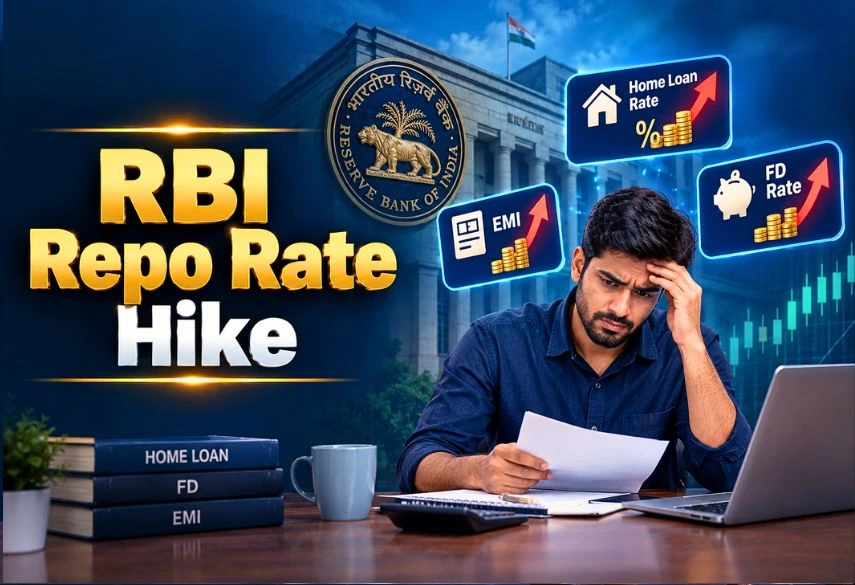
The Reserve Bank of India (RBI) has increased the repo rate by 25 basis points, taking it from 5.25% to 5.50% in its October 2026 Monetary Policy Committee (MPC) meeting. This is the first repo rate increase in nearly four years and marks a shift towards a tighter monetary policy approach.
The RBI’s decision is expected to directly impact borrowers with floating-rate loans. Home loan EMIs, personal loan interest rates, and vehicle loan costs may increase as banks adjust their lending rates. At the same time, depositors may benefit from higher interest rates on new fixed deposits as banks compete for funds.
For most borrowers, the impact will not appear immediately because floating-rate loans are generally revised on scheduled reset dates. However, over the next few months, customers may see changes in their monthly repayments or loan tenure.
What Is the RBI Repo Rate and Why Does It Matter?
The repo rate is the interest rate at which the Reserve Bank of India lends short-term money to commercial banks. It is one of the most important tools used by the RBI to control inflation and maintain economic stability.
When the RBI increases the repo rate, borrowing money becomes more expensive for banks. Banks may then increase lending rates on products such as home loans, personal loans, and business loans.

A repo rate hike generally works in this way:
Higher Repo Rate → Higher Bank Borrowing Cost → Higher Loan Interest Rates → Increased EMI or Longer Loan Tenure.
However, higher interest rates can also benefit savers because banks may increase fixed deposit rates to attract more deposits.
Why Did RBI Increase the Repo Rate to 5.50%?
The RBI’s decision was mainly driven by concerns around inflation and changing economic conditions. Rising crude oil prices, global uncertainty, and supply-side challenges have increased inflation risks.
At the same time, India’s economic growth remains strong. The RBI has maintained a balance between supporting growth and preventing inflation from becoming a bigger challenge.
A calibrated tightening approach means the central bank is taking measured steps instead of aggressively increasing rates. Future decisions will depend on inflation trends, economic growth, and global conditions.
Home Loan EMI Impact After RBI Repo Rate Hike
Home loan borrowers are likely to feel the biggest impact of this rate increase. Most new floating-rate home loans are linked to external benchmarks such as the repo rate. When the benchmark rate rises, banks may revise lending rates for existing borrowers after the next reset cycle.
The actual increase in EMI depends on:
-
Outstanding loan amount
-
Remaining repayment tenure
-
Current interest rate
-
Bank’s rate reset policy.
Borrowers should check their loan agreement or contact their bank to understand when the revised interest rate will apply.
How Much Will EMI Increase on a ₹50 Lakh Home Loan?
Assuming a full 25 basis point increase is passed on by the bank, a borrower may see a moderate rise in monthly EMI.
Example calculation:
|
Loan Amount |
Approximate EMI Increase |
|
₹30 lakh |
Around ₹500 per month |
|
₹40 lakh |
Around ₹650 per month |
|
₹50 lakh |
Around ₹800 per month |
For a ₹50 lakh home loan with a long repayment period, even a small interest rate increase can add a significant amount to the total interest paid over the loan tenure. Borrowers should remember that banks may not always increase the EMI. Some lenders adjust the repayment schedule by increasing the loan tenure while keeping the EMI almost unchanged.
Should You Increase EMI or Extend Loan Tenure?
After an interest rate hike, borrowers usually have two choices. Increasing EMI allows you to repay the loan faster and reduces the additional interest burden. However, it can affect your monthly budget.
Extending the loan tenure keeps the EMI manageable but increases the total interest paid because the borrower remains in debt for a longer period. If your income allows, maintaining the original tenure and paying a slightly higher EMI can be financially beneficial.
Impact on Personal Loans and Auto Loans
The repo rate hike is not limited to home loans. Personal loans, car loans, and other floating-rate borrowing products may also become more expensive. Personal loans usually have shorter repayment periods, so the monthly impact may not be as large as home loans. However, new borrowers may receive higher interest rate offers compared to earlier months.
For vehicle buyers, higher interest rates can increase the overall cost of financing a car or two-wheeler purchase. Existing borrowers should check whether their loan is linked to a floating benchmark or fixed interest rate.
FD Interest Rates After RBI Repo Rate Hike
The rate hike brings some positive news for fixed deposit investors. Banks often increase FD rates when interest rates rise because they need more deposits to support lending activities. New FD customers and people renewing matured deposits may get better returns.
However, existing fixed deposits will continue earning the interest rate agreed at the time of investment until maturity. For example, if a bank increases FD rates by 0.25%, a ₹10 lakh deposit may earn approximately ₹2,500 more annually before taxes. The actual benefit depends on the bank’s revised FD rates and investment duration.
Should You Invest in Fixed Deposits Now?
Investors looking for stable returns may consider comparing FD rates across banks before locking their money. Short-term investors should check whether rates are expected to rise further before choosing long-term deposits.
For conservative investors, higher FD rates can improve returns without taking market risks. However, taxation and inflation should also be considered before making investment decisions.
Use an FD calculator to calculate FD returns.
What Should Home Loan Borrowers Do After RBI Repo Rate Hike?
A repo rate increase does not require panic. Borrowers can take practical steps to reduce the impact. First, check your loan reset date and understand when your revised interest rate will apply. Knowing the timeline helps you plan your monthly budget.
If you have additional savings, partial loan prepayment can reduce your outstanding principal and lower the total interest burden. However, maintain an emergency fund before making large prepayments.
Borrowers can also compare refinancing options if another lender offers significantly lower interest rates.
What Should Investors and FD Holders Do?
Investors should compare FD rates from different banks instead of automatically renewing existing deposits. A higher interest rate environment may provide opportunities to lock money at better returns. However, investors should choose deposit periods based on their financial goals and liquidity requirements.
Avoid investing all available funds in long-term deposits if you may need money for emergencies.
RBI Repo Rate 5.50%: What Happens Next?
The RBI’s future decisions will depend on inflation trends, economic growth, and global market conditions. If inflation remains under pressure, further rate increases cannot be ruled out. However, if inflation improves, the central bank may maintain the current rate level.
For households, the impact of this repo rate hike will likely be gradual. Borrowers may experience slightly higher EMIs, while savers may benefit from improved FD returns. The key is to review your loans and investments regularly instead of reacting emotionally to every policy change.

Conclusion
The RBI repo rate hike to 5.50% marks an important change in India’s interest rate cycle. Home loan borrowers may face higher EMIs or longer repayment periods, while FD investors may see better returns on new deposits.
The best approach is to stay informed, review your financial commitments, and make calculated decisions. A small adjustment today can help reduce the long-term impact of higher interest rates.

DISCLAIMER: This blog is NOT any buy or sell recommendation. No investment or trading advice is given. The content is only for educational purposes. Always discuss with your SEBI-registered financial advisor for investment-related decisions.