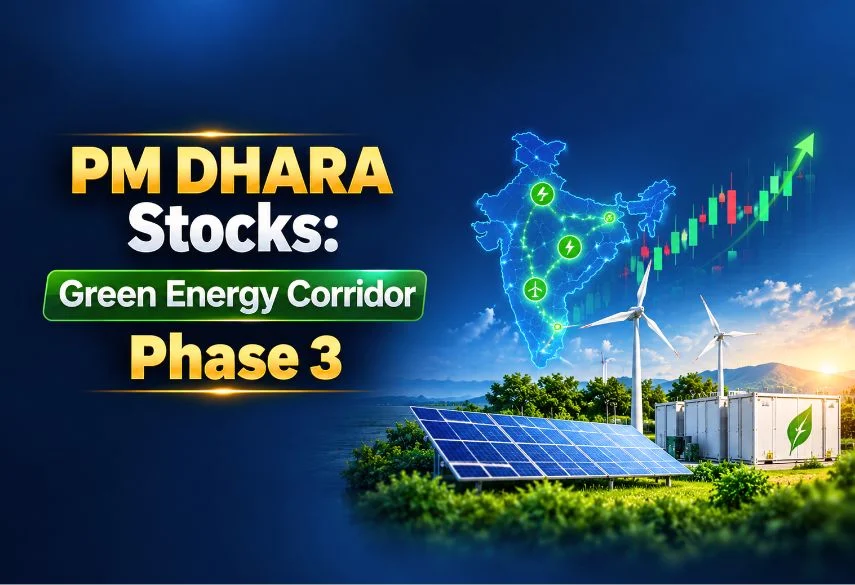
India's ₹1.86 lakh crore Green Energy Corridor Phase III, also known as the PM DHARA scheme, could create a multi-year opportunity for companies involved in power transmission, transformers, high-voltage equipment, cables, and battery energy storage.
The Union Cabinet approved Green Energy Corridor Phase III (GEC-III) on September 30, 2026. The scheme is designed to strengthen India's intra-state transmission network so that up to 135 GW of renewable energy can be integrated into the grid. It also provides for 50 GWh of Battery Energy Storage Systems (BESS), making storage a major part of the programme for the first time.
For investors tracking PM DHARA stocks, Green Energy Corridor stocks and GEC-III beneficiary companies, the key point is that not every company will benefit in the same way. Transmission developers and electrical-equipment manufacturers may have more direct exposure to project spending, while renewable energy companies could benefit indirectly from better grid connectivity and lower power-curtailment risk.

What Is the PM DHARA or Green Energy Corridor Phase III Scheme?
Green Energy Corridor Phase III is a large grid-infrastructure programme aimed at preparing India's electricity network for the next phase of renewable-energy growth.
Renewable power generation is expanding rapidly, but adding solar and wind capacity alone is not enough. Electricity generated in renewable-rich regions must be transported efficiently to areas where demand exists. Grid congestion can otherwise result in renewable power being curtailed or underutilised.
GEC-III seeks to solve this problem by strengthening intra-state transmission systems across states and Union Territories.
The total project outlay is ₹1,86,405 crore. Of this, ₹1,36,378 crore has been allocated to the development of intra-state transmission systems, while ₹50,000 crore has been earmarked for 50 GWh of Battery Energy Storage Systems.
The programme is targeted for completion by FY 2032-33. This makes PM DHARA more than a short-term policy announcement. As individual projects move from planning to tendering and execution, the scheme could translate into orders for transmission developers, EPC contractors, transformer manufacturers, high-voltage equipment suppliers, cable companies and storage-system providers.
PM DHARA Beneficiary Stocks at a Glance
|
Segment |
Companies |
GEC-III SE Potential Connection |
|
Power Transmission |
Power Grid Corporation, Adani Energy Solutions, KEC International, Kalpataru Projects |
Transmission lines, substations aur grid infrastructure projects |
|
Electrical Equipment |
GE Vernova T&D India, Hitachi Energy India, CG Power, Siemens Energy India, ABB India, Voltamp Transformers |
Transformers, switchgear, HV equipment aur grid solutions |
|
Cables & Conductors |
Polycab India, KEI Industries, Apar Industries |
High-voltage cables aur transmission conductors ki demand |
|
Renewable Energy |
NTPC Green Energy, Suzlon Energy, Inox Wind, ACME Solar |
Better power evacuation aur renewable integration |
|
Battery Storage (BESS) |
Battery storage developers, system integrators aur related power companies |
50 GWh energy storage opportunity |
These companies should not automatically be considered investment recommendations. Their actual benefit will depend on project tenders, order wins, execution capability, margins, and individual company fundamentals.
Why Transmission Companies Could Be Direct Beneficiaries
Transmission infrastructure is at the centre of the PM DHARA scheme. Companies such as Power Grid Corporation of India have extensive experience in large transmission networks and substations. Although GEC-III focuses heavily on intra-state infrastructure, the overall expansion of India's transmission ecosystem could keep Power Grid and other established players relevant as renewable capacity increases.
Adani Energy Solutions is another company associated with power transmission and distribution infrastructure. Increased private-sector participation in transmission projects could create opportunities as new projects are awarded.
EPC companies such as KEC International and Kalpataru Projects International may also participate in the opportunity. These companies build transmission lines, towers and substations and therefore sit directly in the infrastructure supply chain.
The important distinction is that approval of the scheme does not guarantee orders to any individual company. The actual beneficiaries will become clearer as project packages are tendered and contracts are awarded.
Why GE Vernova, Hitachi Energy and CG Power Are in Focus
Electrical-equipment companies could be among the more direct beneficiaries of increased transmission investment because every major grid expansion requires equipment such as transformers, switchgear, substations, control systems and high-voltage technology.
GE Vernova T&D India operates across power-transmission equipment and solutions. Its presence in transformers, substations and high-voltage transmission makes it relevant when analysing India's grid-capex cycle.
Hitachi Energy India has exposure to transformers, grid integration and High Voltage Direct Current (HVDC) technology. HVDC systems can become particularly important when large quantities of electricity have to be transmitted efficiently across long distances.
CG Power and Industrial Solutions is another company exposed to transformers and power-system equipment. Brokerage Nomura has highlighted GE Vernova T&D India, Hitachi Energy India and CG Power among companies that could benefit from the increased transmission-equipment demand associated with the new scheme.
Other companies such as Siemens Energy India, ABB India and Voltamp Transformers also operate within relevant parts of the power-equipment ecosystem. However, the scale of opportunity for each company will depend on its product portfolio, manufacturing capacity, competitive positioning and eventual order wins.

Cable and Conductor Companies Could See Higher Demand
Transmission projects do not end with towers and transformers. Large grid-expansion programmes also require substantial quantities of cables and conductors.
This brings companies such as Polycab India, KEI Industries and Apar Industries into the broader Green Energy Corridor theme. Polycab and KEI manufacture cables used across electrical infrastructure, while Apar Industries has exposure to conductors and other transmission-related products.
The opportunity for these companies is therefore linked to actual infrastructure execution. As new substations, transmission lines and related projects move forward, demand for cables and conductors can increase.
The ₹50,000 Crore BESS Opportunity
One of the most important features of GEC-III is the proposed deployment of 50 GWh of Battery Energy Storage Systems with an allocation of ₹50,000 crore. Storage is critical because solar and wind generation is intermittent. Solar production is concentrated during daylight hours, while electricity demand often remains high after sunset. Wind generation also varies according to weather conditions.
Battery storage can absorb excess renewable electricity when generation is high and release it when required. It can also help reduce congestion, manage peak-hour curtailment, and improve grid flexibility.
For investors researching battery storage stocks in India, this part of PM DHARA deserves separate attention from the transmission opportunity.
The eventual beneficiaries could include companies involved in battery manufacturing, energy-storage integration, power electronics, renewable-plus-storage projects and large-scale BESS development.
However, the companies that ultimately capture the largest share of this spending will become clearer only when detailed tenders and project awards emerge.
Renewable Energy Companies Are More Indirect Beneficiaries
Solar and wind companies could also benefit from GEC-III, but their exposure is different from that of transmission or equipment companies. Companies such as NTPC Green Energy, Suzlon Energy, Inox Wind and ACME Solardepend on the electricity grid to evacuate power generated from renewable projects.
A stronger transmission network can reduce grid bottlenecks and make it easier to integrate additional renewable capacity. Battery storage can further improve the economics of renewable projects by allowing electricity to be stored and supplied outside peak generation periods.
This means renewable generators and equipment manufacturers may benefit from an improved operating environment, but they should generally be viewed as more indirect beneficiaries of the Green Energy Corridor compared with companies directly supplying transmission infrastructure.
Direct vs Indirect PM DHARA Beneficiaries
The easiest way to understand the opportunity is through the value chain. Transmission developers and EPC contractors could benefit from construction of lines and substations. Transformer, switchgear and HVDC companies could benefit from equipment orders.
Cable and conductor manufacturers could gain from physical grid expansion, while BESS-related companies could participate in the ₹50,000 crore storage programme.
Renewable-energy developers sit one step further away from the direct government expenditure. Their potential benefit comes from having a stronger grid through which their electricity can be evacuated and stored.
This distinction is important because being associated with renewable energy does not automatically give a company direct exposure to PM DHARA spending.
What Investors Should Track Next
The Cabinet approval marks the beginning of the investment cycle rather than the completion of it. The next important stage will be the development and tendering of individual transmission and storage projects. Investors should therefore pay attention to new project announcements, tender pipelines, contract awards and quarterly order inflows.
For equipment manufacturers, manufacturing capacity and utilisation will also matter. A strong industry order pipeline does not always translate into equally strong profits if raw-material costs rise or companies face execution constraints.
For EPC and transmission players, project timelines, competitive bidding, right-of-way issues and margins will be important. For battery-storage companies, investors should watch the technology used, storage costs, project economics and the companies that actually secure large-scale BESS contracts.
Key Risks in the Green Energy Corridor Theme
-
The size of the programme makes the opportunity significant, but there are also risks. Large power-infrastructure projects can face delays because of land acquisition, right-of-way approvals, regulatory processes, and coordination between central and state agencies. Competitive bidding can also put pressure on margins even when order volumes are strong.
-
Another risk is assuming that every company connected with power or renewable energy will automatically benefit. Revenue impact will depend on actual orders rather than the announcement alone.
-
Valuation also matters. A company may operate in an attractive industry but still carry investment risk if expectations already reflected in its share price are very high.
For this reason, investors should separate the policy opportunity from the investment decision.
Why GEC-III Matters for India's Renewable Energy Expansion
India's renewable-energy transition increasingly depends on transmission and storage rather than generation capacity alone. Building another solar or wind project has limited value if the electricity cannot reach consumers when it is generated.
In simple terms, renewable plants create the electricity, transmission networks act as the highways carrying it, and batteries provide temporary storage when supply and demand do not match.
Green Energy Corridor Phase III attempts to strengthen all three parts of this system. The scale of the scheme also creates a potential multi-year investment cycle rather than a one-quarter demand boost.
The programme is targeted to run through FY 2032-33, meaning orders and project execution could be spread over several years.
Are PM DHARA Stocks Worth Watching?
PM DHARA could create meaningful opportunities across India's transmission and grid-equipment ecosystem.
Power Grid Corporation, Adani Energy Solutions, KEC International and Kalpataru Projects are relevant on the transmission and project-execution side. GE Vernova T&D India, Hitachi Energy India, CG Power, Siemens Energy India and other electrical-equipment companies could benefit from stronger demand for transformers, switchgear, HVDC and related equipment.
Polycab, KEI Industries and Apar Industries provide exposure to the cable and conductor ecosystem, while renewable-energy companies could benefit indirectly as transmission bottlenecks decline.
The battery-storage component could become another important investment theme as the government moves toward 50 GWh of BESS capacity under the programme.
The key question, however, is not simply which companies are associated with the theme. Investors should track which companies actually win orders and whether those projects translate into profitable growth.

Conclusion
The ₹1.86 lakh crore Green Energy Corridor Phase III represents a major expansion of India's renewable-energy infrastructure. Unlike a policy focused only on adding solar or wind capacity, GEC-III addresses two of the biggest challenges facing renewable energy: transmission and storage.
That puts transmission developers, EPC contractors, transformer manufacturers, high-voltage equipment companies, cable suppliers and battery-storage businesses in focus.
However, the announcement should be viewed as the beginning of a multi-year project cycle. The strongest evidence of company-level benefit will come from future tenders, order wins and project execution.
For investors following PM DHARA stocks or Green Energy Corridor stocks, tracking those developments will be more useful than assuming that every company associated with renewable energy will benefit equally.
(Sources: Thehindu, ET, Livemint, Tradebrains)

DISCLAIMER: This blog is NOT any buy or sell recommendation. No investment or trading advice is given. The content is only for educational purposes. Always discuss with your SEBI-registered financial advisor for investment-related decisions.



.webp)