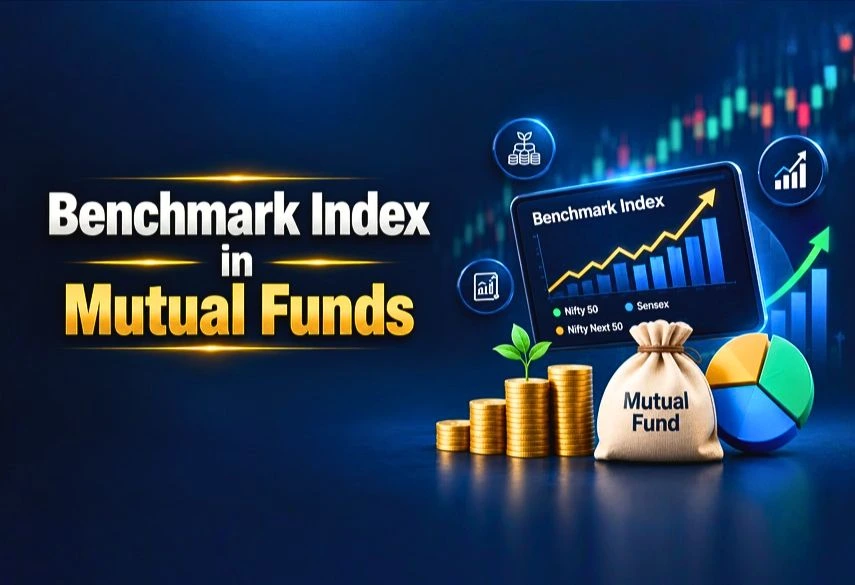
A benchmark index in mutual funds is a standard market index (like Nifty 50 or Sensex) that acts as a yardstick to measure whether a fund has performed better, worse, or similar to the relevant market segment over the same period.
This complete beginner guide will walk you through what a benchmark index is, the mutual fund benchmark meaning, how a benchmark index works, real benchmark index examples, and why it is essential for smart fund performance comparison.
Mutual Fund Benchmark Meaning
In plain words, a benchmark index that mutual funds use is a ready-made basket of stocks or bonds that represents a specific part of the market. Fund houses choose an index that matches the fund’s investment style and goal. SEBI requires every mutual fund scheme to declare at least one such benchmark so investors can make fair comparisons.
Think of it like a school report card. Your marks alone do not tell the full story. You need to know the class average or the topper’s score to understand whether you did well. The benchmark plays the same role for mutual funds.
A large-cap equity fund is usually compared with an index of the biggest companies. A mid-cap fund is measured against mid-sized companies. This matching makes the comparison meaningful.

Since February 2018, SEBI has mandated the use of the Total Return Index (TRI) version. TRI includes price changes plus dividends (assuming they are reinvested). This gives a more complete and honest picture than the older price-only indices.
How Benchmark Index Works in Everyday Investing
How a benchmark index works is straightforward once you see the process:
1. The fund house selects a suitable index based on the scheme’s category, asset allocation, and strategy.
2. Over any chosen period (1 year, 3 years, 5 years, or since inception), the fund’s returns are placed side by side with the benchmark’s returns.
3. If the fund earns more than the benchmark, it has outperformed (this extra return is often called alpha).
4. If the fund earns less, it has underperformed.
5. Investors also look at consistency across different market cycles, not just one good year.
For active funds, the goal is usually to beat the benchmark after fees. For index funds and ETFs, the goal is to stay as close as possible to the benchmark (low tracking error).
A practical example helps. Suppose a large-cap fund returns 15% over three years while its Nifty 50 TRI benchmark returns 12%. The fund has added 3% extra value. That outperformance is what many investors look for when paying higher expense ratios of active funds. Conversely, a 10% fund return against a 12% benchmark signals underperformance, even if 10% looks decent in isolation.
Benchmark Index Examples Across Fund Categories
Different funds need different yardsticks. Here is a clear table of common benchmark index examples used in India:
|
Fund Category |
Common Benchmark Index |
What It Represents |
|
Nifty 50 TRI / Nifty 100 TRI / Sensex TRI |
Top 50 or 100 largest companies |
|
|
Mid-Cap Funds |
Nifty Midcap 150 TRI |
Companies ranked roughly 101–250 |
|
Nifty Smallcap 250 TRI |
Smaller companies beyond the top 250 |
|
|
Nifty 500 TRI |
Broad universe of top 500 companies |
|
|
Large & Mid-Cap |
Nifty LargeMidcap 250 TRI |
Mix of large and mid-sized firms |
|
Sectoral / Thematic |
Nifty Bank, Nifty IT, etc. |
Specific sector or theme |
|
Debt Funds (example) |
Nifty Short Duration Debt Index / CRISIL indices |
Relevant fixed-income segment |
|
Nifty 50 Hybrid Composite Debt indices |
Mix of equity and debt in set ratios |
These benchmarks are chosen so the comparison stays fair. A small-cap fund should not be judged against the Nifty 50, just as a debt fund should not be compared with an equity index.
Globally, similar logic applies. U.S. large-cap funds often use the S&P 500, while broader funds may use the Russell 3000 or MSCI World Index.
Why Benchmarks Matter for Fund Performance Comparison
Without a benchmark, fund performance comparison becomes guesswork. A 12% return may feel excellent until you learn the relevant market rose 18%. Suddenly the same number looks disappointing. Benchmarks give context and help answer three key questions:
-
Did the fund manager deliver extra value for the fees charged?
-
How does this fund rank against others in the same category?
-
Is the risk taken justified by the returns achieved?
They also support deeper analysis using metrics such as alpha (excess return), beta (market sensitivity), and tracking error. SEBI’s rules around transparent disclosure of Tier-1 (category-level) and optional Tier-2 (style-specific) benchmarks further improve clarity for investors.
For beginners, the practical habit is simple: always open the fund factsheet or scheme information document and note the declared benchmark. Then compare returns over multiple periods. Focus more on three- and five-year numbers than short-term noise.
Real-Life Story: From Confusion to Confidence
Let’s return to Riya. After learning about benchmarks, she checked her large-cap fund. Its benchmark was Nifty 100 TRI. Over five years, the fund returned 14.8% while the benchmark returned 13.2%.
The modest outperformance, combined with reasonable risk numbers, gave her confidence to continue the SIP. She also compared two mid-cap funds side by side against the same Nifty Midcap 150 TRI and chose the one that stayed ahead more consistently. That single concept of a benchmark index turned her from a passive saver into a more informed investor.
Practical Tips for Beginners
-
Always use TRI figures for comparison.
-
Look at rolling returns or multiple time frames rather than a single point.
-
Remember that past outperformance does not guarantee future results.
-
For index funds, low tracking error and low expense ratio matter more than trying to beat the index.
-
Review the benchmark annually; fund houses sometimes change it if the strategy shifts, though major changes need proper disclosure.

Conclusion
Understanding the mutual fund benchmark meaning and how the benchmark index works removes a big layer of mystery from investing. It turns raw percentage numbers into meaningful stories about skill, risk, and market conditions.
(Sources: Etmoney, Bajajbroking, Angelone, Indmoney, Paisabazaar, ET)

DISCLAIMER: This blog is NOT any buy or sell recommendation. No investment or trading advice is given. The content is only for educational purposes. Always discuss with your SEBI-registered financial advisor for investment-related decisions.

.webp)

.webp)