Investing in mutual funds can help you build wealth over time, but every mutual fund investment comes with a certain level of risk. Many investors focus only on past returns while choosing a fund and ignore one of the most important factors — the risk involved.
A fund that has delivered excellent returns in the past may also experience significant declines during market corrections. Therefore, understanding the risk level of a mutual fund is as important as understanding its return potential.
This is where the mutual fund riskometer helps investors.
The riskometer is a simple visual tool that shows the risk level of a mutual fund scheme. It allows investors to understand whether a particular fund matches their financial goals, investment duration, and ability to handle market fluctuations.
Before investing in any mutual fund, checking the riskometer can help you make a more informed decision.
What Is a Mutual Fund Riskometer?
A mutual fund riskometer is a risk assessment tool introduced by SEBI to indicate the level of risk associated with a mutual fund scheme.
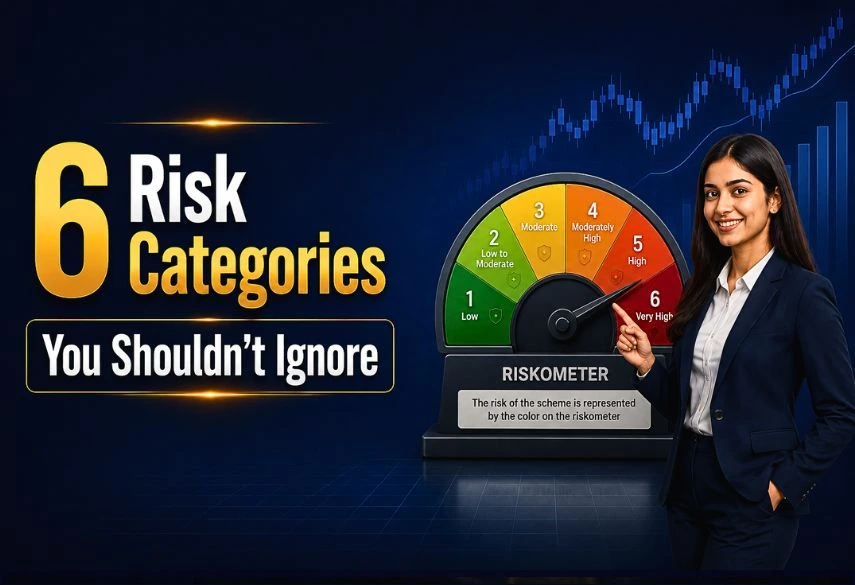
It displays the risk of a scheme through six categories:
Risk Level
- Low
- Low to Moderate
- Moderate
- Moderately High
- High
- Very High
The riskometer is displayed by mutual fund companies on scheme documents, factsheets, and their official websites.
Its purpose is to make investment risks easier to understand, especially for beginners who may not have detailed knowledge about market volatility, portfolio risks, or investment products.
However, investors should remember that the riskometer does not guarantee returns or eliminate losses. It only shows the expected level of risk associated with the scheme.
Why Is the Mutual Fund Riskometer Important?
Many investors select mutual funds based only on previous performance. They often choose funds that generate high returns without understanding whether they can handle the associated risk.
For example, a small-cap fund may provide strong returns during a rising market, but the same fund can experience sharp declines when market conditions become unfavorable. The riskometer helps investors avoid such mistakes by creating awareness about the risk level before investing.
A suitable investment is not always the fund with the highest return. It is the fund that matches your financial objective and risk capacity.
How Does the SEBI Riskometer Work?
The SEBI Riskometer evaluates the actual risk of a mutual fund scheme based on its portfolio characteristics.
For equity mutual funds, factors such as market volatility, company size, liquidity, and portfolio concentration are considered. A fund investing heavily in smaller companies may carry higher risk because small-cap stocks generally experience larger price movements compared with large companies.
For debt mutual funds, risk assessment mainly depends on credit quality, interest rate movements, and liquidity factors. A debt fund investing in lower-rated securities may carry higher risk compared with a fund investing in high-quality instruments.
The risk level is reviewed periodically because the portfolio composition of a mutual fund can change over time.

SEBI Riskometer: Six Risk Categories Explained
Low Risk
Low-risk mutual funds generally focus on stability and capital preservation. They are suitable for investors who prefer lower fluctuations and may need their money within a shorter period.
These funds may be appropriate for conservative investors, but low risk does not mean there is absolutely no possibility of loss.
Low to Moderate Risk
Funds in this category involve limited fluctuations compared with higher-risk investments. They may suit investors who want slightly better growth potential while still maintaining a relatively controlled risk level.
Moderate Risk
Moderate-risk funds offer a balance between stability and growth potential. These funds may be suitable for investors who have medium-term goals and can tolerate some market movement without making emotional investment decisions.
Moderately High Risk
Moderately High-risk funds usually have meaningful exposure to market-linked investments. They may be suitable for long-term investors who want wealth creation opportunities and understand that temporary market declines are possible.
High Risk
High-risk mutual funds can experience significant price fluctuations. Examples may include certain mid-cap, sectoral, thematic, or international funds. Investors choosing these funds should have a higher risk tolerance and a longer investment horizon.
Very High Risk
Very High is the highest risk category in the SEBI Riskometer.Funds in this category may experience sharp upward and downward movements. Small-cap funds and aggressive equity-oriented schemes often fall into this category.
Such investments may suit investors who have a long-term goal and the ability to remain invested during market volatility.
How to Read a Mutual Fund Riskometer?
Reading a riskometer is simple, but investors should not look at it in isolation. First, check the latest factsheet or official fund website and identify the risk category mentioned for the scheme. Next, compare that risk level with your personal situation:
- What is your investment goal?
- How long can you stay invested?
- How much market fluctuation can you comfortably handle?
For example, an investor saving for a goal within one year may not be comfortable with a Very High-risk fund. On the other hand, a young investor investing for retirement may have the ability to accept higher risk.
The correct risk level depends on your individual circumstances.
Can the Riskometer of a Mutual Fund Change?
Yes, the riskometer of a mutual fund can change over time. A mutual fund portfolio is not fixed. Fund managers may change investments based on market conditions, investment strategy, and opportunities. Because of these changes, the risk level of a scheme may move higher or lower.
For example, a debt fund may become riskier if it increases exposure to lower-rated bonds. Similarly, an equity fund may experience changes in risk depending on its portfolio composition.
Investors should review the riskometer periodically instead of checking it only once before investing.
Riskometer vs Mutual Fund Returns: What Should Investors Focus On?
Returns and risk should always be evaluated together. A common mistake among investors is selecting a fund only because it delivered high returns recently. Past performance does not guarantee future results.
The riskometer provides context about how much volatility an investor may experience while targeting those returns.
For example:
- A high-risk fund may generate higher returns during favourable market conditions but may also see larger declines during market corrections.
- A moderate-risk fund may provide relatively stable performance with lower fluctuations.
- The right choice depends on your financial goals, not just return numbers.

Common Mistakes Investors Make While Using Riskometer
How Beginners Can Use Riskometer for Better Investment Decisions
A beginner should first identify the purpose of the investment. If the goal is short-term, lower-risk options may be more suitable. For long-term goals such as retirement planning, investors may consider higher-risk investments if they have the ability to tolerate market fluctuations.
After identifying the goal and investment duration, investors should check whether the fund’s riskometer level matches their comfort level.
Regular portfolio review is also important because financial goals and risk capacity can change with time.
Conclusion
The mutual fund riskometer is an important tool that helps investors understand the risk associated with a mutual fund scheme before investing. It does not predict future returns, but it provides valuable information about the level of volatility and uncertainty an investor may experience.
A successful investment strategy is not about avoiding all risk. It is about choosing the right amount of risk according to your financial goals, investment timeline, and comfort level. Before investing in any mutual fund, always understand the riskometer and make sure the scheme matches your investment journey.

DISCLAIMER: This blog is NOT any buy or sell recommendation. No investment or trading advice is given. The content is only for educational purposes. Always discuss with your SEBI-registered financial advisor for investment-related decisions.