What is Expense Ratio?
Expense ratio is the annual fee charged by a mutual fund to manage and operate a scheme. It is expressed as a percentage of the fund’s average Assets Under Management (AUM) and is deducted automatically from the fund’s NAV every day.
For example, if a mutual fund has an expense ratio of 1%, approximately ₹1 is charged annually for every ₹100 invested in the fund. Although investors do not pay this fee separately, it directly reduces the returns they receive over the long term.
In this blog, we will explore what the expense ratio in mutual funds is, what it means with examples, how it is calculated, how it affects SIP returns, the difference between Direct plan and regular plan expense ratios, good expense ratios in India, and mistakes investors should avoid.
Why Expense Ratio Matters More Than Most Investors Think
When choosing a mutual fund, most investors compare:
- Past returns
- Fund ratings
- Market performance
- Fund manager experience
But one important factor that is often ignored is expense Ratio. A difference of even 0.5% may look insignificant today, but over 10–20 years of compounding, it can create a major difference in your final wealth.
Consider Rahul, a 30-year-old investor who started a ₹10,000 monthly SIP in an equity mutual fund. The fund delivered good returns, but after checking the scheme details, he discovered that another similar fund had a much lower expense ratio.
The difference appeared small initially, but over decades, the lower-cost option allowed more money to remain invested and compound. Understanding expense ratio helps investors make smarter decisions and avoid unnecessary costs.

Expense Ratio Example:
Suppose you invest ₹1,00,000. The mutual fund expense ratio is 1%. The fund charges approximately ₹1,000 per year as expenses. However, this amount is not directly deducted from your bank account. Instead, it is adjusted from the fund’s assets before calculating the NAV.
Expense Ratio Formula
The formula for calculating the expense ratio is:
Expense Ratio = (Total Annual Operating Expenses ÷ Average Assets Under Management) × 100
Example:
A mutual fund has Annual operating expenses: ₹20 crore
Average AUM: ₹2,000 crore
Calculation:
(20 ÷ 2000) × 100
= 1%
Therefore, the fund expense ratio is 1%.
What Does Expense Ratio Include?
Expense ratio generally covers:
1. Fund Management Fees
This is the fee paid to the asset management company (AMC) for managing investments.
It includes:
- Research
- Portfolio decisions
- Fund manager expertise
2. Administrative Expenses
These include:
- Record keeping
- Accounting
- Investor communication
- Operational costs
3. Distribution Expenses
Regular mutual fund plans include distributor commissions. This is one major reason why regular plans have higher expense ratios compared to direct plans.
How Expense Ratio Is Deducted From NAV
Many beginners think: "Will the fund house deduct money from my bank account?" No. The expense ratio is adjusted internally.
Example:
If a fund generates:
- Gross return: 12%
- Expense ratio: 1%
- Your approximate return becomes 11%.
The NAV you see already reflects these charges.
Why Expense Ratio Matters: The Impact of Compounding
Small costs become large over long periods because of compounding.
Example:
Investment: ₹1,00,000
Time period: 20 years
Expected gross return: 12% annually
Scenario 1:
Expense ratio: 1%
Net return: 11%
Final value: Approximately ₹8.06 lakh
Scenario 2:
Expense ratio: 2%
Net return: 10%
Final value: Approximately ₹6.72 lakh
Difference: More than ₹1.3 lakh lost because of only a 1% cost difference.
For SIP investors, the impact can be even larger because every monthly investment gets affected.
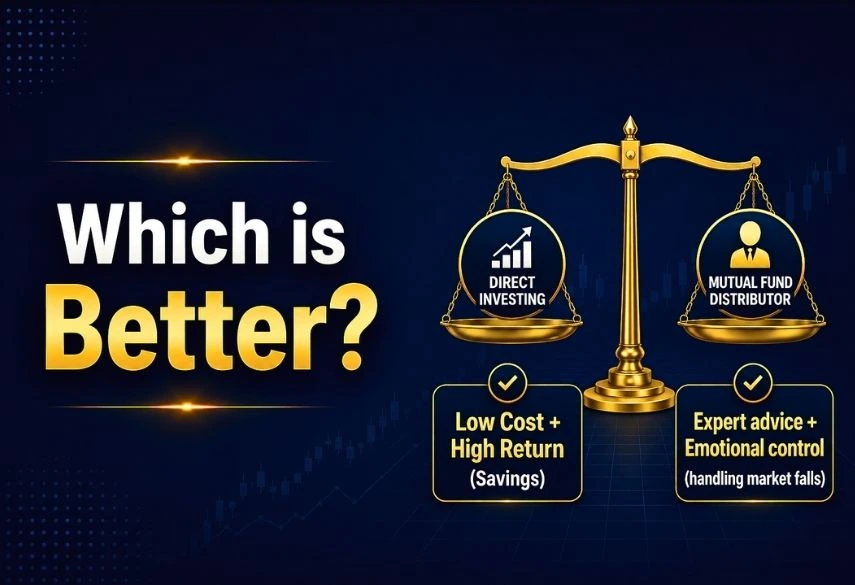
Direct Plan vs Regular Plan: Which Has a Lower Expense Ratio?
One of the biggest factors affecting a mutual fund's expense ratio is whether you invest through a Direct Plan or a Regular Plan.
Both plans invest in the same mutual fund scheme and have the same fund manager, portfolio, and investment strategy.
The main difference is distribution cost.
|
Feature |
Direct Plan |
Regular Plan |
|
Distributor commission |
No |
Yes |
|
Expense ratio |
Lower |
Higher |
|
Returns potential |
Usually higher due to lower costs |
Slightly lower due to higher costs |
|
Suitable for |
Investors who can choose funds themselves |
Investors who need advisor support |
Example:
Suppose the same equity mutual fund has:
- Direct Plan Expense Ratio: 0.60%
- Regular Plan Expense Ratio: 1.40%
- The difference: 0.80% every year
This difference may look small, but over long investment periods, it can significantly impact wealth creation. For investors who understand mutual funds and can select schemes independently, direct plans can be a cost-efficient option.
How to Find the Expense Ratio of a Mutual Fund?
Before investing, investors should always check the latest expense ratio.
You can find it through:
1. Mutual Fund Factsheet
Every AMC publishes monthly factsheets containing:
- Expense ratio
- Portfolio details
- Fund performance
- Asset allocation
2. AMC Website
Visit the official website of the mutual fund company and check scheme details.
3. Investment Platforms
Most mutual fund platforms display:
- Direct plan expense ratio
- Regular plan expense ratio
- Historical changes
4. AMFI Disclosures
The Association of Mutual Funds in India (AMFI) provides industry-related information and disclosures.

What is a Good Expense Ratio in India?
There is no single "perfect" expense ratio. A good expense ratio depends on:
- Fund category
- Fund size
- Investment strategy
- Active vs passive management
Generally:
|
Fund Category |
Good Expense Ratio Range |
|
Index Funds |
0.05% – 0.30% |
|
ETFs |
0.05% – 0.40% |
|
0.50% – 1% |
|
|
0.60% – 1.10% |
|
|
0.70% – 1.20% |
|
|
0.10% – 0.50% |
A lower expense ratio is usually beneficial when comparing similar funds. However, investors should not select a fund only because it has the lowest cost. A low-cost fund with poor performance may not always be the best choice.
Expense Ratio vs Mutual Fund Returns
A common mistake investors make is looking only at historical returns.
Example:
Fund A:
- Gross return: 12%
- Expense ratio: 1.5%
- Investor return: Approximately 10.5%
Fund B:
- Gross return: 11.8%
- Expense ratio: 0.5%
- Investor return: Approximately 11.3%
Although Fund A generated higher gross returns, Fund B delivered better results after expenses. The important factor is returns after expenses, not before expenses.
Expense Ratio Impact on SIP Investment
Expense ratio becomes more important when investing through SIP because:
- Investment duration is longer
- The compounding effect is higher
- Small differences accumulate over time.
Example:
- Monthly SIP: ₹10,000
- Duration: 25 years
- Difference in expense ratio: 0.75%
The final corpus difference can become substantial because the investor loses not only the annual cost but also the future growth on that money.
Common Mistakes Investors Make About Expense Ratio
Mistake 1: Choosing Only Based on Past Returns
A fund with high historical returns may have:
- Higher costs
- Higher risk
- Unsustainable performance
Always evaluate returns after expenses.
Mistake 2: Ignoring Direct Plans
Many investors continue with regular plans without understanding the additional cost.
Mistake 3: Comparing Different Fund Categories
Comparing an equity fund expense ratio with a debt fund expense ratio is not meaningful. Always compare funds within the same category.
Mistake 4: Not Reviewing Expense Ratio Regularly
Expense ratios can change due to:
- Fund size changes
- AMC decisions
- Regulatory changes
Review your investments periodically.
How to Choose a Mutual Fund Using Expense Ratio
Follow these steps:
Step 1: Compare funds within the same category.
Compare a large-cap fund vs. a large-cap fund. Not a large-cap fund vs. a small-cap fund.
Step 2: Check direct and regular plan differences.
Step 3: Evaluate long-term performance after expenses.
Step 4: Consider-
- Fund consistency
- Risk level
- Portfolio quality
- Fund management process
Step 5: Choose lower-cost options when everything else is similar.

Conclusion
Expense ratio is one of the most important but often ignored factors in mutual fund investing. A small percentage difference can become a large amount over decades because of compounding.
(Sources: Motilal Oswal, Mutual Fund Wala, HDFC Fund, Policy Bazaar, Indmoney)

DISCLAIMER: This blog is NOT any buy or sell recommendation. No investment or trading advice is given. The content is only for educational purposes. Always discuss with your SEBI-registered financial advisor for investment-related decisions.









.webp)