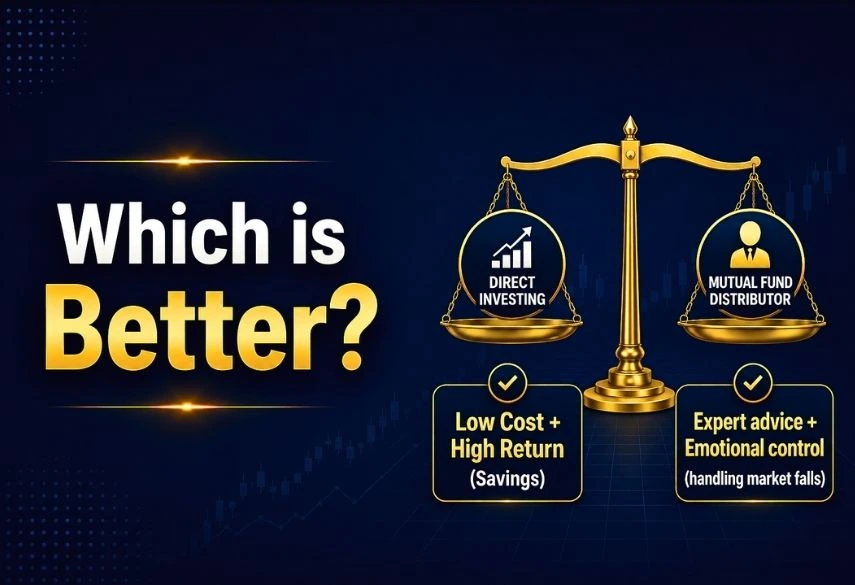
Choosing between a mutual fund distributor and direct investing is not simply a question of which option gives higher returns. The real decision is whether you want to manage your mutual fund investments independently or prefer professional assistance with fund selection, transactions and ongoing investment support.
When you invest through a mutual fund distributor, your investments are generally made in regular plans, where distributor commission is built into the expense ratio. With direct investing, you invest in direct plans without a distributor, which usually means a lower expense ratio and potentially higher long-term net returns.
For investors who understand mutual funds and are comfortable managing their own portfolio, direct investing can be more cost-efficient. For beginners or investors who need guidance and behavioural support, a good mutual fund distributor may still provide meaningful value.
So, which approach is better? Let us compare mutual fund distributor vs direct investing in detail.
What Is a Mutual Fund Distributor?
A mutual fund distributor (MFD) is an intermediary who helps investors purchase and manage mutual fund investments.
A distributor may help with:
- understanding mutual fund categories
- selecting suitable schemes
- starting SIPs
- completing transactions
- maintaining investment records
- reviewing portfolios
- handling redemption or switching requests
- providing support during market volatility
When you invest through a mutual fund distributor, the investment is generally made in the regular plan of a mutual fund scheme. The distributor earns commission from the mutual fund distribution arrangement. This cost is reflected in the higher expense ratio of the regular plan.
You normally do not receive a separate commission bill from the distributor because the cost is incorporated into the fund's expenses.
What Is Direct Investing in Mutual Funds?
Direct investing means investing in mutual funds without using a mutual fund distributor. You invest in the direct plan of a mutual fund scheme through the AMC or a platform that provides access to direct mutual funds.
Because there is no distributor commission included in a direct plan, the expense ratio is lower than the regular plan of the same scheme.
The investor is responsible for decisions such as:
- which mutual funds to choose
- how much to invest
- asset allocation
- SIP selection
- portfolio review
- rebalancing
- switching
- redemption
Direct investing therefore provides more control and lower costs, but it also places more responsibility on the investor.
Mutual Fund Distributor vs Direct Investing: Quick Comparison
|
Factor |
Mutual Fund Distributor |
Direct Investing |
|
Investment Route |
Through a distributor or intermediary |
Directly without a distributor |
|
Mutual Fund Plan |
Usually Regular Plan |
Direct Plan |
|
Expense Ratio |
Higher |
Lower |
|
Distributor Commission |
Included in plan expenses |
Not included |
|
Fund Selection |
Distributor may assist |
Investor selects funds independently |
|
Portfolio Review |
Assistance may be available |
Self-managed |
|
Transaction Support |
Usually available |
Managed by the investor |
|
Investment Control |
Moderate |
High |
|
Long-Term Net Returns |
Slightly lower, all else equal |
Potentially higher due to lower costs |
|
Best Suited For |
Investors who need guidance and support |
Investors comfortable managing investments independently |
How Mutual Fund Distributor Commission Works
One of the most important differences in the mutual fund distributor vs direct investing comparison is cost. Mutual fund distributors generally earn commissions on regular-plan investments.
This commission is not usually charged separately to the investor. Instead, it forms part of the expenses associated with the regular plan.
As a result:
Regular Plan = Higher Expense Ratio
Direct Plan = Lower Expense Ratio
Suppose the same mutual fund has:
Regular Plan Expense Ratio: 1.60%
Direct Plan Expense Ratio: 0.80%
The difference is 0.80% per year.
At first, this may appear small
However, when investments remain invested for 10, 15, or 20 years, even a small annual cost difference can have a meaningful impact because of compounding. Actual expense ratios differ across mutual fund schemes and may change over time, so investors should check the latest fund information before making a decision.
Does Direct Investing Give Higher Returns?
For the same mutual fund scheme, direct plans normally generate slightly higher net returns than regular plans because their expenses are lower.
The difference does not exist because a direct plan has:
- a better fund manager
- better stocks
- a different portfolio
- lower market risk
The direct and regular versions of the same scheme generally invest in the same underlying portfolio. The return difference primarily comes from expenses.
For example:
- If a mutual fund generates a return before expenses and the direct plan charges less than the regular plan, a larger portion of that return remains with the direct investor.
- Over one year, the difference may appear small.
- Over long periods, it can become significant.
Example: Cost of Distributor vs Direct Investing
Suppose an investor starts a monthly SIP of ₹10,000 and continues investing for 20 years. Assume both investors choose the same mutual fund scheme. One invests through a distributor in the regular plan.
The other uses the direct plan.
Even though both investors are investing in the same underlying scheme, the lower annual expense of the direct plan can create a considerable corpus difference over a long investment horizon.
Benefits of Investing Through a Mutual Fund Distributor
Cost is not the only factor investors should consider. A capable mutual fund distributor can provide value in several ways.
1. Guidance for Beginners
A first-time investor may not know the difference between:
A distributor may help simplify these choices.
2. Help With Fund Selection
Many investors select mutual funds only by looking at recent returns. This can be risky.
A good distributor may help investors understand fund categories, investment horizons and risk before making a decision.
3. Transaction Assistance
A distributor may help with:
- SIP registration
- investment applications
- nominee-related processes
- redemption
- switching
- account servicing
This can be useful for investors who do not want to handle everything independently.
4. Behavioural Support
Investor behaviour can have a major impact on long-term returns. During a market crash, some investors stop their SIPs or redeem their entire portfolio out of fear.
A good distributor can help investors stay focused on long-term objectives rather than reacting emotionally to short-term volatility.
5. Portfolio Review
Some distributors periodically review an investor's portfolio and suggest changes when necessary. However, the quality of this service varies considerably from one distributor to another.
Disadvantages of Investing Through a Mutual Fund Distributor
Higher Cost
- The biggest disadvantage is the higher expense ratio associated with regular plans.
- This reduces net returns compared with the direct version of the same scheme.
- Quality of Advice Can Vary
- Not every distributor provides comprehensive financial guidance.
- Some may mainly facilitate transactions
Investors should therefore ask:
What ongoing value am I receiving for the additional cost?
Potential Conflict of Interest
Since distributors earn commissions from distribution, investors should understand how the distributor is compensated.
Fund recommendations should ideally be based on investor suitability rather than commission economics.
Long-Term Cost Impact
A small annual difference may become significant when applied to a large portfolio for many years.
Benefits of Direct Investing
1. Lower Expense Ratio
The most obvious benefit of direct investing is lower cost.
Since distributor commissions are not included, direct mutual funds generally have a lower expense ratio.
2. Potentially Higher Long-Term Returns
Lower expenses mean more of the fund's return remains invested.
Therefore, direct plans can generate higher net returns than regular plans of the same scheme, all else being equal.
3. Full Control
Direct investors decide:
- where to invest
- when to invest
- how much to invest
- when to switch
- when to redeem
- how to rebalance
This can be valuable for experienced investors.
4. Transparency
Direct investors can independently compare:
- expense ratios
- portfolios
- fund performance
- risk
- fund categories
- tracking error
- portfolio allocation
This gives greater control over the investment process.
Disadvantages of Direct Investing
Direct investing is cheaper, but it is not automatically better for everyone.
No Distributor Guidance
The investor must make decisions independently unless they separately hire a professional adviser.
Risk of Wrong Fund Selection
Lower costs cannot compensate for consistently poor investment decisions. For example, an investor may:
- chase top-performing funds
- invest in too many schemes
- take excessive risk
- ignore asset allocation
- frequently switch funds
These mistakes can cost more than the distributor commission saved.
Behavioural Risk
An inexperienced investor may panic during market declines and redeem investments at the wrong time
More Responsibility
Direct investors need to manage:
- portfolio allocation
- reviews
- tax implications
- rebalancing
- scheme changes
For some investors, this responsibility may become difficult.

Mutual Fund Distributor vs Direct Investing: Cost Comparison
Consider the basic difference:
Distributor Route
You receive assistance, but part of the fund expense supports distribution.
Direct Route
You remove the distributor from the investment route and therefore pay a lower expense ratio.
When Should You Choose a Mutual Fund Distributor?
A mutual fund distributor may be suitable if you:
- are a complete beginner
- do not understand mutual fund categories
- do not have time to research investments
- want help with transactions
- need regular portfolio support
- tend to panic during market corrections
- value having someone available to discuss investments
However, do not choose a distributor only because investing independently appears complicated. Evaluate the quality of service you are receiving. A good distributor should provide more value than simply processing transactions.
When Should You Choose Direct Investing?
Direct investing may be suitable if you:
- understand mutual fund basics
- can select appropriate fund categories
- understand your risk tolerance
- have a clear asset allocation plan
- can review your portfolio independently
- can stay disciplined during market volatility
- want to reduce investment costs
Long-term investors with sufficient knowledge may benefit significantly from the lower expense structure of direct plans.
Mutual Fund Distributor vs Investment Adviser: Are They the Same?
- No. A mutual fund distributor and an investment adviser perform different roles.
- A distributor primarily distributes investment products and may earn commissions.
- A registered investment adviser generally charges the client for advice and operates under a separate regulatory framework.
- This distinction is important for investors who want professional guidance but prefer investing in direct mutual funds.
For example, an investor may choose:
Direct mutual funds + fee-based professional advice
instead of:
Regular mutual funds + distributor support
The best model depends on the investor's requirements and the quality of advice received.
Can a Beginner Start With a Distributor and Later Move to Direct Investing?
Yes. This is a practical approach for some investors. A beginner may initially work with a mutual fund distributor to understand:
- mutual fund categories
- risk
- SIPs
- asset allocation
- market volatility
Once the investor becomes confident enough to manage investments independently, future investments can potentially be made through direct plans.
However, existing regular-plan investments should not be switched blindly. There may be tax and other implications.
Can You Switch From a Regular Plan to a Direct Plan?
Yes, investors can generally move from a regular plan to the direct version of a mutual fund scheme. However, the switch can be treated as:
Redemption from the regular plan + fresh investment in the direct plan. This can have tax implications.
Before switching, check:
- capital gains
- investment holding period
- applicable tax rules
- exit-load conditions
- future expense savings
For a large existing portfolio, the correct decision may not always be to switch everything immediately.
Sometimes it may make more sense to leave existing units unchanged and direct future SIPs into direct plans. The appropriate decision depends on the investor's individual situation.
How to Check Whether Your Mutual Fund Is Direct or Regular
If you are unsure whether your mutual fund investment is through a distributor or direct, check the following:
Scheme Name
Your mutual fund statement should normally mention Direct Plan or Regular Plan.
Account Statement
Check your Consolidated Account Statement or AMC statement.
Expense Ratio
Compare the expense ratio of the plan with the direct and regular versions shown by the AMC.
Distributor Details
If the investment was routed through a distributor, distributor-related information may appear in your records.
Is a Mutual Fund Distributor Worth the Extra Cost?
This depends entirely on the value provided.
Imagine Investor A pays a higher expense ratio but receives meaningful support that helps them:
- avoid unsuitable investments
- maintain proper asset allocation
- remain invested during market crashes
- avoid unnecessary switching
For that investor, the distributor may add substantial value.
Now imagine Investor B pays the same higher expense ratio but receives only occasional transaction support.
For Investor B, direct investing may make more financial sense.
Which Option Is Better: Mutual Fund Distributor or Direct Investing?
Choose Direct Investing If:
You understand mutual funds, can manage your portfolio independently, and want to minimize long-term investment costs.
Consider a Mutual Fund Distributor If:
- You need investment support, value human guidance, and are comfortable paying the additional cost associated with regular plans.
- From a purely mathematical cost perspective, direct investing has an advantage because the expense ratio is lower.
- From a behavioural and service perspective, a capable mutual fund distributor can still provide value.
The better option depends on the investor—not merely the expense ratio.
Mutual Fund Distributor vs Direct Investing: Final Verdict
The debate around mutual fund distributor vs direct investing should not be reduced to “commission vs no commission.”
Both approaches solve different investor needs.
Direct investing offers:
- lower expenses
- greater control
- potentially higher long-term net returns
Investing through a mutual fund distributor can offer:
- convenience
- assistance
- investor education
- behavioural support
If you have the knowledge, discipline and time to manage your own mutual fund portfolio, direct investing is usually the more cost-efficient route.
If you need genuine guidance and ongoing support, paying more through a regular-plan distribution arrangement may still be worthwhile.
The important point is to understand what you are paying, what service you are receiving, and whether that service genuinely improves your investment decisions.

Conclusion
When deciding between a mutual fund distributor vs direct investing, focus on both cost and value. Direct investing has a clear cost advantage because direct plans have lower expense ratios.
However, managing investments independently requires knowledge, discipline, and responsibility. A good mutual fund distributor may justify the additional cost if they provide meaningful guidance and help you make better long-term investment decisions.
Ultimately, the better choice is the one that helps you invest appropriately, remain disciplined and achieve your financial goals without paying for services you do not need.
(Sources: Business Today, Equity Research India, Livemint, The Hindu Business Line, Business Standard)

DISCLAIMER: This blog is NOT any buy or sell recommendation. No investment or trading advice is given. The content is only for educational purposes. Always discuss with your SEBI-registered financial advisor for investment-related decisions.











.webp "growth-vs-idcw-mutual-fund")