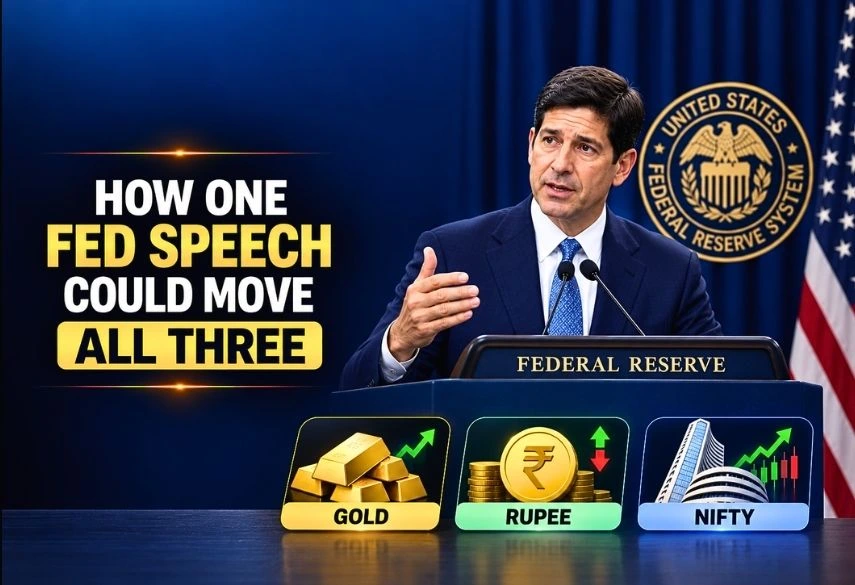
A Federal Reserve speech can influence gold prices, the Indian rupee, and the Nifty within hours—even when the Fed does not actually change interest rates. The reason is simple: investors constantly adjust their expectations about future US interest rates.
A hawkish Fed speech can push US bond yields and the dollar higher, putting pressure on gold, emerging-market currencies such as the rupee and Indian equities. A dovish speech can produce the opposite reaction.
For Indian investors, therefore, understanding the Fed speech impact on Indian markets is not just about following US monetary policy. It is about understanding how changes in global interest rates, the US dollar, foreign portfolio flows, and risk appetite eventually reach Indian asset prices.
Why Can a Single Fed Speech Move Indian Markets?
The US Federal Reserve sets monetary policy for the world's largest economy, while the US dollar remains the dominant currency in global trade, reserves and financial markets.
Because of this, even a change in expectations about US interest rates can affect the attractiveness of assets across the world. Suppose the Fed Chair says inflation is still too high and interest rates may need to remain elevated—or even rise further. Investors may immediately conclude that US rates will be higher than previously expected.
That can lead to a chain reaction:
Hawkish Fed comments → higher US rate expectations → higher Treasury yields → stronger US dollar → pressure on gold and emerging-market assets.
India is affected through several channels, particularly the rupee, foreign portfolio investment and equity-market sentiment.
The reverse can happen when the Fed turns dovish and signals that inflation is cooling enough to justify lower interest rates.
What Do Hawkish and Dovish Fed Speeches Mean?
A hawkish Fed is generally more concerned about inflation. Hawkish communication can suggest that interest rates may remain high for longer, rate cuts may be delayed or additional tightening may be required.
A dovish Fed, on the other hand, is generally more concerned about slowing economic growth or weakening employment.
Dovish comments can increase expectations of rate cuts or easier monetary policy. Markets do not react only to the words "rate hike" or "rate cut." They react to how the Fed's message compares with what investors had already expected.
That distinction is critical. An expected rate decision may create little market reaction, while a single unexpected sentence about inflation or future rates can cause significant moves.
Fed Speech Impact on Gold Prices
- Gold is one of the assets most sensitive to changes in US interest-rate expectations.
- Gold itself does not pay interest.
- Therefore, when Treasury yields rise, interest-bearing assets become relatively more attractive. The opportunity cost of holding gold increases, which can put downward pressure on gold prices.
A hawkish Fed speech can therefore create three headwinds for gold:
Higher interest-rate expectations increase bond yields. Higher yields increase the opportunity cost of holding gold. A stronger US dollar can make dollar-denominated gold more expensive for buyers using other currencies.
A dovish Fed signal can reverse these conditions. Lower expected rates may reduce Treasury yields, weaken the dollar and improve the relative attractiveness of gold.
Why Indian Gold Prices Can Behave Differently
Indian investors should not look only at international gold prices. Domestic gold prices are influenced by both global gold and the USD/INR exchange rate, along with factors such as import duties, taxes and local demand.
A simplified relationship is:
International gold price + USD/INR movement + import costs + taxes + local premium = Indian gold price
Suppose international gold falls after a hawkish Fed speech, but the rupee simultaneously weakens sharply against the dollar. The weaker rupee can partially offset the fall in international gold prices.
That is why Indian gold prices do not always move by the same percentage as international spot gold.
Fed Speech Impact on the Indian Rupee
The Indian rupee is highly sensitive to movements in the US dollar, global bond yields, crude oil prices, and foreign capital flows.
When markets expect higher US interest rates, US fixed-income assets can become more attractive. Some global investors may reduce exposure to emerging-market assets and move capital toward dollar-denominated assets. That creates additional demand for dollars.
Stronger dollar → FPI outflows or weaker inflows → increased dollar demand → pressure on the Indian rupee.
A dovish Fed can have the opposite effect by reducing the relative attractiveness of US yields and improving global appetite for emerging-market assets. However, the Fed is only one factor affecting USD/INR.
Crude oil is particularly important for India because India is a major oil importer. A sharp increase in oil prices can increase demand for dollars from importers and put pressure on the rupee even when other global conditions are favourable.
The Reserve Bank of India can also intervene in the foreign-exchange market to reduce excessive volatility. Therefore, it is more accurate to say that the Fed influences the rupee rather than mechanically determining its direction.
Fed Speech Impact on Nifty and Indian Stocks
Nifty is affected by Fed communication mainly through foreign capital flows, bond yields and global risk appetite.
When US yields rise substantially, international investors have access to potentially higher returns in relatively lower-risk US fixed-income assets. That can reduce the attractiveness of emerging-market equities at the margin.
Indian stocks may consequently experience selling pressure from foreign portfolio investors. Rate-sensitive and high-valuation parts of the market can be particularly vulnerable when global yields rise. However, not every sector reacts in exactly the same way.
Banks, NBFCs, real estate companies and other rate-sensitive businesses may respond differently from exporters, IT companies, commodity businesses or defensive sectors.
A weaker rupee may even provide some translation benefit to export-oriented companies that earn a large portion of their revenue in dollars. This is why a hawkish Fed does not automatically mean every Indian stock will decline.
Hawkish vs Dovish Fed: Typical Market Reaction
|
Fed Signal |
US Dollar |
Gold |
Indian Rupee |
Nifty |
|
Hawkish |
Usually strengthens |
Often comes under pressure |
Often weakens against the dollar |
May face selling pressure due to weaker risk sentiment and FPI outflows |
|
Neutral |
Limited or mixed movement |
May remain range-bound |
Usually sees limited movement |
More dependent on domestic factors and stock-specific triggers |
|
Dovish |
Often weakens |
Usually gets support |
May strengthen against the dollar |
Can benefit from improved risk appetite and foreign inflows |
These are typical relationships, not guaranteed outcomes. Oil prices, geopolitical events, Indian inflation, RBI policy, corporate earnings, domestic institutional flows and valuations can overpower the Fed effect.
2026 Case Study: Kevin Warsh's Jackson Hole Speech
A recent example shows how quickly markets can reprice after Fed communication. On August 28, 2026, Federal Reserve Chairman Kevin Warsh delivered keynote remarks at the Jackson Hole Economic Policy Symposium.
Warsh emphasized that inflation remained above the Fed's 2% target and said policymakers needed to be confident that underlying inflation was moving clearly toward that objective.
The Federal Reserve's published speech showed that the 12-month PCE inflation rate stood at 3.7%, while Warsh argued that price stability remained the central bank's predominant near-term concern. Financial markets interpreted the remarks as hawkish.
Reuters reported that spot gold fell more than 3% following the speech, while market-implied expectations for a September Fed rate increase jumped from roughly 36% to 58%. The dollar also strengthened.
This is exactly why investors should watch Fed communication rather than focusing only on actual FOMC rate decisions.
What Happened in India After the Speech?
The effect was visible in Indian markets as the new week began. On August 31, 2026, Indian equities opened under pressure as markets reacted to rising expectations of a US rate hike alongside higher crude-oil prices.
The Nifty 50 was down about 0.68% at 24,011.48 during early trade. The Indian rupee also came under pressure, briefly weakening to around ₹95.60 per US dollar before Reserve Bank of India intervention helped stabilise the currency near ₹95.44.
However, it would be incorrect to attribute these moves entirely to the Federal Reserve. Higher crude prices and geopolitical risks were also major drivers. That provides an important lesson: markets rarely move because of only one variable.
Why Markets React to the Surprise, Not Just the Decision
A common beginner mistake is to assume:
Fed rate hike = market falls
and
Fed rate cut = market rises
Financial markets are more complicated. Prices usually reflect expectations before an official decision occurs. Suppose almost every investor expects the Fed to cut rates by 25 basis points. If the Fed delivers exactly that cut, markets may barely react.
But suppose the Fed cuts rates and then says inflation risks remain significant and further cuts are unlikely. Despite the rate cut, bond yields and the dollar could rise because the future policy path has become more hawkish than expected. The most important question is therefore not: "What did the Fed do?" It is: "What did the Fed say or do compared with what markets had already priced in?"
Five Indicators That Explain the Market Reaction
Indian investors trying to understand the reaction after a major Fed speech should focus on a small group of indicators rather than the headline alone.
1. US 2-Year Treasury Yield
The two-year Treasury yield is highly sensitive to expectations about near-term Federal Reserve policy. A sharp rise after a Fed speech usually signals that markets have become more hawkish about the interest-rate outlook.
2. US 10-Year Treasury Yield
The 10-year yield reflects a broader combination of rate expectations, inflation expectations, and economic conditions. Rising long-term yields can put pressure on valuations across global equity markets.
3. US Dollar Index
A strengthening Dollar Index can put pressure on currencies and commodities around the world. For India, a stronger dollar can contribute to USD/INR weakness.
4. USD/INR
USD/INR shows whether global dollar strength is actually transmitting into the Indian currency market. Investors should also monitor crude oil and possible RBI intervention before concluding.
5. Foreign Portfolio Investor Flows
Foreign investor activity can help determine whether a change in global risk appetite is translating into actual buying or selling of Indian assets. Strong domestic institutional buying may sometimes absorb foreign selling, reducing the impact on headline indices.
Why Indian Markets Sometimes Ignore the Fed
The Federal Reserve is powerful, but it does not control Indian financial markets. There are several situations where domestic or geopolitical factors can dominate the Fed signal.
For example, strong Indian corporate earnings may support equities despite higher US yields. Heavy domestic institutional buying can offset foreign investor selling. RBI intervention can reduce extreme moves in the rupee.
Lower crude-oil prices can improve India's external outlook and support the currency. Major geopolitical events can suddenly become more important than monetary policy.
Similarly, a Fed speech can initially trigger a sharp market reaction that fades once investors reassess the economic data. The Fed should therefore be treated as one major input within a larger market framework.
How Fed Policy Reaches Different Indian Sectors
The Fed's impact is not uniform across Nifty sectors.
Banking and Financial Services
A major global risk-off move can affect foreign flows into large Indian banks and financial companies. Domestic RBI policy and credit conditions, however, remain more important for long-term banking fundamentals.
Information Technology
Indian IT companies earn significant revenue in foreign currencies. A weaker rupee can provide some support to rupee-denominated revenue, although concerns about slower US economic growth can negatively affect demand for technology services.
Real Estate
Higher global yields can put pressure on rate-sensitive and high-duration assets. Domestic mortgage rates and RBI policy remain the more direct drivers of Indian real estate demand.
Metals and Commodities
These sectors are affected by the dollar, Chinese demand, commodity prices and global economic expectations. A strong dollar can often pressure commodity prices.
Oil-Sensitive Companies
Oil can complicate the Fed relationship significantly. A hawkish Fed combined with rising crude prices can create a particularly challenging environment for India because both global yields and India's import bill can rise simultaneously.
Can Gold and Nifty Rise at the Same Time?
Yes. The traditional assumption that gold and equities must always move in opposite directions is too simplistic. A dovish Fed environment can sometimes support both. Lower interest-rate expectations can reduce bond yields and support gold because the opportunity cost of holding a non-yielding asset falls.
At the same time, easier financial conditions can improve global risk appetite and support equities. Gold and Nifty can therefore rise simultaneously for different reasons. The relationship between asset classes changes depending on inflation, liquidity, growth expectations and currency movements.
How Long Does the Impact of a Fed Speech Last?
The strongest market reaction can occur within minutes or hours of an important Fed statement. However, the duration depends on whether the speech materially changes the expected path of monetary policy.
If investors view the comments as a minor communication adjustment, the reaction may fade quickly. If the speech causes markets to reprice several future rate decisions, its influence can last for days or weeks.
Subsequent inflation data, employment numbers, oil prices, geopolitical developments and other Fed speeches can then change the outlook again.
What Should Indian Investors Do Before a Major Fed Speech?
For long-term investors, attempting to predict the exact wording of a central-bank speech is rarely necessary. A better approach is to understand portfolio exposure and recognise that short-term volatility can increase around major monetary-policy events.
Changes in US yields, the dollar, USD/INR, crude oil and foreign investor flows provide important confirmation of how markets are interpreting the message. Investment decisions should ultimately be based on individual objectives, risk tolerance, asset allocation and investment horizon rather than one speech or one trading session.
Conclusion
One carefully chosen sentence from the Federal Reserve Chair can move gold prices, the rupee-dollar rate and the Nifty index because global capital is mobile and the dollar remains the centre of the financial system.
Hawkish talk usually pressures gold and the rupee while weighing on risk assets; dovish talk tends to do the reverse. For Indian households and investors, the practical takeaway is simple: stay informed about Fed language, respect short-term volatility, and keep a diversified, long-term plan that accounts for these global linkages. The next Fed speech will come; now you know why gold, the rupee, and Nifty often move together when it does.
(Sources: Business Today, The Hindu Business Line, Money Control, Outlook Business, Angelone)

DISCLAIMER: This blog is NOT any buy or sell recommendation. No investment or trading advice is given. The content is only for educational purposes. Always discuss with your SEBI-registered financial advisor for investment-related decisions.