Fed Meeting Today: What a Rate Hike Actually Means for Your Nifty Portfolio
If you woke up today to headlines about the US Federal Reserve raising interest rates, and you're wondering whether that means you should be worried about your Nifty stocks — you're asking the right question. Overnight, the Fed did something it hasn't done since 2023: it raised rates instead of cutting them. And because global money doesn't stay in one country, that decision is already showing up in the Sensex, the rupee, and specific pockets of your portfolio today.
This is our detailed, plain-English breakdown of exactly what happened, how Indian markets have actually reacted so far, which sectors are feeling it most, and what a sensible Nifty investor should watch next — not just today, but over the coming weeks.
What Exactly Did the Fed Do Last Night?
Let's start simple. The federal funds rate is basically the interest rate at which US banks lend money to each other overnight. The Fed doesn't control it directly — it sets a target range and nudges the banking system toward it. When that range goes up, borrowing gets more expensive across the entire US economy, and because the dollar sits at the centre of global finance, the ripple travels everywhere, including to Dalal Street.

Here's what happened on September 16:
- The Fed's rate-setting committee voted unanimously (12-0) to raise the federal funds rate by 25 basis points (0.25%), taking it to a new range of 3.75%–4.00%.
- This was the first rate hike since 2023 — reversing what had been a cutting cycle, including a cut as recently as December 2025.
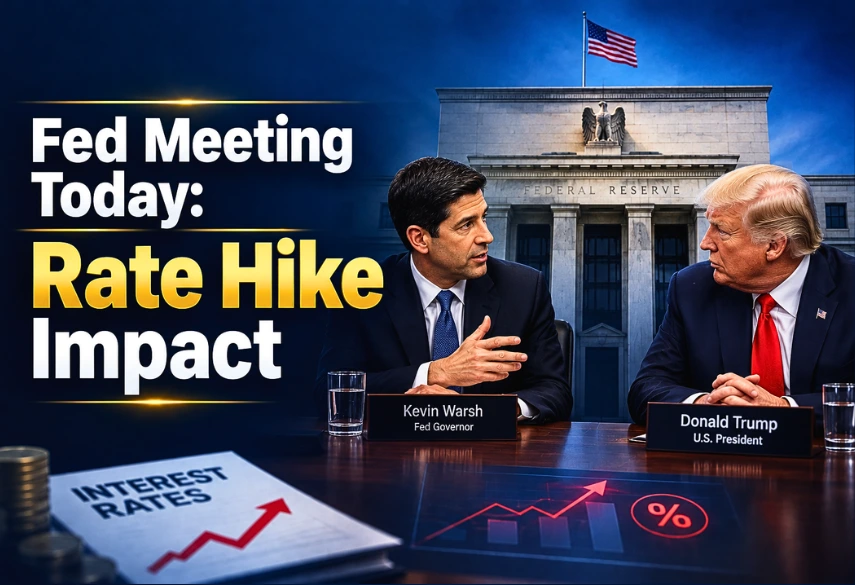
- It was also the first policy decision under new Fed Chair Kevin Warsh, who took over the Fed's top job this year.
- The Fed's reasoning: inflation is still running well above its 2% target — largely because of sharply higher energy prices — even though the US job market and overall growth remain solid. When growth is strong and inflation won't come down, hiking is the Fed's standard playbook.
- The Fed's own forecast (the "dot plot") now points to one more possible 25-bps hike before the end of 2026 — Reuters reported that 16 of the Fed's 18 policymakers see at least one further increase this year. That's not a promise, but it tells markets the Fed isn't done yet.
One more thing worth knowing: this decision hasn't been politically quiet. President Trump publicly pushed back within hours, calling for much lower rates, while Chair Warsh avoided commenting on the pressure during his press conference. That tension between the White House and the Fed is now part of the backdrop investors are pricing in, alongside the rate move itself.
Does a US Decision Move Your Indian Portfolio?
Think of global investment money as water — it flows toward wherever it can safely earn the best return. Here's the simplified chain:
Fed raises rates → US government bonds pay more → Global investors can now earn a solid, safe return just by holding US debt → India's stock market has to work harder to look attractive by comparison → Some foreign money that was sitting in Indian shares moves back to the US → That selling adds pressure on both Nifty and the rupee.
This flow of foreign money into and out of Indian markets is measured through FPI (Foreign Portfolio Investor) flows — you may also hear the older term FII (Foreign Institutional Investor) used interchangeably.
Importantly, this chain is a tendency, not a law of physics. If Indian companies post strong earnings, valuations are reasonable, and the rupee looks stable, foreign money can and does stay put—or even come in—even when US rates are high. We'll come back to this with real historical evidence later in this piece, because it matters more than the headline.
How Nifty, Sensex, Bank Nifty and Nifty IT Actually Reacted Today
This is where today's story gets genuinely interesting — because the reaction hasn't been uniform at all.
|
Index |
Today's Level / Move |
Key Detail |
|
Sensex |
~74,620, up ~0.40% (~285 pts) |
Resilient by mid-session |
|
Nifty 50 |
Slipped ~1.2% Tuesday, opened firmer Wednesday |
Broadly tracking Sensex's resilience |
|
Bank Nifty |
Almost flat, down ~0.29% |
Trading around 56,100 |
|
Nifty IT |
Down close to 1%, intraday low ~28,805 |
8 of 10 constituents in the red; down >6% over the past month |
Within Nifty IT, HCL Technologies led the fall (around -1.4%), followed by TCS (-1%), with Wipro, Tech Mahindra, Mphasis, OFSS and Coforge all down roughly 1% each.
Why the muted headline reaction but a sharp IT-specific one? According to Dr VK Vijaykumar, Chief Investment Strategist at Geojit Investments, the market had largely already priced in this hike — the Fed, in his view, had little real choice given the inflation backdrop. But not everyone is convinced the calm will hold. G Chokkalingam, founder of Equinomics Research, said he wouldn't be surprised by a further correction, flagging a possible 2–3% short-term dip in Nifty given the combination of the Fed hike, a weaker monsoon, rising bond yields, and elevated inflation. That's an individual analyst's near-term view, not a certainty — but it's a useful gut-check against over-confidence.
Rupee Crosses ₹96 — What FPI Selling Means for You
Two numbers matter here, and they're connected.
The rupee crossed ₹96 to the US dollar today — its weakest level in about two months. A weaker rupee raises the cost of anything India imports (starting with oil), and it also eats into returns for foreign investors when they convert their Indian gains back into dollars — which, in turn, can encourage more of that FPI selling we described above.
FPI flows have been genuinely under pressure this year:
-
According to NSDL data, FPIs have net-sold roughly ₹2.41 lakh crore worth of Indian equities so far in calendar 2026.
-
September alone has seen ₹17,222 crore of selling — notably reversing two straight months of FPI buying in July and August.
-
Zooming out, SEBI's own annual report pegged net FPI equity outflows for FY2025-26 at ₹1,80,832 crore, attributing it to a mix of high US bond yields, geopolitical tension, Indian valuations, rupee weakness and earnings concerns — the Fed is one factor among several, not the sole driver.
On the more reassuring side, the RBI is sitting on roughly $785.7 billion in foreign exchange reserves (as of early September), which gives it real firepower to smooth out disorderly rupee moves — though it's a buffer, not a guarantee of a fixed rate.
One additional risk analysts flagged alongside today's move: reports that the US House of Representatives has passed a bill proposing a 100% tariff on countries that import Russian oil — a category that includes India. If this progresses further, it would add a trade-policy headwind on top of the currency and rate story, and it's worth tracking over the coming weeks.
Crude Oil: The Hidden Story Behind This Whole Rate Hike
Almost everything above traces back to one commodity: oil.
Brent crude spiked to $107–109 a barrel in the days just before this Fed meeting, after drone attacks damaged Saudi Arabia's East-West pipeline — an important alternative route that lets crude bypass the Strait of Hormuz. That's eased somewhat since, back to around $102 a barrel, as Saudi Arabia signalled it could restore roughly half the pipeline's capacity within days and full capacity within about six weeks. Even so, crude remains dramatically higher than a year ago — up somewhere between 60–77% year-on-year, depending on the benchmark — almost entirely due to Middle East tensions.
This matters twice over for an Indian investor:
-
It's the single biggest reason US inflation has stayed sticky enough to force the Fed's hand — which is the whole story above.
-
India imports the vast majority of its crude oil. Expensive oil directly widens our trade deficit, adds to domestic inflation, and pressures the rupee further — completely independent of anything the Fed does.
If you watch one non-obvious number in the weeks ahead, make it crude oil, not just the Fed's next statement.
Sector-by-Sector: What This Means for Your Portfolio
Here's where "the market fell" turns into something you can actually act on. A Fed hike doesn't hit every stock the same way.
IT & Technology Services — genuinely a mixed bag
A weaker rupee is normally good news for IT exporters, since their dollar revenues convert into more rupees. But today's price action shows the opposite force winning for now: higher US rates raise the risk of tighter corporate tech budgets among IT firms' American clients, and that fear is outweighing the currency tailwind — hence today's sector-wide fall. Within the pack, some analysts continue to favour companies with strong AI-linked order books, such as Coforge and Persistent Systems, over the sector broadly.
Banks & NBFCs — largely a domestic story, for now
Since the RBI hasn't moved its own rate and remains in neutral mode, Indian banks aren't facing a direct funding-cost shock. The bigger sensitivity is indirect — global bond yield and liquidity spillovers — which is why Bank Nifty barely moved today. Worth watching, not worth panicking about.
Auto, Metals & other globally cyclical names
These sectors are more tied to global growth and commodity-demand expectations than to Indian rates specifically. A world where the Fed is hiking to cool growth is a headwind here, though domestic demand (especially auto) can partly offset it.
Import-heavy businesses — oil marketing companies, aviation, paints, etc
These face a double hit: a weaker rupee and, in some cases, higher crude directly raise input costs. Margins are the thing to track here.
Export-oriented & pharma names
Rupee weakness is a modest tailwind on realisations, all else being equal — though US-specific demand and pricing dynamics usually matter more for pharma than currency alone.
Rate-sensitive, high-leverage and expensive "growth" names
When global rates rise, the "discount rate" investors mentally apply to future profits goes up too, which tends to compress valuations hardest for stocks priced on earnings many years out. Balance-sheet strength and actual profitability matter more in this environment than growth stories alone.
FMCG & other domestic defensives
Typically the most insulated corner of the market from this specific story, since their revenue, costs and demand are overwhelmingly domestic.
The common thread across every sector: a strong balance sheet and real earnings growth matter more right now than they did a month ago.
RBI Also Raise Rates? Home Loan or FD?
Short answer: not automatically. The RBI does not mechanically copy the Fed — it runs its own, India-specific mandate.
At its last meeting (August 3–5, 2026), the RBI's Monetary Policy Committee kept the repo rate unchanged at 5.25%, holding a neutral stance for the fourth consecutive review, under Governor Sanjay Malhotra. The RBI is currently projecting 6.7% GDP growth and inflation of roughly 5% for FY27 — above its 4% target, largely due to food and fuel prices, but expected to peak in the October–December quarter before easing. The RBI itself has flagged West Asia tensions, volatile crude prices, an uneven monsoon and global trade uncertainty as its own key risks — the same forces driving this entire story.
The next RBI policy decision is due October 5–7, 2026 — just under three weeks away — and it's arguably the more important date for your home loan EMI or FD returns than anything the Fed does directly. What the Fed does affect is the RBI's room to manoeuvre: if a widening rate gap between the US and India adds more pressure on the rupee and imported inflation, that makes an RBI rate cut harder to justify, even if the RBI would otherwise prefer to support growth.
Déjà Vu? What Happened Last Time the Fed Went on a Hiking Spree
This isn't India's first rodeo with Fed tightening, and the history is genuinely more reassuring than the headlines today might suggest.
-
2013 ("Taper Tantrum"): Even the anticipation of Fed tightening was enough to trigger heavy FII outflows and a sharp rupee slide — proof that markets often react to expectations as much as to actual moves.
-
2015–2018: The Fed hiked gradually, and Indian markets held up reasonably well, cushioned by strong domestic reforms and improving corporate earnings. The lesson: when India's own fundamentals are solid, Fed pressure matters less.
-
2022–2023: This is the closest parallel to today — an aggressive Fed hiking cycle (which eventually peaked around 5.25–5.50%) combined with what were, at the time, record FPI outflows from India. And yet, the Sensex and Nifty still closed 2022 up 4.4% and 4.3% respectively — their seventh straight year of gains. Markets wobbled through the year, but domestic earnings and buying ultimately outweighed the foreign selling.
The takeaway isn't that Fed hikes don't matter — they clearly create real pressure, volatility and sector rotation, as we're seeing today. The takeaway is that a single Fed decision has never, on its own, been the deciding factor for where Nifty ends the year. Earnings and domestic fundamentals have consistently mattered more over any meaningful time horizon.

So, What Should a Nifty Investor Actually Do Today?
A one-day market move — up or down — is rarely a good reason to overhaul a portfolio. Here's what we'd suggest watching and doing instead:
Five things to track over the coming weeks, not the next few hours:
- The Fed's next signals — does incoming US inflation data support or undercut the case for another hike?
- US bond yields and the dollar — a sustained move matters far more than the day-of spike.
- FPI flow trends — a week or two of consistent buying or selling tells you more than any single session.
- The rupee and crude oil together — this combination hurts India more than either one alone.
- RBI's October 5–7 decision — and whether its tone shifts more hawkish or stays neutral.
Practical portfolio housekeeping:
- Resist the urge to panic-sell quality holdings on one red session — today's IT weakness, for instance, is a valuation and sentiment reaction, not evidence that fundamentally sound businesses have suddenly broken.
- Review how concentrated your portfolio is in rate-sensitive or richly valued growth names; this is a good moment to check, not necessarily to sell.
- If you're investing fresh money, staggering it (SIP-style) through a volatile phase is usually a more comfortable approach than trying to time a single "right" entry point.
- Keep an eye on companies with strong balance sheets and consistent earnings delivery — history suggests they're the ones that shrug off macro noise the fastest.

DISCLAIMER: This blog is NOT any buy or sell recommendation. No investment or trading advice is given. The content is only for educational purposes. Always discuss with your SEBI-registered financial advisor for investment-related decisions.