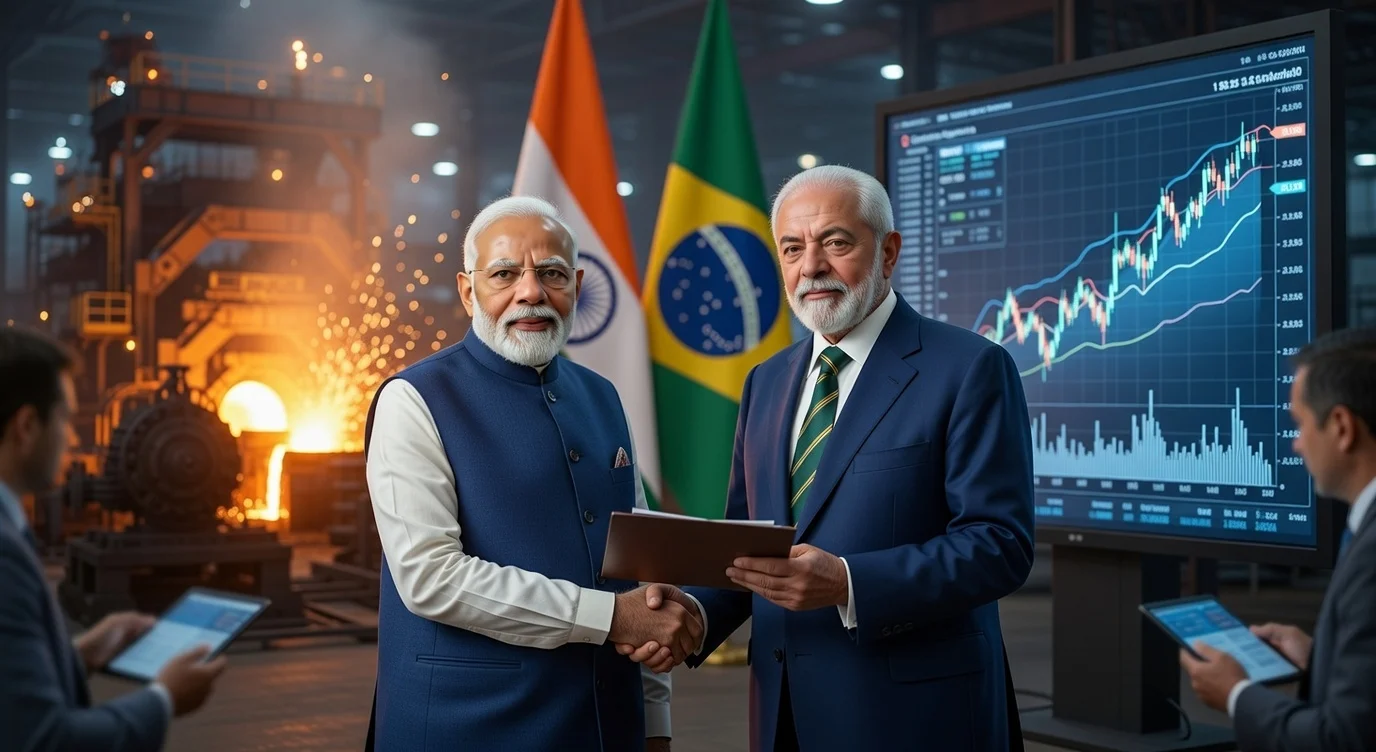
The latest iteration of the India-Brazil governmental collaboration has landed some of the players in the global trade market with some possible short-term gains. This memorandum of understanding (MoU) was signed on 21st February 2026, in conjunction with the state visit of the President of Brazil, Luiz Inacio Lula da Silva, to India. This MoU is an agreement pertaining to the India Steel Ministry and Brazil Ministry of Mining and Energy, and outlines the cooperation for the mining and minerals of steel.
With regards to the two of the main nations of BRICS vertically integrating, the big question that needs to be posed is whether it is a short-term spike or a long-term sustainability for the steel industry? This post will address the steel industry impact in India, the Brazil steel export deal, and the latest announcements in the stock market regarding steel news to assist the readers.
The Memorandum of Understanding (MoU) provides cooperation on the steel industry process, particularly as India is greatly increasing its steel production. Such production is driven by infrastructure, industry, and the construction of new urban areas. Steel production in India is estimated to be about 218 million metric tons annually. Because companies in India are increasing their production capacity, they will need to secure a continuous supply of raw materials.
Since Brazil is a leading producer of iron ore, this country will likely serve as India’s primary supplier of iron ore. The MoU will also aid in the supply of iron and other raw materials, such as manganese, nickel, and niobium. The MoU will also assist in the areas of technology, environmental management, and a financial commitment for raw materials.

The India-Brazil Trade Agreement on Steel
The India-Brazil Trade Agreement with the MoU, focuses on all segments of the India-Brazil steel trade. The MoU was signed by the two leaders, the Prime Minister of India Mr., and the President of Brazil Mr. Lula, in New Delhi and has the following objectives:
- Investment in Exploration and Mining: Funding for the identification and extraction of minerals needed for the production of steel.
- Development of Mining Infrastructure: Construction and improvement of mining facilities necessary for the preparation of the raw materials.
- Processing and Recycling Technologies: Improved methods for recycling minerals.
- Automation & AI Integration: Utilizing artificial intelligence in analyzing geoscientific data and the processes of automated mining.
- Sustainable Extraction: Implementing the best practices for the extraction processes to ensure long-term sustainability.
This is a Multilateral Agreement. It aims for significant improvement in international trade with a goal of 20-30 Billion for short-term bilateral trade. The initial goal for trade is 5 years and then in 2030, the goal increases to 30 billion. The MoU then aligns with another agreement for core and rare minerals, which illustrates a Diversified Supply Chain for the minerals that are currently in demand, with the involvement of global players in rare mineral extraction, specifically China.
For India, the India-Brazil MoU Steel initiative fits the Brazil National Priorities in the National Steel Policy and aims to have a Steel Production Capacity of 300 million tons by 2030. Due to the large iron ore reserves, Brazil, being the second top exporter of iron ore, positions itself well to mitigate the risks from the international market.
Short-Term Spike: Immediate Benefits for the Steel Sector
The MoU could lead to a significant increase in activity in the steel industry in India very soon. One benefit is the ease of access to high-grade raw materials from Brazil. This could also stabilise the input costs of raw materials like iron ore, which are critical for steel production and have been fluctuating due to geopolitical issues and supply chain disruptions. India’s steel production needs also require a raw material supply that is more predictable in both price and volume, with iron ore.
Steel’s impact in India is already visible in the early reactions. Experts in the industry are seeing the steel sector impact India as less dependency on old suppliers of raw materials, which will mean more cost savings for the industry leaders like Tata Steel, JSW Steel, and Steel Authority of India Limited (SAIL).
In the last few days, stock market steel news has shown steel-related shares on the Bombay Stock Exchange (BSE) have increased slightly. In the first rounds of trades, JSW Steel is believed to have gained a trading edge of 2 to 3 percent, based on the guarantee of free raw materials supply to the industry. This is likely to create more production capacity in the coming quarters as India’s National Infrastructure Pipeline and the India Infrastructure Development Plan are likely to create demand for more steel.
Additionally, the steel export deal with Brazil contained within the MoU, allows for Brazilian steel export arrangements with India to happen in the near future. Previously, Brazil’s steel exports to India were few, but this MoU allows for greater deal possibilities. This may also include deals on blended iron ore and Brazilian tri-partite deals for Indian ports like Adani Gangavaram. Immediate benefits include pilot projects on mineral blending and processing to relieve Indian mills' raw material shortages.
As for the steel market, the United States has put tariffs on steel imports, and the market is vertically supply-heavy. Many critics are of the opinion that a delayed crowning for this spike in trade activity is inevitable.

Indefinite Future: India-Brazil, MoU Steel
The India-Brazil steel MoU will create a longstanding promise within India’s steel sector for new improvements. The integration of technology within these improvements will also help create global standards for India’s steel sector. AI has the possibility of discovering new ore deposits that may be used for steel production, and mineral recycling technology is in support of green steel India has under the Paris Agreement.
With respect to the impact of the steel sector on India, over the years India will be able to receive steel or raw materials that are used to make steel from Brazil, decreasing dependence on Australia and China, two of Brazil's competitors, which is aligned to the Atmanirbhar Bharat initiative. Furthermore, steel production and consumption in India are expected to grow by approximately 8-10%, which is due to an increase in steel exports.
From Brazil's perspective, the deal on steel exportation from Brazil aids in economic growth by providing new alternatives for the exports of its minerals, further increasing export revenue, while Brazil is also in the process of economic growth. This could also lead to cost-sharing for new and improved infrastructure in the region, such as export logistics on India's east coast.
This partnership will also create opportunities for the Global South to improve their position in Multilateral Agreements and International Forums to increase equity in resources and jobs in the world, including Technical, Mining and Processing jobs, Environment and Sustainable Mining.
Challenges Ahead: Navigating Possible Roadblocks
Every agreement has obstacles. Initially, there may be issues related to bilateral regulatory compatibility, especially concerning differences in regulations related to the environment and foreign investments. The anticipated benefits may be diminished due to currency and global commodity price fluctuations. Furthermore, if the MoU is executed in a delayed manner, competition from other countries rich in minerals may hinder the MoU's impact.
The trade agreement between India and Brazil will also face a changing geopolitical environment. For example, the U.S. steel tariffs and recent increases on Brazil affect U.S. relations and therefore impact Brazil and India. India must balance its steel import tariffs to promote the objectives of the MoU.
Where there is uncertainty, there is also potential. The region's first use of digital technologies and artificial intelligence may create a new precedent for South-South cooperation and encourage similar frameworks in other sectors.
Steel Industry Stock Market Update: Investor Reactions and Predictions
In the steel industry stock market update, the recent MoU has prompted some positive sentiment towards Indian steel stocks. The Nifty Metal Index has gone up by around 1.5% and has also benefited Hindalco and Vedanta because of the critical minerals angle. Analysts from Angel One have predicted that if the MoU translates to some real deals, positive sentiment will persist, and the steel major’s earnings per share will increase by 5-7% in about 3-5 years.
On the other hand, the Brazilian steel giant Vale will benefit in terms of stock prices from new export opportunities. Investors will have to keep an eye on the timelines for the potential increase in stock prices because there are usually corrections in the stocks when there’s a delay in some of the important milestones.

Conclusion
The India-Brazil MoU on steel is a strategic step toward a strong, sustainable steel future, not just a bilateral agreement. The true value is in long-term resilience, innovation, and mutual growth, even when short-term production and stock increases are expected. With the Brazil steel export agreement acting as a pillar, India's steel industry might revolutionize global supply networks as the two countries negotiate this relationship.

DISCLAIMER: This blog is NOT any buy or sell recommendation. No investment or trading advice is given. The content is purely for educational and information purposes only. Always consult your eligible financial advisor for investment-related decisions.