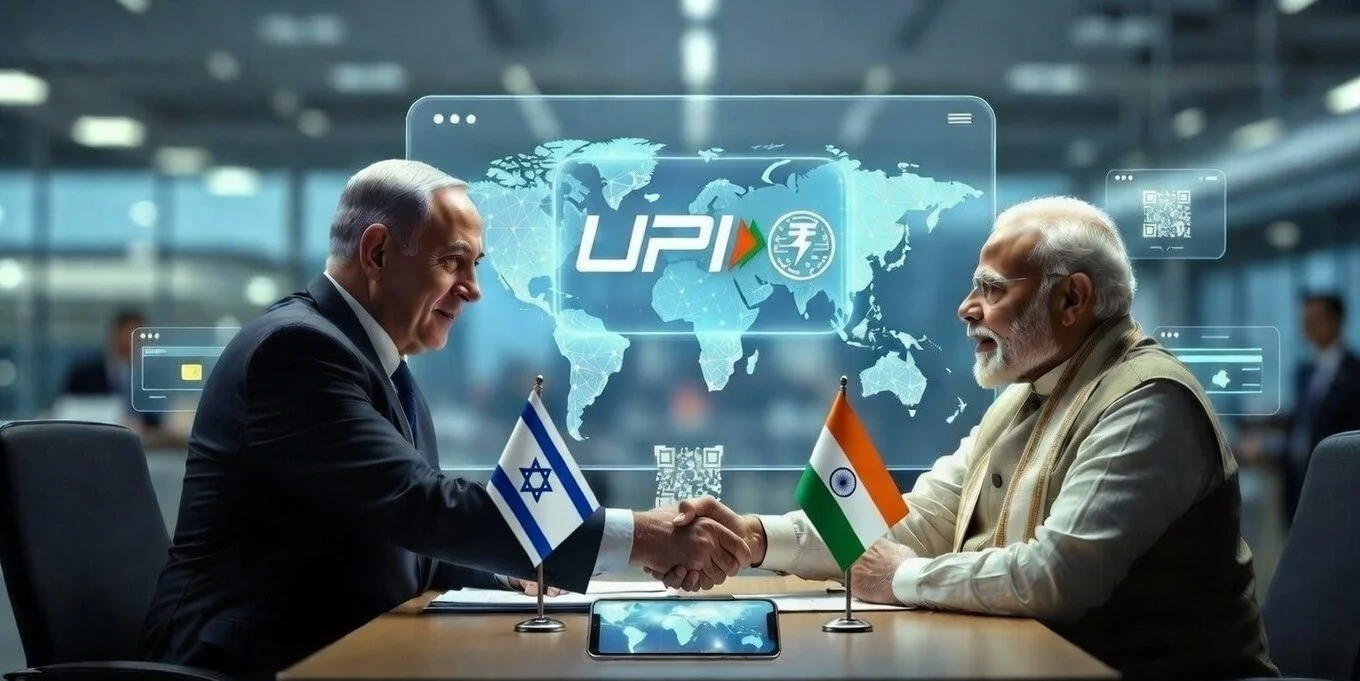
In a historic development for the Fintech sector on the India and Israel frontiers, on February 26, 2026, during the two-day state visit of the Prime Minister of India, Narendra Modi, to Israel, a press release confirmed that India and Israel have agreed to interlink India’s Unified Payments Interface (UPI) with Israel’s domestic fast payment system. The integration of UPI with Israel’s fast payment system will transform the payment system for Indians travelling to Israel and for thousands of cross-border traders.
Indian travellers, Non-Resident Indians (NRIs), Businesspeople, Students, and Professionals will benefit from this payment system integration. This will provide a solution to a critical problem of performing real-time payment transactions using an application like UPI. This development brings us to the most pertinent of all the questions surrounding the UPI integration - does the India-Israel UPI Deal 2026 mean that cross-border payment costs will go down? Will money transfers become cheaper from India?
Yes, this development will have far-reaching effects on India’s expanding global economic influence, resulting in positive changes for India and the Indians. In this article, we will explore the answers to this question, the implications, and the resultant positive changes for an ordinary Indian in this historic development.

The Phenomenal Rise of UPI: From Domestic Revolution to International Expansion
UPI, which stands for Unified Payments Interface, is India’s transactional invention that allows real-time digital peer-to-merchant payments using Quick Response (QR) codes. Because of UPI’s unique payment model, India has become the largest real-time digital payments market in the world. As of this year, UPI has become the fastest-growing payment service globally, averaging 18 billion transactions monthly. More than 80% of these monthly transactions are cardless.
Because of the model’s unique payment system, UPI-based payments are virtually free (zero fees for merchant payment and person-to-person payments). As a result of UPI’s transactions, payments do not require the input of banking details, wallets, or plastic cards. The success of UPI within the borders of India has made UPI a globally accepted payment system with the National Payments Corporation of India’s (NPCI) International Payments Division (NIPL).
The India-Israel UPI deal 2026 elevates UPI’s growing market to Israel, where, for the first time, UPI and Israel’s Money Automated Clearing House (MASAV) will be integrated. This means that India will be able to pay for Israeli goods and services, and vice versa, in their local currencies.
Outcomes from India-Israel UPI Deal: Strategic Partnership with Focused Fintech Collaboration
Israel hosted PM Modi from 25th to 26th February 2026, marking his first visit as Prime Minister of India. This visit is not merely ceremonial, as is typical for first visits by leaders to other countries; it has significant implications for bilateral relations. The two countries reaffirmed their connection as a ‘Special Strategic Partnership’ and signed over a dozen agreements covering defence, agriculture, AI, cybersecurity, critical minerals, and most notably, digital payments.
During the joint press briefing with Israeli Prime Minister Benjamin Netanyahu, Modi announced, “I am pleased that an agreement has been reached for the use of UPI in Israel.” Netanyahu praised India's UPI, describing it as a “world-class model for affordable, real-time cross-border transactions.”
The outcomes of Modi's visit, viewed primarily through an economic lens, further illustrate that the relationship between India and Israel is centred on digital payments and financial streams. The fintech sector, particularly digital payments, aligns perfectly as Israel seeks to expand its fintech connections with developing countries while supporting India's Digital India initiative.
The UPI integration, along with the ongoing negotiations for a Free Trade Agreement (FTA) and Israel's agreement to permit 50,000 Indian workers to migrate over five years (Workers’ Mobility Agreement), showcases a significant technological progression in India-Israel relations.
NPCI International Expansion Israel: Strategic Global Push
The NPCI International Expansion into Israel forms part of a positive strategy. NIPL is joining forces with regional payment solution providers to develop real-time, interoperable payment systems. A memorandum of understanding exists between NPCI International and Israel's MASAV operator in this region.
This initiative closely mirrors the successful model established with the UPI-PayNow linkage with Singapore, which became operational in early 2023. The remittance costs for small transactions decreased to 1.42% for certain banks, compared to 5-7% with traditional banks. Israel is anticipated to experience similar outcomes with real-time settlements and reduced fees for direct bank transfers.
This will position Israel as the 9th country to adopt UPI, and the positive digital public good value will further reinforce India’s leadership in digital innovation.
How will UPI in ISRAEL Work?
Regarding digital payments, users will be able to make transactions via their mobile devices at any terminal that is part of the UPI system. Indian digital payment users will have access to payment terminals in suburban and rural areas, as services will operate on mobile devices.
- For tourists and travellers: Merchants in Tel Aviv, Jerusalem, and Haifa will be able to accept payments through Indian digital payment systems in their stores and will facilitate transactions in Indian rupees via their payment systems.
- Use for Businesses and Exporters: Selling to Indian clients has been simplified as payments can be settled without delays in SWIFT payment systems, and without incurring high fees from correspondent banks.
- Use for Remittances: Sending payments to families (NRIs) is made simpler and cheaper, as the direct payment system avoids expensive money transfer operators.
- Two-way Benefit: Indian tourists visiting Israel can utilise local payment-linked applications (via the payment gateway) to bolster tourism in Israel.
The system will manage push and pull payments and will employ modern safety technologies (such as two-factor authentication and tokenisation) to ensure it is as secure as UPI.

Cross-border payment costs in India: The issues
Cross-border payments for Indian users remain expensive, and while the World Bank has projected this for late 2025, the world average for sending money stands at 6.5%, with estimates for India as follows:
- For a $200 transfer, India’s inbound remittance cost is 4.77%.
- 5-7% for outward remittances through banks.
- 1-3% for business wire transfers, in addition to flat fees, with a settlement period of 2-5 days.
The costs associated with cross-border payments from India are significantly impacting small exporters, making overseas education for Indians a financial burden, and raising costs for families sending remittances. This is primarily due to the involvement of several intermediaries, currency conversion spreads, and the use of outdated payment systems.
Will the Deal for India-Israel UPI Produce Foreign Remittance at a Lower Cost?
Yes, and here is the reason why we expect such a dramatic reduction in costs.
1. Fewer Intermediaries: A direct connection between UPI and MASAV is going to mean fewer steps in the payment process. This has been proven with UPI linkage in Singapore. Retail transfers are below 2%.
2. Funds Settlement in Real Time: No more 2-5 day waits. This means costs from lost profit opportunities and changes in foreign exchange will no longer be a concern.
3. Better Foreign Exchange Rates: This will occur because the banks and fintechs involved in the payment corridor will act in foreign exchange conversion the same way as we saw in the UAE and Singapore payment corridors.
4. User Fees Will Be Zero or Minimal: UPI payments domestically are very close to free. Internationally, a small user fee (0.5% to 2%) plus a foreign exchange charge that is fully disclosed and is substantially lower than traditional payment routes will result in lower payment processing fees.
The new deal for foreign remittance services will allow Indians sending money to their families or sending to Israeli partners to save about 50 to 70% when compared to current international wire transfer services. For example, a remittance of 500 dollars that currently costs 25-35 dollars in fees may cost less than 10 dollars after the deal.
Businesses that operate in Israel and tourists will benefit as well. The deal will enable customers to pay for their falafel in Jerusalem and also for their stay at the hotel in Eilat without the need to pay in cash.
Economic Benefits of the India-Israel Deal
Saving costs aside, the India-Israel UPI deal 2026 will:
- Increase bilateral trade, which is about 10 to 12 billion dollars a year, as payments will be easier.
- Increase the number of people travelling from India to Israel, as payments will be simplified. Currently, more than 100,000 Indians visit Israel annually.
- Provide remittance services to newly arrived Indian low-wage workers in Israel.
- Open new possibilities for Indian Fintech.
- Secure to strengthen the Axis of Digital Geopolitics.

Conclusion
More than just a payment pact, the India-Israel UPI deal 2026 is a potent representation of how two innovative democracies are working together to address pressing issues for their constituents. For Indians, this means more convenience when interacting with Israel, really cheaper overseas remittances, and lower cross-border financial expenses.
One thing is certain as UPI continues its global spread under NPCI in Israel and beyond: the days of costly, sluggish international payments are coming to an end. Indians will soon be able to enjoy the same seamless digital enchantment overseas as they do at home, thanks to the results of PM Modi's visionary visit to Israel and the implementation of NPCI.

DISCLAIMER: This blog is NOT any buy or sell recommendation. No investment or trading advice is given. The content is purely for educational and information purposes only. Always consult your eligible financial advisor for investment-related decisions.