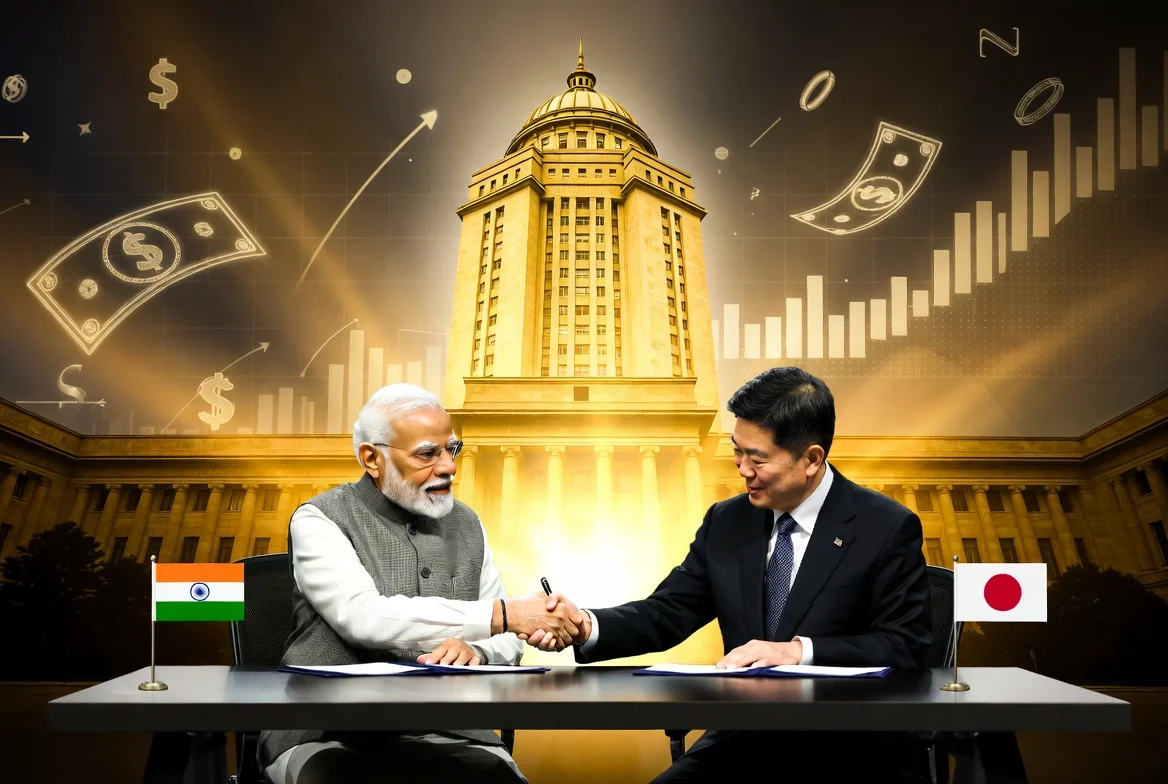
International trade deals have both risks and opportunities. One of the big opportunities lately has been the renewed trading relationship between these two countries. Experts estimate the India Japan economic deal is set to start on February 28th 2026. The deal focuses on creating a more effective bilateral currency swap. The deal also illustrates India’s growing dominance in the Asian economy. India’s economic growth has been rapid. Is the India Japan swap agreement a cause for an India economy boost? Is the India-Japan financial partnership a response to the current state of India’s economy?
What is the India Japan economic deal?
The India-Japan economic deal is not a new deal. The countries have a long trading relationship. The India-Japan economic deal is part of their economic relationship that has existed since the end of World War 2. India and Japan created the Special Strategic and Global Partnership in 2014. The India-Japan economic deal also includes other economic partnerships of the two countries.
The Comprehensive Economic Partnership Agreement (CEPA) formed the basis for the gradual reduction of tariffs and increased market access, allowing bilateral trade to reach nearly $25.17 billion for FY25.
Now, looking ahead to 2026, the 'new' agreement is merely a reworked version of this arrangement. However, it is incredibly well timed. With the current geopolitical changes, particularly the hostility between the U.S. and China and emerging supply chain problems, the renewal of the bilateral currency swap for the first time since 2021 is seen as a sign of strength of the two nations' relationships. Respective central banks (Reserve Bank of India & Bank of Japan, through Japan's Ministry of Finance), have signed a new agreement, which will preserve and extend the current agreement's maturity.
Why the India and Japan Economic Deal at this particular time? India's economy is growing at 7 to 8% but is being impacted by the volatility of the rupee and capital outflows. Japan is having problems with the depreciation of the yen, and is also looking for economic stability. From this perspective, the India Japan economic deal will serve as a conduit for enhanced economic liquidity while also providing some economic stability. As stated by the RBI on March 2, 2026, "the arrangement will further deepen financial cooperation between the two countries and contribute to regional and global financial stability."
Besides the financial swap aspect of the deal, it also relates to the 15th India-Japan Annual Summit and the Joint Statement of August 2025, which provided a 10-year diversified trade and investment vision. Japan has committed to an investment of 10 trillion yen, which is approximately 100 billion USD, as a pledge towards this diversified vision. Sectors such as semiconductors, green energy, and infrastructure will benefit. This deal has also undergone a transformation and is no longer just a financial instrument, but now will also help with the development of a more sustainable economic growth.

Understanding the India Japan Swap Agreement
The India Japan swap agreement is essentially a two-way bilateral currency swap system. In these kinds of agreements, the RBI and the Bank of Japan will make currency (INR and JPY) and dollar (USD) exchanges at certain pre-fixed rates and with an option for reverse transactions. This is a large (up to 75 billion USD, or approximately ₹ 6.25 lakh crore) liquidity buffer and does not involve an IMF (International Monetary Fund) loan.
India has previously implemented swap agreements with the Federal Reserve and other banks, but the agreement with Japan is different in terms of size, bilateral nature and reciprocation. The agreement, which represents enduring trust, is set to last until 2026. It was signed in 2018 at a meeting of PM Modi in Tokyo and renewed for 2022.
Other features include:
- Threshold Criteria for Activation: Swaps can be activated to respond to balance-of-payments issues or other scenarios of rapid movement of capital to ensure that the country has ready access to dollar liquidity without causing panic in the market.
- No Interest: Unlike most other types of financing that can be easily borrowed commercially, these swaps are almost interest-free, with only small fees which are based on LIBOR rates.
- Flexible Duration: The agreement is of indefinite duration, with the provision for a review at the end of the allocated time, allowing it to balance the significant risks of a changing world, including those which are caused or exacerbated by climate factors.
India needs to reduce risks caused by changes in exchange rates. This has always been a problem because of the large imports of oil and electronics. With the first fiscal year of 2024 in India, the current account deficit was 1.2% of the gross domestic product. However, this can extend due to external shocks. The swap works as a shock absorber by making the rupee stable and reducing the need for expensive interventions.
As for the country of Japan, this is an opportunity for greater investment, as they will now have INR (Indian Rupees) in greater quantity, making this investment liquidity accessible. Japan has invested over $38 billion in India. This kind of investment is a true partnership.
How the India Japan Financial Partnership Drives Broader Growth
The India Japan Financial Partnership is more than just a swap; it is part of a grand design of both countries for trade and investment coupled with innovations. The 2-way trade between both countries for the fiscal year 2023-2024 was only at $22.85 billion. The trade relations of both countries have a lot of room for improvement. The exports from India to Japan and the imports into India from Japan decreased to $4.92 billion, a decrease of 3.71% from the previous year. The 3 main fields of this trade relation are agribusiness, textiles, and pharmaceuticals. Japan is the 13th biggest trade partner of India and exports to India chemicals and machinery and imports gems, jewellery, and seafood from India.
The other investment Japan is making into India is in automobile manufacturing with Maruti Suzuki and Toyota. This investment will create many jobs in India. This investment will also pave the way for many other foreign direct investments (FDI) into India, especially the technology sector. The investment and trade relations between both countries have been set to increase by the 2025 Joint Vision, especially in the area of exports of electric vehicles.
Infrastructure: Since 2000, Japan's Official Development Assistance (ODA) has financed metro projects in Delhi and Ahmedabad, exceeding ¥4 trillion. The current financial partnership looks at private financing for bullet trains and smart cities projects under India’s Gati Shakti initiative.
There has been an increase in collaboration for technology and environmentally safe projects, such as the India-Japan Clean Energy Partnership (2022). The stability of the swap encourages investment in hydrogen and solar energy, which could increase GDP by 1-2% through enhanced diversified exports.
Analysts project that refining this partnership could increase bilateral trade to $50 billion by 2030, generating 500,000 jobs and supporting India's manufacturing under PLI schemes. It’s about positioning India as Japan's "China+1" alternative, not just numbers.
Bilateral Currency Swap: The Silent Guardian of Financial Security
Focusing on the bilateral currency swap, we cannot undermine its role as a safety net. Emerging economies like India are exposed to “sudden stops” in capital flow within a dollar-centred world. The crises of 2008 & 2020, and the resulting rupee crashes, were mitigated by the swaps offering immediate dollar inflows.
Compared to other countries, India's $75 billion agreement is the largest, allowing India greater control to combat imported inflation. When the agreement is activated, India gets US dollars and pays interest in rupees. When the agreement matures, the interest is reversed, minimising India's long-term debt.
There is also the benefit of less need to depend on multilateral lenders, which helps India retain some of its autonomy. A 2024 report suggests that the bilateral swap agreements (BSAs) lessen the need to de-dollarise and improve credibility of reserves. For Japan, it obtains Indian rupees (INR) to pay back its Official Development Assistance (ODA) and to make future investments.
The situation in 2026 becomes bilateral with a swap due to the increase in global interest rates and the decline of the Yen. India's $650 billion foreign exchange (forex) reserves are supplemented by the agreement, and it serves as the first level of protection.
Real Impact and Projection of the India Economy Boost
The deal results in an India economy boost and is positive in multiple ways. In the short run, increased foreign exchange (forex) stability is expected to lower interest rates by 50 to 100 basis points, which will provide the government with increased fiscal space to spend on new projects. The Indian rupee is expected to reach 85 rupees per dollar (₹85/USD) by 2025, and this will lead to a reduction in the value of the Indian rupee and cause a significant decrease in the level of imports. The agreement is expected to support a 7.5% increase in economic growth in the value of the Indian economy.
The long-term impact of the agreement is that India will improve its value chains by attracting new technology that will come from Japan. This will lead to the creation of new high skill employment opportunities and will increase the export revenues of India. India is expected to receive $10 billion in foreign direct investment (FDI) in the semiconductor area of the Rappu project in Gujarat. This will lead to a significant increase in the value of the Indian economy.
Moody's expects a 0.5% increase in India's GDP by 2028 due to improved trade and investment with Japan. India's exports will increase in Pharmaceuticals and IT services. Therefore, there will be an increased India economy boost.

Conclusion
The India Japan economic deal with the India Japan swap agreement and bilateral currency swap is a clear boost for India's economy. It strengthens financial shields, stimulates investments, and secures future prosperity.

DISCLAIMER: This blog is NOT any buy or sell recommendation. No investment or trading advice is given. The content is purely for educational and information purposes only. Always consult your eligible financial advisor for investment-related decisions.