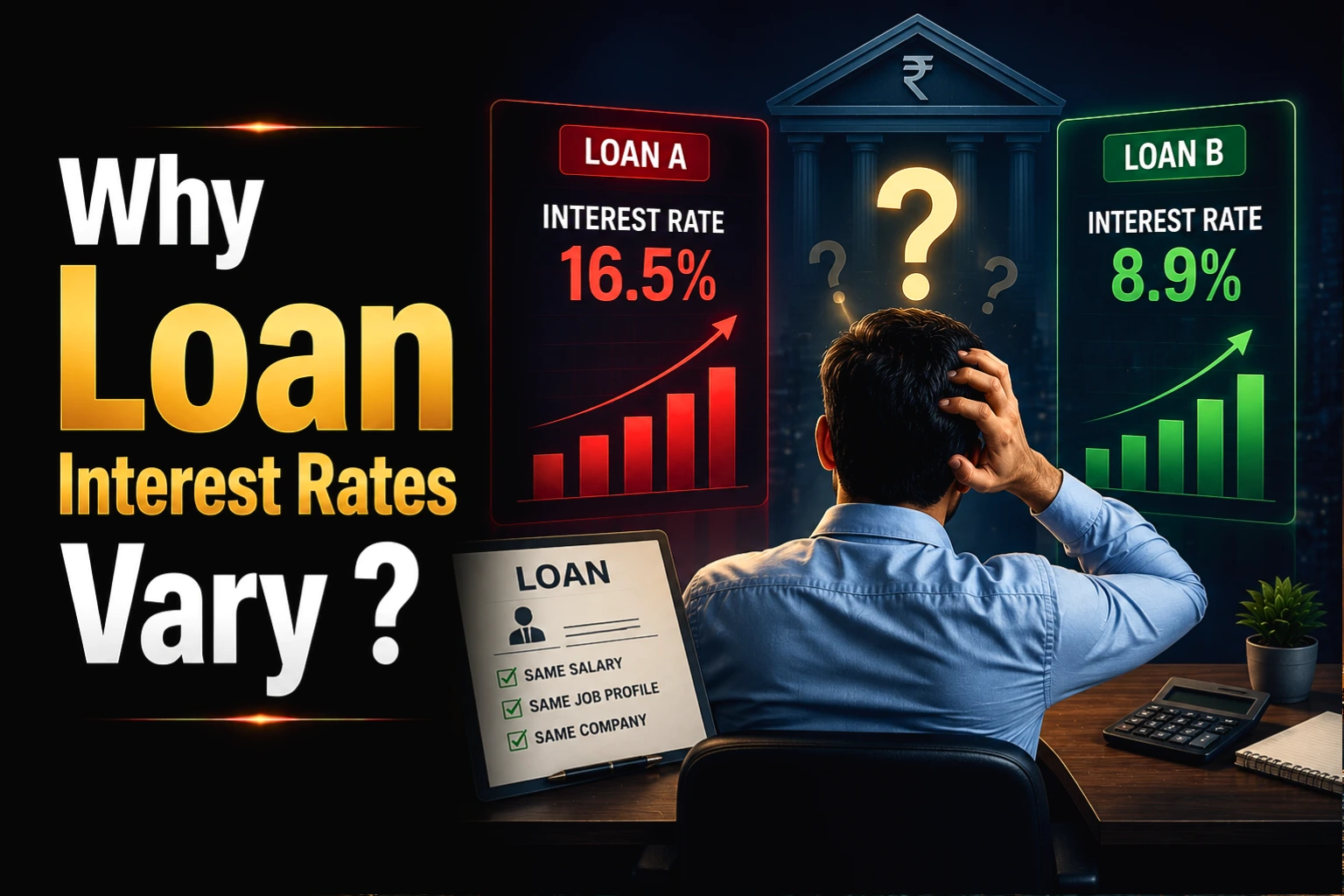
Two people earning the same salary often expect similar personal loan interest rates. So when one receives a significantly lower rate while the other is quoted higher, it feels inconsistent, almost unfair.
But in actual lending systems, salary is only a surface-level indicator. The real decision is driven by internal risk models that evaluate borrower behavior, financial stability, repayment predictability, credit history, FOIR (Fixed Obligations to Income Ratio), employer and employment stability, job tenure, and many other layered variables.
To understand how pricing structures are built at a system level, you can explore how lenders define personal loan interest rates in India based on borrower risk and policy models.
Risk Assessment in Personal Loans: Why Income Is Only the Entry Point
Most borrowers assume income determines loan pricing. In reality, income only determines eligibility to enter the system, not the final pricing outcome.
Once a borrower qualifies, lenders shift focus to a more important question:
“How predictable is this borrower’s financial behavior over time?”
Two applicants with identical salaries can behave very differently from a risk perspective:
- One maintains controlled credit usage, stable repayment habits, a long credit history, and consistent job tenure.
- The other shows fluctuating credit activity, irregular financial patterns, or shorter employment stability.
Even if both are equally “eligible,” their perceived risk levels differ. Risk directly influences interest rates.
Key additional factors lenders scrutinize include:
- Employer and employment stability: Government or reputed private sector jobs with low attrition often attract better rates than high-turnover industries or startups.
- Job tenure: Longer continuous service with the current employer (typically 2+ years) signals reliability and reduces risk premium.
- FOIR: Lenders prefer FOIR below 40–50%. High existing EMIs relative to income increase perceived strain, pushing rates higher even at the same salary.

Bank Algorithms: The Invisible Layer Behind Loan Pricing
Modern lending decisions are increasingly automated. Internal scoring systems evaluate hundreds of behavioral signals before assigning a final rate.
These systems typically analyze:
- Credit utilization trends over time
- EMI-to-income ratio (FOIR)
- Number of active loans and credit cards
- Frequency of credit inquiries
- Stability of repayment cycles
- Changes in financial behavior patterns
At a deeper level, these algorithms are not just checking affordability; they are identifying financial consistency under uncertainty.
Real lending insight
Once a borrower has a stable income, the algorithm stops focusing on “Can they pay?” and shifts to:
“Will their financial behavior remain stable if conditions change?”
This shift explains why salary parity does not guarantee rate parity.
Borrower Profile: The Real Factor Behind Interest Rate Differences
A borrower profile is a behavioral timeline, not a static snapshot.
Lenders interpret patterns such as:
- Long-term credit history and discipline
- Debt dependency levels
- Spending and repayment stability
- Credit mix diversity
- Financial volatility signals
- Job tenure and employer reputation.
Real-world scenario
Two employees in similar companies:
- Borrower A maintains steady credit usage and long-standing accounts
- Borrower B frequently opens and closes credit lines
Even with similar credit scores and income, Borrower A is often offered a lower interest rate due to stronger behavioral stability.
This is why personal loan eligibility is not just about salary; it is about financial behavior consistency across time.
Why Salary Bands Don’t Guarantee Fixed Interest Rates
A common misconception is that lenders assign fixed interest rates based on salary brackets.
In reality, salary is just one variable in a multi-layered pricing model.
Lenders also evaluate:
- Credit history depth and consistency
- Repayment discipline across multiple credit products
- Debt exposure levels
- Financial behavior stability over time
- Risk category of employment and income structure
Practical insight
A borrower earning slightly less but showing stable financial behavior can receive a better rate than someone earning more with inconsistent credit activity.
This is because interest rates are essentially a risk premium, not a reward for income level.
Key lending reality
Credit score alone does not determine interest rates. It is the trend of financial behavior behind the score that matters more.
How Credit Behavior Directly Impacts Loan Pricing
Even when income and credit scores are similar, behavioral differences can influence final loan pricing.
Lenders typically reward:
- Low and stable credit utilization
- Long credit history continuity
- Minimal recent credit inquiries
- Predictable EMI repayment patterns
On the other hand, rates may increase when:
- Credit usage spikes frequently
- Multiple loan applications are made in a short time
- Debt levels increase suddenly
- Financial behavior appears unstable or reactive
Additional Pricing Variables: Loan Structure and Lender-Side Factors
Beyond borrower behavior, several structural and institutional factors influence the final rate:
- Loan amount: Smaller loans may carry slightly higher rates due to fixed processing costs. Very large loans may attract stricter scrutiny or lower rates if the borrower’s profile supports it.
- Loan tenure: Shorter tenures usually mean lower interest rates (less risk exposure for the lender). Longer tenures increase total interest outgo and sometimes the rate itself.
- Pre-approved status: Pre-approved loans bypass much of the fresh scrutiny and often come with the lowest rates available for that profile.
- Existing lender relationship: Banks reward long-term customers with relationship-based pricing discounts.
- Lender risk appetite: NBFCs or fintechs with aggressive growth targets may offer competitive rates to acquire customers, while traditional banks remain conservative.
- Cost of funds: Changes in the RBI repo rate, liquidity conditions, or the lender’s own borrowing costs directly impact the base rate they can offer.
- Promotional offers: Festive seasons, salary account tie-ups, or limited-period campaigns can significantly reduce rates for eligible customers.

Total Borrowing Cost: Look Beyond the Interest Rate
Smart borrowers focus on total borrowing cost rather than just the headline interest rate. This includes:
- Processing fees
- Stamp duty and documentation charges
- Insurance (if bundled)
- Prepayment/foreclosure charges
- Impact of tenure on overall interest paid.
A slightly higher rate with lower fees and shorter tenure can be cheaper overall than a lower rate with high add-on costs and long tenure.
Comparison: Why Two Similar Salaries Get Different Rates
|
Factor |
Borrower A |
Borrower B |
Impact on Rate |
|
Monthly Income |
₹60,000 |
₹60,000 |
Neutral |
|
Credit History |
Long, clean, diverse |
Short, some late payments |
Lower for A |
|
FOIR |
35% |
55% |
Lower for A |
|
Job Tenure / Employer |
4+ years, stable MNC |
10 months, frequent switches |
Lower for A |
|
Recent Hard Enquiries |
None in last 6 months |
4–5 in last 3 months |
Lower for A |
|
Credit Utilization |
Stable 30–40% |
Fluctuating 70–90% |
Lower for A |
|
Lender Relationship |
Existing customer |
New customer |
Lower for A |
|
Pre-approved |
Yes |
No |
Lower for A |
|
Interest Rate Outcome |
Lower rate |
Higher rate |
- |
Common Mistakes That Increase Interest Rates Without Awareness
Many borrowers unknowingly raise their costs through:
- Multiple applications causing recent hard enquiries
- Maintaining high FOIR or credit utilization
- Frequent job switches affecting employment stability signals
- Closing old credit accounts (shortens credit history)
- Ignoring lender relationship benefits
- Chasing promotional offers without checking total borrowing cost.
How Borrowers Can Improve Their Interest Rate Profile
Improving loan pricing is less about negotiation and more about financial behavior optimization over time.
Practical improvements include:
- Maintaining controlled credit utilization levels
- Avoiding unnecessary credit inquiries
- Keeping long-standing credit accounts active
- Reducing short-term borrowing frequency
- Building a consistent EMI repayment history
Over time, these patterns improve borrower profile quality, which can lead to better loan pricing.
For borrowers actively comparing loan options, understanding low-interest personal loan structures and eligibility patterns can help make more informed decisions.

Conclusion
Personal loan interest rates are not fixed based on salary alone. They are shaped by a multi-dimensional evaluation of credit history, FOIR, employment and job tenure stability, behavioral patterns, loan structure, lender relationships, and institutional factors like risk appetite, cost of funds, and promotions.
Even with similar salaries, differences in these factors create different risk premiums. Understanding the full system helps borrowers improve their profile, compare total borrowing cost, and secure better personal loan terms in India. Focus on long-term financial discipline and stability — that’s what truly moves the needle.

DISCLAIMER: This blog is NOT any buy or sell recommendation. No investment or trading advice is given. The content is only for educational purposes. Always discuss with your SEBI-registered financial advisor for investment-related decisions.











.jpeg)