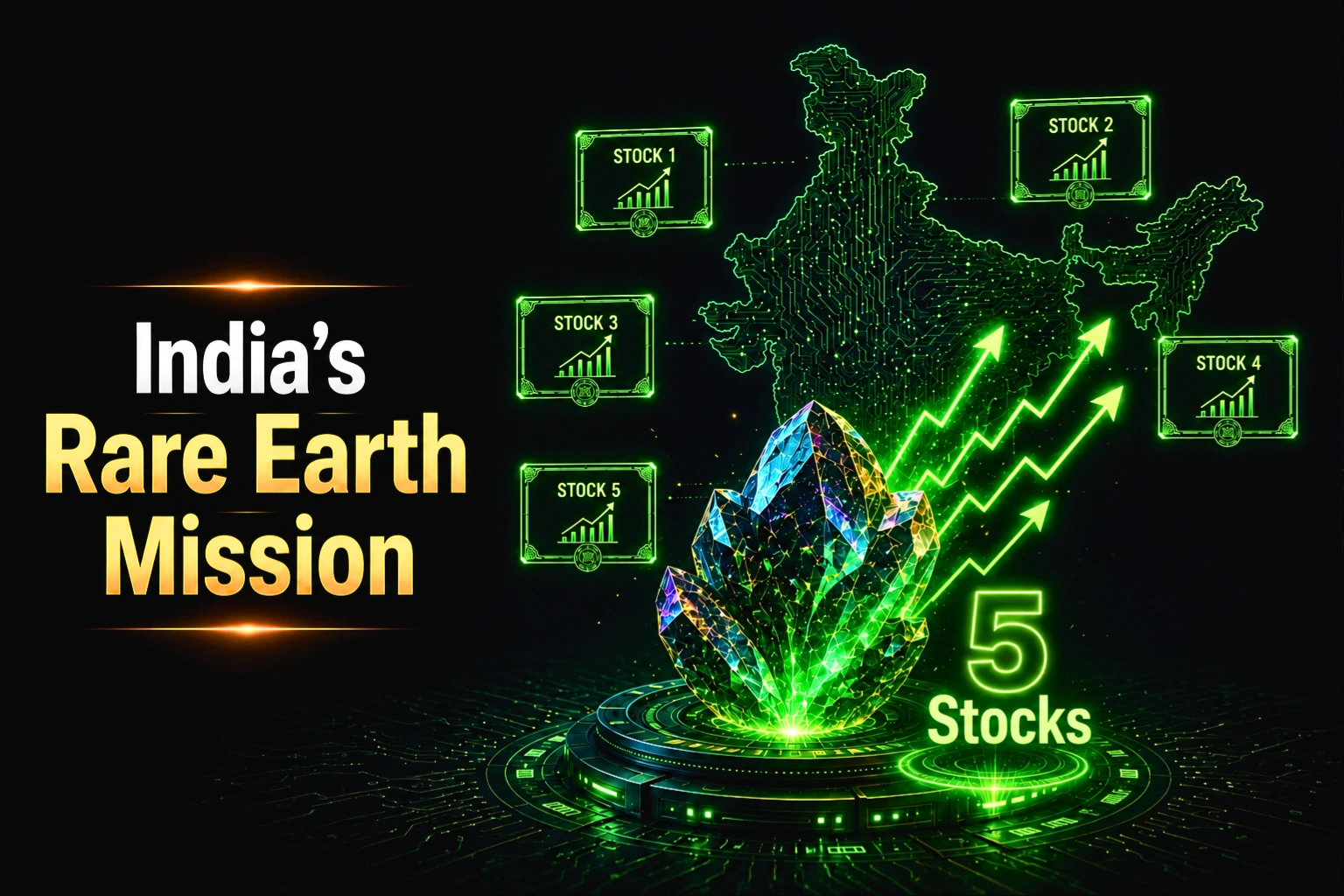
India is stepping up in a big way with its rare earth mission to reduce dependence on imports, especially from China. The government’s push includes schemes worth thousands of crores to build mining, processing, and magnet manufacturing capacity.
This creates exciting opportunities in rare earth stocks in India, mining stocks, and related sectors like EV stocks and defence stocks in the Indian stock market.
Short solution upfront: Investors can consider exposure to companies involved in critical minerals exploration, beach sand mining, and downstream manufacturing of rare earth magnets.
Key beneficiaries include mining firms like GMDC and Hindustan Zinc, along with magnet makers. Always do your own research, as stock markets carry risks, and past performance is not a guarantee of future results. Data as of early July 2026.

Why Rare Earths Matter for India’s Future
Imagine a world without smartphones, electric cars, wind turbines, or advanced defence missiles. Many of these modern wonders rely on rare earth elements (REEs) – a group of 17 special metals that are not actually “rare” but hard to mine and process cleanly.
For years, India had huge reserves but produced very little. The country holds significant monazite deposits in beach sands along its coasts, rich in rare earths like neodymium and praseodymium, essential for powerful magnets. But global supply was dominated by one country, creating risks for India’s growth in EVs, renewables, and defence.
That’s changing fast. Through the Rare Earth Mission and the National Critical Mineral Mission, India is building a full value chain. A major ₹7,280 crore scheme aims to create 6,000 MTPA of rare earth permanent magnet (REPM) capacity. Rare earth corridors are being developed in states like Odisha, Kerala, Andhra Pradesh, and Tamil Nadu.
What Are Rare Earth Elements and Why the Sudden Buzz?
Rare earths are used in tiny amounts but make a huge difference. Neodymium magnets are super strong and light – perfect for EV motors and wind turbines. They also go into electronics, medical devices, and military equipment.
India’s demand is expected to double in the coming years. The rare earth mission focuses on exploration, auctions, and incentives. This opens doors for mining stocks and companies that can move up the value chain.
India’s Strategic Moves: From Policy to Action
The government has opened mining to more players and partnered internationally. IREL (India) Limited is expanding, and private companies are entering through auctions. Latest updates (as of July 2026) show steady progress in block allocations and processing plants.
Direct Rare Earth & Critical Minerals Plays
These companies have direct exposure through mining, exploration, or magnet production.
- GMDC (GMDCLTD): Market Cap ~₹18,500-19,000 Cr, PE ~19-20, strong revenue growth from minerals. Exploring REE in Gujarat with plans for value chain development. Low debt position as a government-backed miner. Stock has shown volatility but benefits from policy tailwinds.
- Hindustan Zinc (HINDZINC): Market Cap ~₹2,24,000-2,27,000 Cr, PE ~16-17, robust revenue growth (~20% TTM), excellent profitability (high ROE/ROCE). Won a monazite block for rare earths. Strong balance sheet with low relative debt. Consistent performer with dividend appeal.
- NMDC (NMDC): Market Cap ~₹73,000-74,000 Cr, PE ~9.9-10.3, solid iron ore base with early REE exploration. Good cash flow and dividend yield (~4%). Low debt. Diversification into critical minerals provides exposure beyond iron ore, though rare earth contribution remains at an early stage.
- Permanent Magnets (PERMAG): Market Cap ~₹760-830 Cr, PE ~40-55 (premium valuation due to growth expectations), smaller player focused on magnet manufacturing. Benefits directly from the REPM scheme for EV and industrial use. Higher risk-reward as a small-cap.
- Vedanta (VEDL): Diversified metals major with potential in rare earth processing. Vedanta has a strong overall balance sheet, but monitor group-level debt.

Indirect Beneficiaries (EV, Defence & Broader Ecosystem)
These gain from increased local supply of magnets and critical minerals:
- EV/Auto plays like Tata Motors (TATAMOTORS), Mahindra & Mahindra (M&M), Bajaj Auto (BAJAJ-AUTO) – lower input costs for motors.
- Defence-related stocks are benefiting from indigenous magnet supply for advanced systems.
- Energy firms like NLC India (NLCINDIA) have synergies in critical minerals and power.
- NLC India (NLCINDIA) also has direct mineral exposure alongside energy operations.
Key Financial Highlights (as of early July 2026)
|
Company |
Ticker |
Market Cap (₹ Cr) |
PE (TTM) |
Key Strengths |
1Y Performance Note |
|
GMDC |
GMDCLTD |
~18,600 |
~19-20 |
REE exploration, low debt |
Volatile, policy-driven |
|
Hindustan Zinc |
HINDZINC |
~2,25,000 |
~16-17 |
Monazite block, high ROE, revenue growth |
Strong, dividend payer |
|
NMDC |
NMDC |
~73,600 |
~10 |
Diversification, cash rich |
Stable with upside |
|
Permanent Magnets |
PERMAG |
~800 |
~40-55 |
Direct magnet play |
Growth-oriented, volatile |
|
Vedanta |
VEDL |
Large |
Varies |
Processing potential |
Diversified exposure |
Note: Figures are approximate and fluctuate daily. Check live data on NSE/BSE. Revenue growth and debt positions are generally healthy for large miners like HINDZINC and NMDC due to strong cash flows.
How This Impacts EV & Defence Stocks
Local rare-earth magnets can reduce costs for EV makers and strengthen defence self-reliance. The ecosystem effect benefits the broader Indian stock market.
Challenges and Risks to Keep in Mind
- Environmental clearances and execution delays.
- Technology and processing challenges.
- Commodity price volatility and global competition.
- Small-caps like PERMAG carry higher risk.
Beginners should diversify and focus on long-term potential.
The Road Ahead: A Self-Reliant India
India’s rare earth mission is turning potential into progress. Watch for more auctions, capacity updates from GMDCLTD, HINDZINC, etc., and quarterly results.

Conclusion
India’s rare earth mission is more than a policy initiative — it is a strategic step toward economic self-reliance, technological advancement, and national security. By developing domestic capabilities in critical minerals, the country is not only reducing risky dependence on foreign supplies but also positioning itself as a key player in the global green energy and defence sectors.
(Sources: Yahoo Finance, Screener, Trendlyne, Indmoney, Ticker Tape, Economic Times, Livemint)

DISCLAIMER: This blog is NOT any buy or sell recommendation. No investment or trading advice is given. The content is only for educational purposes. Always discuss with your SEBI-registered financial advisor for investment-related decisions.