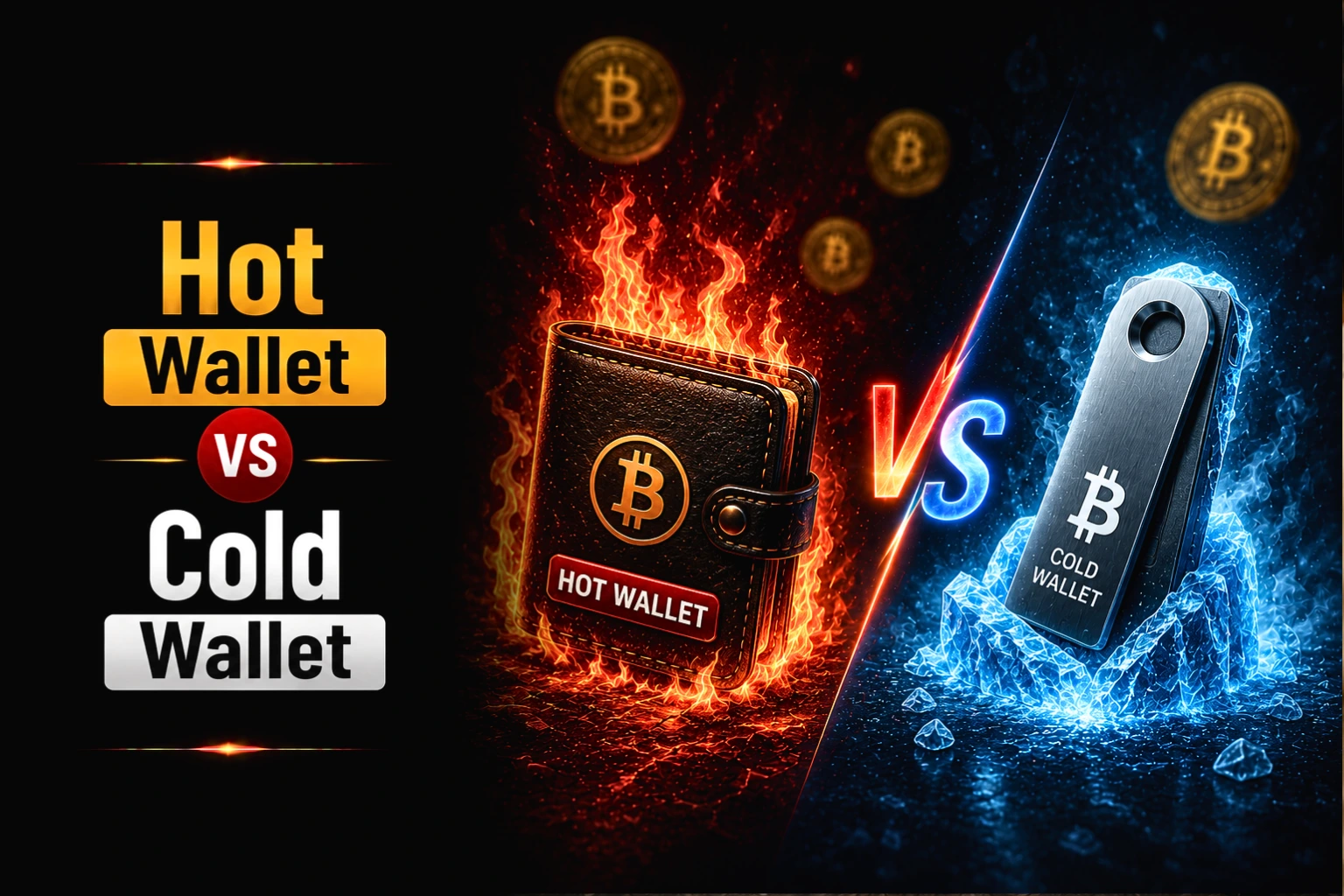
Choosing a crypto wallet can be confusing when you are just getting started. Some wallets provide instant access through a mobile app or browser, while others keep your private keys offline on a separate device.
So, which option is better in the hot wallet vs cold wallet comparison?
A hot wallet is generally more convenient for frequent transactions, learning, and interacting with crypto applications. A cold wallet offers stronger protection against many online threats because the private keys remain offline.
However, neither option is automatically safe in every situation. The right choice depends on how often you use crypto, how confidently you can manage wallet backups, and what type of risks you want to reduce.
In this blog, we will cover what a crypto wallet stores, types of hot and cold wallets, advantages and risks, safety of each wallet, checklist, mistakes to avoid, etc.
Hot Wallet vs Cold Wallet
A hot wallet is connected to the internet and is suitable for regular transactions, small experimental balances, and Web3 activity.
A cold wallet keeps the private keys or transaction-signing process offline. It is generally better suited to assets that you do not need to access frequently.
Many experienced users follow a combined approach:
- A hot wallet for regular activity.
- A cold wallet for assets intended for longer-term storage.
- A separate exchange account for buying or selling when necessary.
The safest setup is not simply the wallet with the strongest technology. It is the setup that you understand, can recover correctly, and can use without exposing your seed phrase or approving suspicious transactions.
What Does a Crypto Wallet Actually Store?
A crypto wallet does not store Bitcoin, Ether, or other crypto assets in the same way that a physical wallet stores cash.
Crypto assets remain recorded on their respective blockchains. A wallet acts as an application or interface that helps you access an account, view balances, generate addresses and sign transactions.
The most important element controlled by the wallet is the private key. A private key proves that you are authorised to move assets associated with a blockchain address. Anyone who obtains access to that key may be able to control the associated funds.
Ethereum’s official documentation describes a wallet as an application that lets users interact with their blockchain accounts, check balances and sign transactions. (ethereum.org)
This is why wallet security is primarily about protecting:
- Private keys
- Recovery or seed phrases
- Transaction approvals
- Connected devices
- Access to custodial accounts
What Is a Hot Wallet?
A hot wallet is a crypto wallet that operates on an internet-connected phone, computer, browser or online platform.
Because it is connected to the internet, it can quickly communicate with blockchain networks and crypto applications. This makes it convenient for sending tokens, receiving payments, swapping assets, accessing decentralised applications and experimenting with Web3 services.
Common Types of Hot Wallets
Hot wallets may include:
- Mobile wallet applications
- Desktop wallet software
- Browser-extension wallets
- Web-based wallets
- Exchange or custodial wallets
Popular examples include MetaMask, Trust Wallet, Coinbase Wallet, and Exodus. These are examples only, not product recommendations. Wallet features, network support and security policies may change, so users should review current official documentation before choosing one.
Advantages of a Hot Wallet
A hot wallet offers several benefits for beginners:
- It is usually free to download.
- Setup can be completed quickly.
- Funds can be accessed from a phone or computer.
- Sending and receiving transactions is convenient.
- Many wallets connect directly to decentralised applications.
- It is easier to use for frequent blockchain activity.
Risks of a Hot Wallet
The main disadvantage is its exposure to internet-connected environments. A hot wallet may be affected by:
- Phishing websites
- Fake wallet applications
- Malicious browser extensions
- Clipboard-replacement malware
- Keyloggers
- Compromised phones or computers
- Fraudulent token approvals
- Social-engineering scams
- Stolen recovery phrases
A strong password or biometric lock can protect the wallet application on your device, but it cannot protect funds when the recovery phrase has already been exposed or when you manually approve a malicious transaction.
Who Should Use a Hot Wallet?
A hot wallet may be suitable for users who:
- Make regular crypto transactions
- Use decentralised applications
- Are learning how blockchain transfers work
- Need convenient access to a limited transaction balance
- Understand basic phishing and device-security practices
Instead of choosing an arbitrary rupee limit, keep only the amount required for your planned activity in a hot wallet. The appropriate amount depends on your personal circumstances and risk tolerance.
What Is a Cold Wallet?
A cold wallet is a wallet setup in which the private keys or signing environment remain offline.
Cold storage reduces exposure to malware and remote attacks because the private keys are not normally available to an internet-connected computer or phone.
Is a Hardware Wallet the Same as a Cold Wallet?
A hardware wallet is one of the most common forms of cold storage, but the terms are not completely identical.
A cold wallet describes the broader security approach of keeping private keys offline. A hardware wallet is a physical device designed to generate, protect, and use private keys in an isolated environment.
Hardware wallets can connect to a phone or computer to prepare and broadcast transactions. However, a properly designed device signs the transaction internally without exposing the private key to the connected device. (Trezor)
Examples of hardware-wallet brands include Ledger, Trezor, Tangem, and SafePal. These names are provided for general awareness and do not represent endorsements.
Advantages of a Cold Wallet
Cold wallets can provide:
- Reduced exposure to online malware
- Offline private-key generation
- Physical confirmation of transactions
- Better separation between storage and everyday browsing
- Stronger protection for assets that are not frequently moved
Risks of a Cold Wallet
Cold wallets are safer against many remote attacks, but they are not risk-free. Users may still lose funds because of:
- A stolen or exposed recovery phrase
- Incorrectly recorded recovery words
- Loss of an optional passphrase
- Fake or tampered devices
- Fraudulent wallet software
- Phishing websites
- Address-replacement attacks
- Signing a malicious transaction
- Sending assets through the wrong blockchain network
- Poor inheritance or recovery planning
A hardware wallet cannot determine whether every transaction you approve is financially sensible or whether a smart contract is trustworthy. Users must still verify the destination address, network, amount, and transaction details.
What Happens If the Hardware Device Is Lost?
Losing the device does not necessarily mean losing the crypto assets.
In many wallet systems, access can be restored on a compatible wallet using the recovery phrase. However, the recovery phrase must be correct, confidential, and safely stored.
If someone else obtains that phrase, they may be able to restore the wallet without having the original device. For this reason, the recovery phrase is often more important than the hardware itself.
Hot Wallet vs Cold Wallet: Key Differences
|
Feature |
Hot Wallet |
Cold Wallet |
|
Internet exposure |
Regularly connected |
Keys or signing process remain offline |
|
Convenience |
High |
Lower |
|
Transaction speed |
Quick to access |
Requires additional verification |
|
Typical cost |
Usually free |
Hardware devices generally cost money |
|
Best use |
Regular transactions and Web3 activity |
Infrequent access and longer-term storage |
|
Malware exposure |
Higher |
Lower |
|
Phishing risk |
High |
Still possible |
|
Recovery |
Seed phrase or account recovery |
Usually seed phrase, sometimes with passphrase |
|
Physical device needed |
Not always |
Usually required for hardware wallets |
|
Transaction confirmation |
Phone, browser or computer |
Often confirmed on the physical device |
|
Beginner learning curve |
Lower |
Moderate |
|
Main responsibility |
Protect device and recovery phrase |
Protect device, recovery phrase and signing process |
Which Is Safer: Hot Wallet or Cold Wallet?
A cold wallet is generally safer against remote attacks because the private keys remain offline. However, “safer” depends on the specific risk being considered.
Security Comparison by Risk
|
Security Risk |
Hot Wallet |
Cold or Hardware Wallet |
|
Remote malware |
Higher exposure |
Lower exposure |
|
Fake application |
Possible |
Possible through fake companion software |
|
Seed phrase theft |
Vulnerable |
Vulnerable |
|
Device theft |
Possible risk |
Usually protected by PIN and recovery process |
|
Malicious smart-contract approval |
Vulnerable |
Still vulnerable if approved |
|
Address poisoning |
Vulnerable |
Still requires careful verification |
|
Physical loss |
Device or phone may be lost |
Hardware device may be lost |
|
Supply-chain tampering |
Less relevant |
Possible if bought from an untrusted seller |
|
Frequent transaction convenience |
Better |
Less convenient |
|
Offline key protection |
Limited |
Stronger |
Cold storage reduces certain technical risks, but it cannot fix unsafe user behaviour.
For example, a person using a hardware wallet may still lose assets after entering their recovery phrase into a fake website. Similarly, confirming a fraudulent transaction on the hardware device can authorise the transaction even though the private key never leaves the device.
Custodial vs Non-Custodial Wallets
Beginners often confuse the difference between a hot wallet, an exchange account, and a self-custody wallet.
Custodial Wallet
In a custodial arrangement, a third-party platform controls the private keys on your behalf.
This commonly happens when crypto is stored inside a centralised exchange account. You log in using an email address, password, and potentially two-factor authentication, but the platform manages the underlying keys.
Advantages may include:
- Familiar login and recovery process
- Convenient buying and selling
- Customer-support access
- Easier onboarding
Risks may include:
- Exchange hacks
- Withdrawal restrictions
- Account suspension
- Platform insolvency
- Loss caused by compromised login credentials
Non-Custodial Wallet
A non-custodial wallet gives the user control of the private keys or recovery phrase.
Advantages include:
- Greater direct control
- No dependence on an exchange for withdrawals
- Access to decentralised applications
- Ability to restore the wallet using the recovery phrase
The major disadvantage is personal responsibility. There may be no customer-support team capable of restoring access when the recovery phrase is permanently lost.
Why This Difference Matters
An exchange wallet can technically be a hot wallet, but not every hot wallet is controlled by an exchange.
For example:
- Exchange account: The platform controls the keys.
- Mobile self-custody wallet: The user controls the recovery phrase.
- Hardware wallet: The user controls keys kept in an offline device.
Understanding custody is as important as understanding the difference between hot and cold wallets.
Which Crypto Wallet Should a Beginner Choose?
There is no single wallet that is best for every beginner. Use the following decision framework.
Choose a Hot Wallet When:
- You are learning how transactions work.
- You need regular access to your assets.
- You use decentralised applications.
- You make frequent transfers.
- You can keep the wallet on a secure, updated device.
- You only keep the balance required for planned activity.
Consider a Cold Wallet When:
- You intend to hold assets without frequent transactions.
- The value of the assets would represent a meaningful financial loss.
- You understand how recovery phrases work.
- You can maintain a secure offline backup.
- You are comfortable checking transaction details on a separate device.
- You want to reduce exposure to phone or computer malware.
Use Both When:
- You need regular access to part of your portfolio.
- You also hold assets that are rarely moved.
- You want to separate everyday activity from longer-term storage.
- You understand how to transfer assets safely between wallets.
A combined approach can reduce risk by preventing one wallet from being used for every purpose.
For example:
- Use one hot wallet for regular transactions.
- Use a separate wallet for unfamiliar applications.
- Keep longer-term holdings in cold storage.
- Use an exchange account only when buying, selling, or withdrawing is required.
Crypto Wallet Safety Checklist for Beginners
1. Download Wallets Only From Official Sources
Use links provided on the wallet’s verified official website. Fake search ads, cloned websites, and unofficial application files can imitate legitimate wallet software.
Check:
- Website spelling
- App publisher
- Download count and history
- Official social profiles
- Application permissions
2. Never Share Your Recovery Phrase
No legitimate wallet support representative should ask for your complete seed phrase. Never enter it into:
- Google Forms
- Chat messages
- Email replies
- Customer-support tickets
- Unknown websites
- Unverified recovery tools
Anyone with access to the recovery phrase may be able to control the wallet.
3. Do Not Store the Seed Phrase Digitally
Avoid keeping it in:
- Phone screenshots
- Cloud notes
- Email drafts
- Messaging applications
- Online documents
- Unencrypted password files
Use a durable offline backup stored in a secure location. Avoid inventing your own complicated method of splitting or rearranging the words unless you fully understand the recovery implications.
4. Secure Custodial Accounts With 2FA
Two-factor authentication is mainly relevant to exchanges and other account-based custodial services.
Use an authenticator application or security key when supported. SMS-based verification may be better than using only a password, but it can be exposed to SIM-swap attacks.
Most self-custody wallets do not offer conventional account-based 2FA because there is no central company controlling the wallet login.
5. Verify the Blockchain Network
The same token may exist on multiple networks.
Before transferring, confirm:
- Token name
- Blockchain network
- Receiving address
- Deposit support
- Required memo or destination tag
- Network fee
When transferring to a new platform, send a small test transaction before moving a larger amount.
6. Read Every Transaction Before Approving It
Check the destination address, amount, network, and permissions.
Do not approve a transaction simply because a website says it is required for verification, airdrop access, or account recovery.
7. Use a Separate Wallet for Risky Web3 Activity
Do not connect your main storage wallet to every new decentralised application. A separate low-balance wallet can be used for:
- Experimental applications
- New NFT platforms
- Token claims
- Unverified smart contracts
This limits the impact if an application is malicious.
8. Buy Hardware Wallets Carefully
Purchase directly from the manufacturer or an authorised seller. When setting up the device:
- Confirm the packaging and device condition.
- Generate the recovery phrase yourself.
- Do not use a phrase printed inside the package.
- Install firmware through official software.
- Verify addresses on the hardware-wallet screen.
9. Maintain a Recovery Plan
Ask yourself:
- Can I restore the wallet if my phone breaks?
- Can I recover access if the hardware device is lost?
- Is the recovery phrase readable?
- Does a trusted person know what to do in an emergency?
- Have I documented the process without exposing the secret?
Test the recovery process only in a controlled and secure way. Never enter a valuable wallet’s seed phrase into an unfamiliar application simply to test it.
Common Crypto Wallet Mistakes Beginners Should Avoid
- Keeping Everything in One Wallet: Using the same wallet for storage, trading, and unknown applications creates unnecessary exposure.
- Confusing a Wallet With an Exchange: A wallet manages blockchain access. An exchange helps users buy, sell, or trade assets. Some platforms offer both functions, but they involve different custody and security arrangements.
- Trusting Fake Support Accounts: Scammers often contact users pretending to be wallet employees. Legitimate support teams do not need your seed phrase to diagnose a normal problem.
- Taking a Screenshot of the Seed Phrase: Screenshots may be uploaded automatically to cloud storage or accessed by malicious applications.
- Blindly Signing Transactions: A hardware wallet protects the key, but it cannot protect you when you intentionally approve a harmful transaction.
- Ignoring Token Approvals: Some decentralised applications request permission to spend tokens from your wallet. Unlimited or unnecessary approvals may create ongoing risk.
- Sending Assets on the Wrong Network: A correct-looking address does not guarantee that the receiving platform supports the selected network.
- Buying a Preconfigured Hardware Wallet: A device that arrives with a recovery phrase already prepared should not be trusted. The user should generate a new phrase during the official setup process.
Crypto Wallet Considerations for Users in India
Indian users should separate three activities:
- Buying or selling crypto through an exchange or on-ramp
- Storing crypto in a self-custody wallet
- Recording transactions for tax and compliance purposes
UPI availability is generally a feature of an exchange or payment provider, not a defining security feature of a crypto wallet.
Users should maintain records of:
- Purchases and sales
- Exchange withdrawals
- Wallet-to-wallet transfers
- Transaction hashes
- Network fees
- Dates and asset quantities
- Relevant INR values
The Income Tax Department continues to include dedicated reporting and TDS provisions relating to virtual digital assets. Requirements can change, so users should review the latest official guidance or consult a qualified tax professional before filing returns. (Income Tax Department)
Using a personal wallet does not remove potential tax or reporting responsibilities.
Hot Wallet vs Cold Wallet: Final Recommendation
For most beginners, the right choice depends on how the wallet will be used.
|
User Situation |
Suitable Approach |
|
Learning basic transactions |
Reputable hot wallet with a limited balance |
|
Regular Web3 activity |
Separate hot wallet |
|
Frequent buying and selling |
Secured exchange account plus personal wallet where appropriate |
|
Long-term storage |
Cold or hardware wallet |
|
Valuable holdings |
Cold storage with a carefully tested recovery plan |
|
Unfamiliar applications |
Separate low-balance wallet |
|
User cannot manage a seed phrase |
A reputable custodial solution may be more practical, despite custody risks |
A cold wallet usually provides stronger protection against online key theft, but it also places greater responsibility on the owner.
A hot wallet offers easier access, but that convenience increases exposure to phishing, malicious software, and unsafe applications.
The strongest approach is often to avoid relying on a single wallet for everything. Separate regular activity from longer-term storage, protect every recovery phrase, and verify every transaction before approving it.

Conclusion
The hot wallet vs cold wallet decision is not simply about choosing convenience or security. A hot wallet is useful for regular transactions, learning and accessing decentralised applications. A cold wallet is better suited to assets that do not need to be moved frequently and provides stronger isolation from many online threats.
Whichever option you choose, your security ultimately depends on how you protect the recovery phrase, verify transactions, manage connected devices and respond to suspicious websites or messages.

DISCLAIMER: This blog is NOT any buy or sell recommendation. No investment or trading advice is given. The content is only for educational purposes. Always discuss with your SEBI-registered financial advisor for investment-related decisions.




.webp)