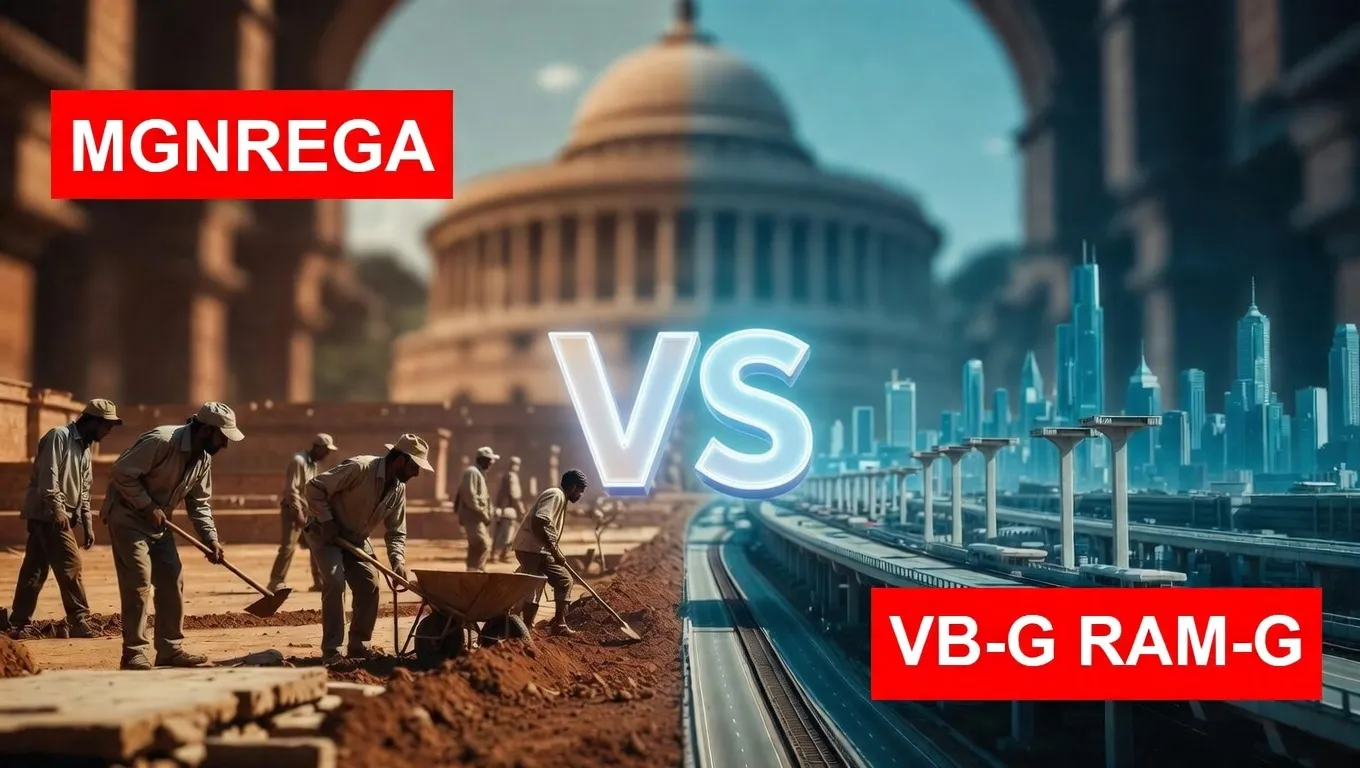
With changes in India's employment policies, the MGNREGA & Viksit Bharat employment programmes comparison has gained interest rapidly. With India aiming to become a developed country by 2047, is the government discontinuing MGNREGA to focus on the Viksit Bharat employment scheme? This employment scheme comparison signals a shift in focus within government jobs scheme India to employment creation integrated with sustainable, developed, and skilled solutions.
This blog analyses the India employment scheme comparison, MGNREGA 2026 update, and examines if changes represent replacement or evolution.
Overview of MGNREGA
The government of India first introduced the MGNREGA programme in the year of 2005 to help combat financial inequality and poverty in the countryside and to assist with the construction of rural infrastructure by providing families in rural India with 100 days of employment in construction to develop rural public works. MGNREGA also instructs the government to pay the participant the amount of money that they would have made through working as a construction public servant, should the participant not be able to be provided a job after 15 days.
The problems that MGNREGA faces include payment delays and issues related to state-level management differences.

Recent information concerning the MGNREGA update 2026 indicates a considerable shift in the MGNREGA programme. The MGNREGA programme for 2025 - 2026 reported 192 crore person-days of work completed, averaged out to 12 crore active workers working on the MGNREGA programme.
MGNREGA update 2026 revealed that the Union Budget 2026 - 2027 was a 50% decrease in allocation for MGNREGA, dropping from 88,000 crore to 30,000 crore, in order to pay off pending government debts. It is also a signal to workers that pending government debts are a way to begin the phasing out of the MGNREGA programme, leaving workers protesting to try to hang on to their MGNREGA employment benefits.
MGNREGA's model is based on a government programme that was designed to pay construction workers in order to stimulate the economic market to recover from the recession, which is a permissible and legal practice, and demonstrated the need for such a model during times of economic distress and recession.
Viksit Bharat: A Vision for Employment and Developed India
Viksit Bharat, meaning Developed India, aims to transform India into a high-income economy by 2047. It focuses on infrastructure and technology while also including the employment schemes Viksit Bharat Rozgar Yojana which aims to reward employment opportunities created in 2025.
This scheme focuses on first-time employment and the framing of the workforce into the newly created jobs. In A, new employees registered in the EPFO of up to ₹ 1,00,000 and under get a bonus of ₹ 15,000 in two parts. In B, employers get EPFO contribution reimbursements, which benefit up to 4 years in the manufacturing sector to create 3.5 crore jobs with ₹ 99,446 crore allocation. This scheme, as well as Viksit Bharat, aims to enhance the social security and employability of the target group.
Also adding the urban and semi-urban areas, creating formal and skill development jobs, the vision aims to fight youth unemployment, which among educated youth stood at a staggering 3.2 percent in 2023 and 2024. Integrating green energy, digital governance and entrepreneurship with the semi-urban and urban skill and formal employment, the Viksit Bharat scheme also aims to combat the rural bias of MGNREGA. It also integrates green energy, digital governance and entrepreneurship.
Viksit Bharat Versus MGNREGA: A Deep Dive Comparison
The comparison between Viksit Bharat and MGNREGA primarily focuses on whether Viksit Bharat is replacing MGNREGA. This can be seen with the introduction of the Viksit Bharat-Guarantee for Rozgar and Ajeevika Mission (Gramin) (VB-G RAM G) Act, 2025.
The Act was passed in December 2025 and MGNREGA was replaced by VB-G RAM G, which now provides 125 days (previously 100) of guaranteed work and weekly payments. They also prioritise four areas: water security, rural infrastructure, climate resilience, and livelihood improvement.
Below is a brief comparison of India employment schemes in table format.
|
Aspect |
MGNREGA (2005) |
VB-G RAM G (2025) / Viksit Bharat Rozgar Yojana |
|
Guaranteed Days |
100 days per household |
125 days (VB-G RAM G); Incentives for formal jobs (Rozgar Yojana) |
|
Funding Model |
100% Centre for wages; 75% for materials |
75:25 Centre-State for wages; Normative funding |
|
Focus Areas |
Broad rural works |
Water security, infrastructure, Skill-linked jobs |
|
Payments |
Bi-weekly or delayed |
Weekly; Direct incentives up to ₹15,000 |
|
Scope |
Rural unskilled labor |
Rural + Urban; First-time employees and employers |
|
Unemployment Allowance |
Yes, if the work is not provided within 15 days |
Retained in VB-G RAM G |
|
Budget 2026-27 |
₹30,000 crore (pending dues) |
₹95,692 crore for VB-G RAM G |
The evolution of this government jobs scheme in India addresses issues with MGNREGA, such as asset quality and payment delays, while also aiming to align with Viksit Bharat 2047. The funding shift now places the burden on states, and the 60-day agricultural pause may disrupt seasonal work. Protests have raised concerns over the potential dilution of rights, and the name change, omitting “Mahatma Gandhi,” has sparked political controversy.
Changes in the 2026 MGNREGA Update and What It Means For Us
The 2026 MGNREGA update reflects the changes in the Union Budget. VB-G RAM G received the largest funding for rural development, with an expansion of 95,692 crores; the MGNREGA budget for clearing overdue payments indicates a reset. The dual funding totalling 1.25 lakh crores shows a staged transfer, while VB-G RAM G is focused on funding more permanent digital assets and tools.
Experts agree that the economic uplift of rural areas, with higher earnings and lower distress migrations, is a positive reason for the changes. Data mismatch exclusions continue to cause concern for many. The name change controversy has seen a budget allocation for the Mahatma Gandhi Gram Swaraj Initiative for khadi and handicrafts, indicating that the name is respected, but the initiative also moves forward.
Broader Government Jobs Schemes in India
The employment landscape in India encompasses more than just Viksit Bharat vs. MGNREGA. There is the Atmanirbhar Bharat Rojgar Yojana (ABRY), which provides positive employment creation incentives post COVID and has benefited 60.49 lakh workers. Self-employment is supported under the Pradhan Mantri Mudra Yojana through unsecured loans, while the Employment Linked Incentive (ELI) under PMVBRY aims to reach 4.1 crore young people.
Urban schemes like the Pradhan Mantri Rojgar Protsahan Yojana (PMRPY) promote the creation of formal jobs. They complement rural schemes and mitigate disparities and negative structural changes. Given that unemployment stood at 5% in January 2026, these initiatives focus on creating productive jobs in response to technological advancements.
Is India Replacing MGNREGA? The Road Ahead
So, is India replacing its largest job scheme? Yes, but it is more of a replacement of the scheme. VB-G RAM G builds on MGNREGA and provides more guarantees while aligning with the ambitions of Viksit Bharat. The Viksit Bharat Rozgar Yojana formalises this and supports sustained growth. However, this will only be possible if the implementation of these initiatives is more streamlined, inclusive, and less of a burden on the state.

Conclusion
These initiatives are India’s response to the dual demographic and climate crises and will help move the country closer to Viksit Bharat. For rural workers, the transition must protect all rights of workers and create work opportunities that develop the necessary skills. In the comparative study of employment schemes in India, this evolution is expected, but to be effective, the changes must be managed closely.

DISCLAIMER: This blog is NOT any buy or sell recommendation. No investment or trading advice is given. The content is purely for educational and information purposes only. Always consult your eligible financial advisor for investment-related decisions.







 72.jpg)