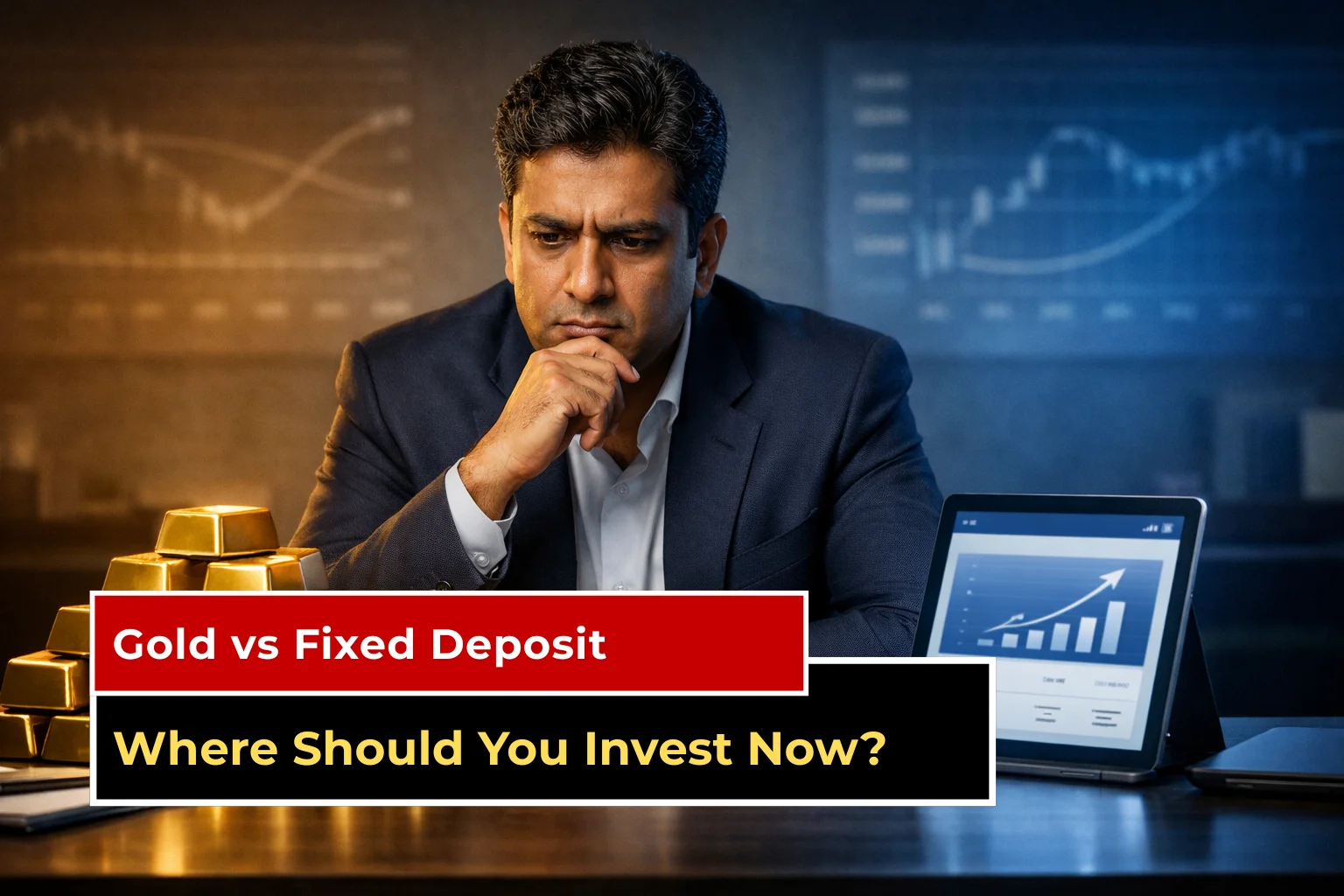
Introduction: The ₹5 Lakh Question Every Indian Investor Asks
Imagine you have ₹5 lakh saved after years of careful planning. Prices of daily essentials keep rising quietly, and the world feels uncertain with global tensions. Your bank manager recommends a Fixed Deposit (FD) for complete safety. Your friend swears by gold because it has given exceptional returns lately. This gold vs FD dilemma is one of the most common financial questions in Indian households today.
In this beginner-friendly guide, we compare gold vs fixed deposit returns, safety, tax implications, and liquidity using real 2026 data. We also examine the gold price outlook for 2026 and how gold works as an inflation hedge in India. No jargon — just clear examples and actionable insights.
The Story of Raj and Meena: Why This Question Matters in 2026
Raj and Meena are cousins in their 30s, both working professionals in India. Raj is deeply risk-averse — he parks all savings in bank FDs and sleeps soundly knowing his principal is safe. Meena started buying digital gold through a trusted app last year and watched her money grow significantly when gold prices rallied sharply through 2025 into 2026.
Raj had guaranteed returns. Meena had higher returns. Now, with gold at record highs and FD rates stable at 7–8%, both are wondering: should I stay the course, or change strategy? Their dilemma is yours too.
What Is Gold Investment? (Types Explained)
Gold investment means buying gold in any of these forms:
• Physical Gold: Coins, bars, or jewellery. High emotional value for Indian families, but involves making charges (5–25%) and storage costs.
• Digital Gold: Buy from as little as ₹1 through apps like PhonePe, Google Pay, or MMTC-PAMP. No storage headache.
• Gold ETFs: Traded on NSE/BSE like shares. Highly liquid. Tracked by SEBI. Require a demat account.
• Gold Mutual Funds: Invest in Gold ETFs without needing a demat account. Good for SIP investing.
• Sovereign Gold Bonds (SGB): RBI-issued bonds. Earn 2.5% annual interest + gold price appreciation. Capital gains tax-free on maturity (8-year tenure). Best long-term option.
What Is a Fixed Deposit (FD)? (Complete Guide)
A Fixed Deposit is a savings instrument where you deposit a lump sum with a bank or NBFC for a fixed period (6 months to 10 years) at a guaranteed interest rate.
• Regular Bank FD: 6%–7.5% p.a. at major banks (SBI, HDFC, ICICI, etc.)
• Small Finance Bank FD: Up to 8.5% p.a. — higher returns, slightly more risk (still DICGC insured up to ₹5 lakh)
• Senior Citizen FD: Additional 0.25%–0.5% above regular rates — available at most banks
• Tax-Saving FD: 5-year lock-in, qualifies for ₹1.5 lakh deduction under Section 80C
DICGC insures deposits up to ₹5 lakh per depositor per bank. If you have more to invest, spread across multiple banks.

Gold vs Fixed Deposit Returns: Historical Performance
|
Period |
Gold Returns (Approx. CAGR) |
FD Returns (Average) |
Winner |
|
Last 1 Year (2025–26) |
~25–35% (strong rally) |
6.5–7.5% |
🥇 Gold |
|
Last 5 Years |
12–15% |
6.5–7.5% |
🥇 Gold |
|
Last 10 Years |
11–12% |
~7% |
🥇 Gold |
|
Long Term (20+ years) |
10–12% |
7–8% |
🥇 Gold (mostly) |
Important Note:
The above are approximate CAGR figures. Gold returns are not guaranteed and can be volatile year-to-year. FD returns are fixed as agreed at time of investment. Past performance does not guarantee future results.
Before investing, use the Finowings FD Calculator to calculate your exact maturity amount.
Gold Price in India Today (April 2026) and 2026 Outlook
As of 21 April 2026, 24K gold is trading at approximately ₹15,200–₹15,528 per gram (₹1,52,000–₹1,55,280 per 10 grams) in India. Prices have eased slightly from recent peaks but remain elevated.
Gold Price Outlook 2026: Goldman Sachs has raised its gold price forecast to $5,400 per ounce by end-2026, driven by continued central bank purchases and investor demand for safe-haven assets. If this materialises and the INR-USD rate stays stable, 10-gram gold in India could approach ₹1.7 lakh or beyond. Note: This is an analyst projection, not a guarantee.
Is Gold a Safe Investment in India?
Gold is considered a reliable store of value for Indian investors over the long term. However, it is important to understand what 'safe' means:
• Short-term safety: FD wins. Gold prices can fall 10–20% in any given year.
• Long-term safety (5+ years): Gold has historically maintained or grown purchasing power.
• Inflation safety: Gold has beaten India's CPI inflation over most 5–10 year periods.
• Crisis safety: Gold typically rises during economic crises, geopolitical tensions, or currency weakness.
Conclusion: Gold is not risk-free, but it is one of the most proven long-term wealth preservation assets for Indian investors.
Gold as an Inflation Hedge in India: Does It Really Work?
India's CPI inflation stood at 3.4% in March 2026. Over the past 10 years, gold has delivered approximately 11–12% CAGR — far exceeding inflation. In contrast, an FD at 7% for someone in the 30% tax bracket yields an effective post-tax return of around 4.9%, which barely keeps pace with even moderate inflation.
Real Return Comparison (30% Tax Slab, 4% Inflation):
FD at 7% → Post-tax: ~4.9% → Real return: ~0.9% (barely beats inflation)
Gold at 12% CAGR → Post-tax LTCG (12.5%): ~10.5% → Real return: ~6.5%
Real Return Comparison (30% Tax Slab, 4% Inflation):
FD at 7% → Post-tax: ~4.9% → Real return: ~0.9% (barely beats inflation)
Gold at 12% CAGR → Post-tax LTCG (12.5%): ~10.5% → Real return: ~6.5%
Gold vs FD: Tax Comparison (2026 Rules)
|
Tax Aspect |
Fixed Deposit (FD) |
Gold (Physical/ETF) |
Sovereign Gold Bond (SGB) |
|
Short-Term Tax |
Income slab rate |
Income slab rate (<24 months) |
Income slab rate (<3 years) |
|
Long-Term Tax |
Income slab rate (always) |
12.5% (no indexation, >24 months) |
12.5% (>3 years) |
|
Maturity Tax-Free? |
No |
No |
Yes, if held till maturity (8 yrs) |
|
TDS Applicable? |
Yes (>₹40,000; ₹50,000 seniors) |
No |
No (on capital gains) |
|
Annual Interest Tax? |
Yes, every year |
No |
Yes, at slab rate (2.5% p.a.) |
SGB Maturity Tax Note:
Capital gains on SGB are tax-free ONLY if held to the 8-year maturity.
Premature redemption via the RBI window (allowed after 5 years) attracts 12.5% LTCG tax. Consult a tax advisor for your specific situation
Real-World Example: ₹5 Lakh Invested Over 5 Years
Scenario: ₹5,00,000 invested for 5 years (Approximate, illustrative only) FD at 7% p.a. (30% tax slab): Gross maturity: ~₹7,01,000 | Tax on interest (~₹2,01,000): ~₹60,300 | Net amount: ~₹6,40,700 Gold at 12% CAGR (12.5% LTCG on gains): Gross maturity: ~₹8,81,170 | LTCG tax on gains (~₹3,81,170): ~₹47,646 | Net amount: ~₹8,33,524 Verdict: Gold generates ~₹1.93 lakh more after tax in this scenario. However, gold returns are not guaranteed.
Scenario: ₹5,00,000 invested for 5 years (Approximate, illustrative only)
FD at 7% p.a. (30% tax slab):
Gross maturity: ~₹7,01,000 | Tax on interest (~₹2,01,000): ~₹60,300 | Net amount: ~₹6,40,700
Gold at 12% CAGR (12.5% LTCG on gains):
Gross maturity: ~₹8,81,170 | LTCG tax on gains (~₹3,81,170): ~₹47,646 | Net amount: ~₹8,33,524
Verdict: Gold generates ~₹1.93 lakh more after tax in this scenario. However, gold returns are not guaranteed.

Decision Matrix: Who Should Choose What?
|
Your Situation |
Better Choice |
Reason |
|
Need money in 1–2 years |
FD |
Guaranteed returns, zero price risk |
|
Investing for 5+ years |
Gold (or mix) |
Higher growth, strong inflation hedge |
|
Cannot tolerate market swings |
FD |
Peace of mind, predictable income |
|
Want to beat inflation long-term |
Gold / SGB |
Better real returns after tax |
|
Senior citizen seeking higher rate |
Senior Citizen FD |
Extra 0.5% interest benefit |
|
Want safety + growth balance |
60–70% FD + 30–40% Gold |
Balanced, diversified portfolio |
When FD Beats Gold — and When Gold Beats FD
FD Wins When:
• Investment horizon is under 3 years
• You need guaranteed returns without any volatility
• You are a senior citizen needing regular income
• Gold prices are flat or declining for a sustained period
• You are in a lower tax bracket (below 20% slab)
Gold Wins When:
• Investment horizon is 5 years or more
• Inflation is high and eroding purchasing power
• There is global economic uncertainty or geopolitical tension
• You are in the 30% tax bracket (LTCG at 12.5% beats slab-rate FD tax)
• You want portfolio diversification beyond bank products
5 Common Mistakes to Avoid
1. Putting all money in one option — neither gold nor FD alone is ideal for most investors
2. Buying physical gold jewellery for investment — making charges (5–25%) destroy returns
3. Breaking FDs early for emergencies — check if a loan-against-FD is cheaper than the penalty
4. Investing in gold without accepting short-term volatility — prices can drop 10–20% in months
5. Ignoring TDS on FD interest — submit Form 15G/15H if your income is below the taxable limit
How to Start: Step-by-Step for First-Time Investors
Starting With FD:
1. Compare FD rates on your bank's website and rate aggregators
2. Consider spreading deposits across 2–3 banks to maximise DICGC coverage
3. Senior citizens: ask specifically for senior citizen rates (extra 0.5%)
4. Use the Finowings FD Calculator to project your maturity amount
Starting With Gold:
1. Open a demat account (if not already done) for Gold ETFs
2. Use reputed apps (PhonePe, Paytm, MMTC-PAMP) for digital gold starting from ₹1
3. For long-term investment: apply for Sovereign Gold Bonds (SGB) during RBI issuance windows
4. Avoid buying gold jewellery purely for investment — high making charges hurt returns
General Tips:
• Start small — even ₹500/month in Gold ETF SIP builds wealth over time
• Review your gold vs FD allocation every 6–12 months as rates and prices change
• Never invest money you will need within 1–2 years in gold

Final Thoughts
Gold investment vs FD is not a question of one being always superior. In 2026, with moderate inflation at 3.4% and a positive gold price outlook, gold looks attractive for long-term wealth creation and as an inflation hedge in India. FD remains the safest investment in India for short-term needs and peace of mind.
The smartest move for most beginners? Diversify. Keep a solid base in FD and add gold for growth. Review your portfolio regularly and invest according to your goals.
Start today with small amounts in both. Your future self will thank you for this balanced and informed decision.
(Source: ToI, Clear Tax, Financial express)

DISCLAIMER: This blog is NOT any buy or sell recommendation. No investment or trading advice is given. The content is purely for educational and information purposes only. Always consult your eligible financial advisor for investment-related decisions.










.jpg)