Congratulations on finding this mutual fund guide for beginners! If you are learning about what mutual funds are for the very first time and want to understand the fundamentals of investing, then you are in the right place. Mutual funds are one of the easiest ways for finance beginners to step into the world of investing and learning.
Investors planning long-term wealth creation through index funds can also explore SIP planning strategies and estimate future returns using a SIP Calculator before investing in NFOs or mutual funds.
In this article, we aim to simplify the process by teaching you how to invest in mutual funds, understand what SIP is, discover how mutual fund returns work, know the definition of NAV, and learn how to invest in mutual funds.
How Mutual Funds Work
Mutual funds are professionally managed funds that pool together capital from several different investors to purchase securities like stocks and bonds. Think of it like a basket of securities. Mutual funds buy multiple securities and this helps to reduce risk while increasing the potential for higher rewards. For beginners, this is ideal because you don’t need to have in-depth knowledge of the stock market.
In India, mutual funds are under the regulation of the SEBI (Securities and Exchange Board of India). SEBI regulates mutual funds to bring investors transparency and offer them protection. AMFI (Association of Mutual Funds in India) recently published a report that over 400 million (40 crores) Indians have invested in mutual funds and the total assets under management (AUM) have crossed ₹40 lakh crores. Given the above statistic, it is most definitely important to know how mutual funds work when you are starting your financial journey.
Investing in mutual funds is different from direct equity investments because, in direct investments, you select companies individually, while in mutual fund investments, you are able to diversify immediately across many companies, including many sectors, provided that you select the right mutual fund. For instance, if you select the right equity mutual fund, you may be able to invest in 50-100 different companies in the IT, Banking, and Healthcare sectors, and because of this, the effect of a single poor-performing stock will be reduced and you will have a balanced portfolio.

Step by Step Explanation
Now, let's go into a bit of detail on how mutual funds work. The very first step in the process is your decision to invest in it. You put your money into a fund house, i.e., HDFC Mutual Fund, SBI Mutual Fund, and that amount is collected with the money of thousands of other investors.
A professional fund manager with a team of analysts determines how this pool will be allocated. The objective behind this is to achieve the objective of the fund; if it is capital appreciation, then the fund would buy securities, and if it is regular income, then the fund would buy dividends. The fund, depending on the type of fund it is, will buy:
Type of Mutual Funds
- Equity Funds: For high growth, equity funds invest mostly in stocks, but that is alsoof higher risk.
- Debt Funds: For stability and low risk, these funds focus on bonds and fixed-income securities.
- Hybrid Funds: These funds are a combination of equity and debt and therefore are able to provide balanced returns.
- Index Funds: These funds simply track the market index,i.e., if Nifty 50 is the market index, then these funds will track Nifty 50 and with that, you will get to invest at a low cost.
When you invest in a fund, you buy "units" based on its current Net Asset Value, or NAV, which we will explain in more detail soon, is the price per unit. The more the fund's assets grow, either from market appreciation or from the fund earning interest, the more value your units will have.
You will realise your profit when you redeem or sell your units. The fund house does all the buying and selling, and charges a small expense ratio, usually between 0.5%-2%, for management. Because of this, mutual funds are ideal for investors who do not have the time or skill to actively trade.
The mechanics of mutual funds are based on the principle of compounding. If you reinvest your dividends or capital gains into the fund, you will grow your investment exponentially. For instance, if you were to invest ₹10,000 every month for 20 years at an annual interest rate of 12%, you could have more than ₹1 crore. That’s the power of long-term investing!
NAV: The Core of Mutual Fund Valuation
One of the most asked questions in any mutual fund beginner guide is 'What is NAV?' NAV stands for Net Asset Value. It is the per-unit price of a mutual fund and it is calculated based on the fund's assets and how much it owes (its liabilities). The NAV is calculated every day and is derived from the following formula: (Total Assets - Total Liabilities) / Number of Outstanding Units.
Formula: NAV = (Total Assets - Liabilities) / Number of Units
Why does this matter? When you put your money into a mutual fund, you buy units at the current NAV. If the NAV is ₹100, and you put ₹10,000 in, you buy 100 units. If the NAV increases to ₹120, your investment is worth ₹12,000. That is a 20% gain.
NAV depends on the conditions of the market. For equity funds, the NAV goes up and down with the stock market. For debt funds, the NAV is affected by the current interest rates. Higher NAV does not equal a better fund. What counts is how much value grows over time. The historical NAV tells you how the fund performed in the past. You can check NAV history on Groww or Zerodha.
Note: If NAV is lower, you can invest and buy more units. This means you can make more money during a market recovery.
SIP Investment Guide: The Best Way to Begin
The best investment guide for a beginner is SIP. If you want to invest in a mutual fund, a Systematic Investment Plan (SIP) is a great option. You get to invest a certain amount every month, which means you always buy units and it does not matter how high or low the market is.
Here’s why SIP excels at how mutual funds work:
1. Rupee cost averaging: When you invest the same amount at first every month, you get more units at lower prices than at higher averages, which in the end lowers your average cost. It could even out your costs over a long time.
2. Discipline and compounding: SIPs automate the savings, which encourages investors to save. People spend ₹5,000 per month on SIP for 25 years at a 15% return, and at the end get a 1000% return, which is ₹1.5 crores.
3. Less than ₹500 available: You can even go lower than ₹500 to start, which makes it possible for every salaried person.
Here’s how to set up an SIP
- Research the mutual funds and know your risk appetite. (Value Research is a great tool. It gives all the basics and even the ratings of the mutual funds.)
- Set up auto debit for your mutual fund SIP using your bank account.
- Use an investment app to check for fund performance, but skip switching to let your money hit the target that you set.
SIP is a great tactic for serious investors who are tired of how index funds are changing. In the times following the COVID market, SIP has provided much higher mutual fund returns compared to lump-sum investments.

Understanding Expected Mutual Fund Returns.
Mutual fund returns are the money earned on your investment. Returns are never guaranteed, because fund managers have many factors to consider before making decisions. The two types of returns are capital gains and dividends. With capital gains, funds increase the NAV, and with dividends, a fund manager decides to share the profit with the investors periodically.
Historical data shows that over a decade, equity mutual funds return an average of 12-15% per year, while fixed deposits return only 6-7% per year. Also, debt funds provide 6-8% returns, while hybrid funds give 8-12% returns. The following factors affect mutual fund returns:
1. Market Conditions: Bull markets enhance equity returns, while bear markets may cause short-term losses.
2. Fund Management: Active funds depend on the skill of fund managers, while passive index funds only follow a certain index like the Sensex.
3. Expense Ratio: If the fund house's expense ratios are lower, then after deducting such fees the return will be higher.
4. Taxes: There is a tax on the long-term capital gains of equity funds of 10% if the gains are more than ₹1 lakh. With debt funds, the tax is governed by the income tax slab.
The return can be calculated using a method called Compound Annual Growth Rate or CAGR. The formula is CAGR = (EV/BV)^(1/n) - 1, where EV = Ending Value, BV = Beginning Value, and n = years.
Remember to set realistic expectations. If you think you will need the money soon, invest in debt funds. To build long-term wealth, such as for retirement, invest in equity funds. To achieve the optimal combination of risk and return, invest in a variety of fund categories.
How to Invest in Mutual Funds: A Step-by-Step Beginner’s Roadmap
Ready to start investing in mutual funds? In this beginner’s guide to mutual funds, we explain how to do it step by step.
- Identify Your Investment Goals and Risk Appetite: For short-term goals (1-3 years), Debt is preferable. For long-term goals, Equity is better. Check your risks on online risk profiling tools.
- Complete your KYC: Your KYC can be done online by submitting your PAN, Aadhaar and bank details at e-KYC.
- Select your Investment Platform: Investment platforms like Groww App, Paytm Money App, etc., as well as the websites of direct fund houses, offer commission-free investments.
- Fund Selection: Use research tools such as Morningstar and AMFI, and check fund performance and metrics like fund size and exit loads.
- Start Investing: Choose SIP (Systematic Investment Plan) to invest on a regular basis, and start with a small investment, like ₹1,000. Investment can also be made using a ‘lump-sum’ strategy, where all the funds to be invested are placed in the fund at once, rather than in multiple separate investments.
- Review and Rebalance: Use tools to check the NAV (Net Asset Value) and unexpected returns on the mutual fund to measure your investments. Do this as an annual activity.
What to avoid:
1. Investing for short terms to gain returns instead of understanding risks in the market.
2. Do not ignore inflation when planning investments; investments that are indicative of a return of less than 7% are likely to lose value after considering 7% annual inflation.
3. Selling investments due to market panic.
Financial literacy has been steadily improving in India, and as a consequence, many people in the cities are investing in mutual funds. With the banking system opened to the public as a result of Jan Dhan Yojana, investing has been made possible.
Hazards and Advantages of Mutual Funds for New Investors
Advantages
- Risk is controlled with the help of Diversification
- Your investment is automatically and consistently managed by Other People
- Funds can be withdrawn easily (other than bonused funds that are Controllable and Un-attackable for 3 years, and your funds are withdrawn).
Tax on funds is easily managed and is also repaid if invested in an ELSS (Equity-Linked Saving Scheme) EFT with confirmed tax deduction exemptions up to ₹1.5 lakh under Section 80C of the tax system in India.
Risks
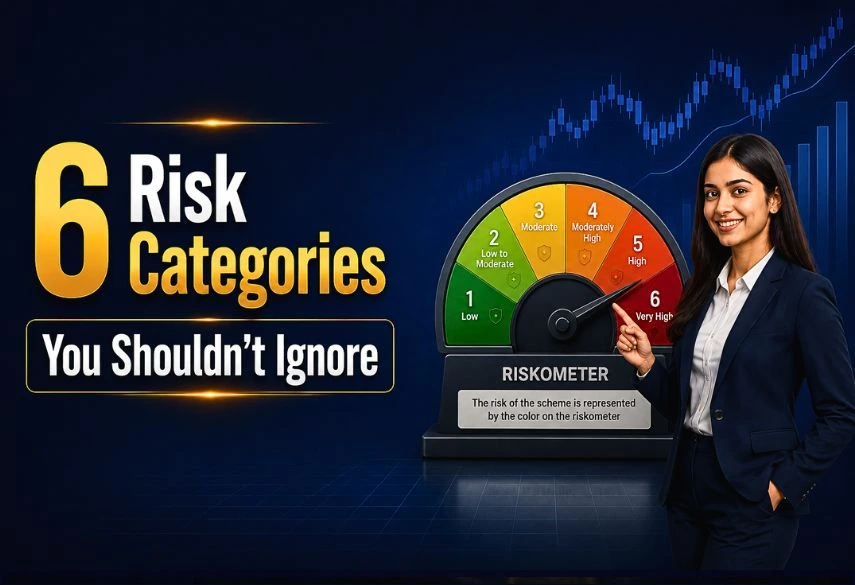
The risks involved with mutual fund investing include the following:
- Market Risk: Investments may decline in value.
- Inflation Risk: Potential returns may be less than the increasing cost associated with inflation.
- Credit Risk: In the case of debt fund investing, there may be a risk of loss when issuers default.

Conclusion
The wealth that you are planning to build with mutual funds and how the mutual funds function has been explained to you – the basics, the advanced tips, the SIP investment guide, the mutual fund returns and NAV meaning, the ways to invest in mutual funds, and the learning to earning process and the beginner-friendly way.

DISCLAIMER: This blog is NOT any buy or sell recommendation. No investment or trading advice is given. The content is purely for educational and information purposes only. Always consult your eligible financial advisor for investment-related decisions.












.webp "growth-vs-idcw-mutual-fund")