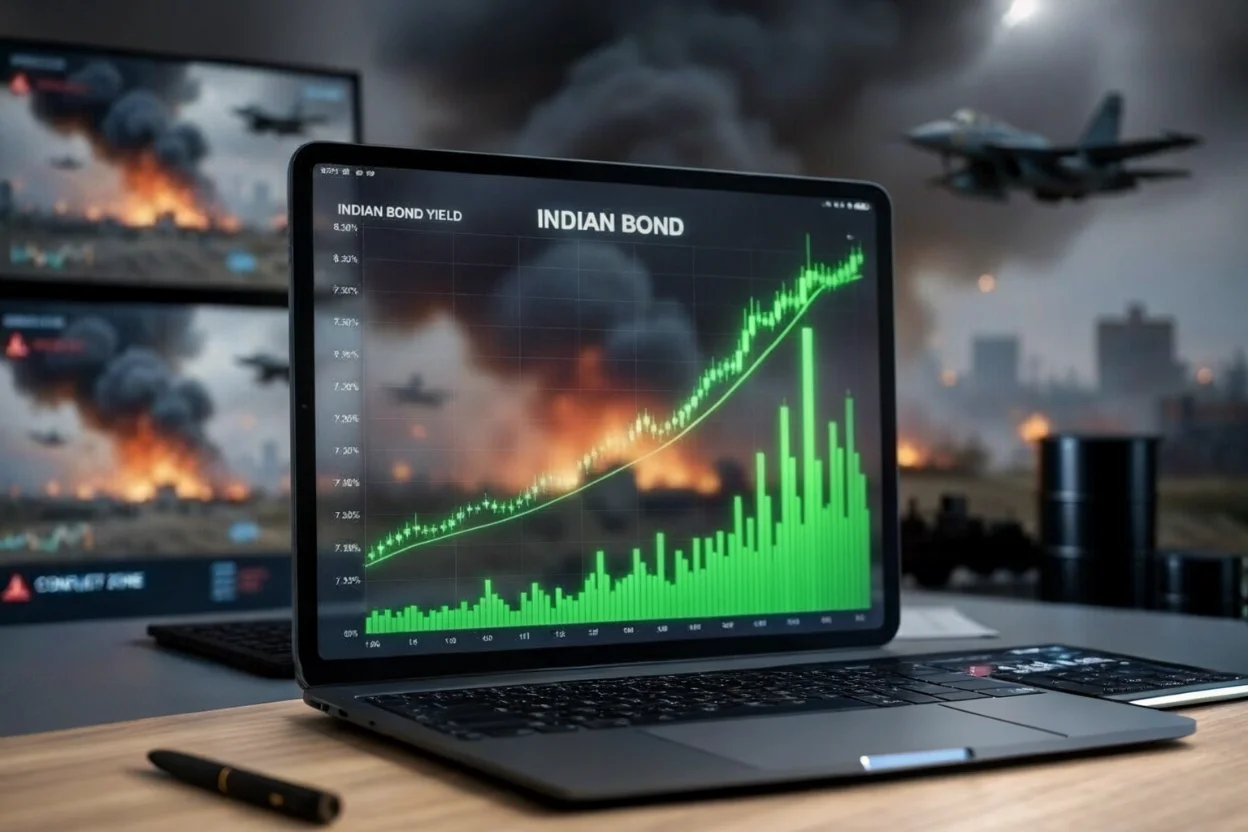
The ongoing US-Israel-Iran war impact is providing India, an energy-importing country, with multiple economic challenges since fuel prices have increased due to the war, and the US and Israel have struck Iran. The Indian bond yields rise, with India's benchmark 10-year government bond yields hitting 6.67%, which also includes the Indian 10-year G-Sec yield increasing by 6.67% due to the war.
The war is increasing the Indian bond yields, which adds fuel to the already economically challenged India. The borders might be a few miles away from the war, but the economic challenges are widespread as the impact of the war is interrelated with the world's economy.
Recently, the conflict has pushed up crude oil costs, making people worried about imported inflation and a drop in the value of currencies. U.S. Brent crude oil prices are around $82.76, and there is a possibility that it could increase to $100 if there are more disruptions in the Strait of Hormuz.
This is bad news for India since almost 50% of the country’s crude oil imports are from that area, which will increase India’s crude oil inflation impact. Investors are pulling out of more risky investments, including bonds from emerging markets, worsening the impact of the global conflict on India and other economies.
Investors planning long-term wealth creation through index funds can also explore SIP planning strategies and estimate future returns using a SIP Calculator before investing in NFOs or mutual funds.
In this blog, we will explain why there is turbulence in the bond market in India and the other impact so you can plan your investments to make the most of it. These conditions are complicated for both inexperienced and experienced people, so knowing the situation is in your best interest.
The rising crude oil prices, bond market volatility, and geopolitical uncertainty are also creating sharp movements in commodity and precious metal markets. Investors following inflation fears and safe-haven assets should also understand the recent MCX gold price crash and why gold prices can sometimes witness sudden corrections even during global conflict situations.
The US-Israel-Iran War Impact
There has been a crisis brewing in the world since the Israeli attacks on the Iranian nuclear programmes. This has triggered the involvement of both the United States and Iran and has begun a World War. This has caused a global crisis in trade and the stocks of the world have dropped 2% to 4% in two days since the war started. The world is in a World War.
Here in India, the US-Israel-Iran war impact is the strongest. We had just hit a 7% growth rate before the war. The Indian rupee is weaker against the dollar now than at any point in history. This has greatly impacted our ability to import. The war is going to affect Western military funding, cause India to lower its military funding, and lead to a collapse in trade.
The unique purchasing agreements India's foreign policy has made with Russia to obtain oil at a discount after the Russian invasion of Ukraine provide some insulation from the full impact of the energy crisis. However, the supply of oil from the Middle East is a critical resource, and the inability to replace the volume of oil supplied to the world is an issue. Inflation pressures from the rapidly escalating price of oil are felt at all levels of the economy. Analysts estimate that a price of oil above $90 per barrel increases consumer price index (CPI) inflation by 0.3 to 0.5% per barrel. The impact of global warfare on the market is evident. The flight of capital from emerging markets and the safe haven of US Treasury bonds increases demand. The rise in the price of gold is another example of safe-haven assets.
The 2019 Abqaiq attack on Saudi Arabian oil facilities is a good example of the Middle Eastern flare-ups that India is accustomed to. However, with the current war in Ukraine, the Middle East is experiencing a greater level of unpredictability due to new alliances, cyber warfare, and the use of artificial intelligence (AI) for warfare.
For the bond market, the added unpredictability from the Ukraine war has meant an increase in the level of risk that is accepted for investments in bonds, which has driven foreign institutional investors (FIIs) to sell bonds at an unprecedented rate. The core issue in the economy that has been exposed by the war in the Middle East is the direct link between rising oil prices and inflation.

Crude Oil Shock: The Crude Oil Inflation Impact India Can't Ignore
The US-Israel-Iran war impact cannot be discussed without mentioning crude oil. The war has driven up Brent crude by 1.6% in one session to $82.76, with futures predicted to rise to $100 if Iran decides to close the Straits of Hormuz, where 20% of the world's oil supply is. For India, an oil importer of 5 million barrels a day, this is a fiscal nightmare.
The crude oil inflation impact on Indiais immediate and complex. Increased costs of energy are felt throughout the entire supply chain: from the petrol pumps to the freight trucks and, ultimately, to the grocery shelves. Moody's has predicted that the CAD will widen by 36 basis points with retail inflation increasing by 0.4-0.6%, caused by a sustained $10 price increase per barrel of oil.
CPI is predicted to be 5.2% in February 2026, and this will force the Reserve Bank of India (RBI) to make policy changes that will delay rate cuts as a result of a more aggressive inflationary stance.
India's oil import has reached $150 billion and could increase by $20-30 billion, which indicates an increase in expenses for the country and a decrease in the forex reserves, along with an increase in inflation with the rupee costing 85.5/USD. Imports will come with a price. With an increase in the cost of oil, the budget will be strained with an increase in the subsidised cost of fertiliser.
There is no denying that India's attempts at post-diversification show determination, but after 2022, long-term contracts with Guyana and Brazil changed the dependence on the Middle East from 82% to 65%. Diversifying, India's persistence is evident in the long-term contracts made with Guyana and Brazil post-2022, which reduced dependence on the Middle East from 82% to 65%.
The strategic petroleum reserves provide 10-12 days of cover, but the effects of the global conflict market exacerbate India's vulnerabilities. The price of LNG has increased by 20%, which is affecting the cost of cooking gas and power generation.
India's inflation is a combined result of an oil price shock from global markets and conflicts. Bond investors in India are the most impacted. The oil shock is also an inflation accelerant, which is increasing the need for India to revise its monetary policies and fiscal budget.
Global Conflict Market Impact: How Wars Warp Emerging Economies
When it comes to analysing the effects of the US-Israel-Iran war on the global conflict market, the ramifications are not limited to oil but also involve changes to the global investor outlook. U.S. 10-year Treasury yields are back over 4%-a “flight to quality” symptom. Gold hit $5,390-an all-time peak; the dollar index is up +2%; the Asia and Latin America dollar-pegged currencies are under pressure.
Emerging markets such as India are seeing the effects of the global conflict market as a “risk-off” syndrome. Foreign institutional investors (FIIs), accounting for 20% of the bond market in India, owing $5 billion in sovereign debt due to inflation and rupee depreciation, have divested $5 billion in sovereign debt. RBI actions have resulted in the shortening of selling pressure on long-term bonds and the steepening of the yield curve.
Geopolitical tensions have always resulted in adverse outcomes for EM bonds: the 2022 Russia-Ukraine war saw Indian yields increase by 50 basis points within a few weeks. The current situation is similar, but with the added positive effects resulting from U.S. fiscal expansion-deficits funding war efforts are expected to keep global yields elevated. The whole central banking world, from the Fed to the ECB, is currently facing “oil shock” inflation, which would require rate increases if inflation were to slow down.
While India’s strong macroeconomic indicators, including a 7% growth forecast, provide a buffer against economic shocks, the economy still presents weaknesses. A widening current account deficit (CAD), which is projected at 2.5% of GDP, has been drawing the scrutiny of rating agencies, which is pushing yields higher. Indian bond yields rose by 20-30 basis points in a week, according to Bloomberg, because market participants shifted their capital to U.S. bonds.
Why Yields in the Indian Bond Market are so Volatile
The Indian Bond Market (IBM) is the second largest in the world at $2 trillion. 90% of this market is dominated by government bonds (G-secs). Yield is a function of price, so when demand decreases, the price of the bond decreases, and yields increase. Following the end of the war, a combination of foreign portfolio investment (FPI) outflows and domestic mutual fund investors betting on inflation resulted in higher yields.
Some important components are the Reserve Bank of India (RBI)'s liquidity management, the purchase of government bonds through Open Market Operations (OMOs), which resulted in the stabilisation of the short end of the yield curve, while the 10-year benchmark yield still increased by 15 basis points. Following the 2024 inclusion of Indian government bonds in the JP Morgan Emerging Markets Bond Index (EMBI), the bonds attracted new foreign investment; however, due to the war, the trend was reversed and $2.5 billion was withdrawn in March alone.

Conclusion
The impact of the US-Israel-Iran war has brought attention to India's bond market, with rising bond yields highlighting the dangers of reliance on oil. However, the foundations of our economy, diversified commerce, and strong reserves, put us in a strong position to withstand this. The effects of global conflict, markets and crude oil inflation on India are significant, but so is our ability to respond. Vigilant investing will transform volatility into opportunity as markets stabilize. As with bonds, timing is crucial in geopolitics, so make good decisions.

DISCLAIMER: This blog is NOT any buy or sell recommendation. No investment or trading advice is given. The content is purely for educational and information purposes only. Always consult your eligible financial advisor for investment-related decisions.












.webp "growth-vs-idcw-mutual-fund")