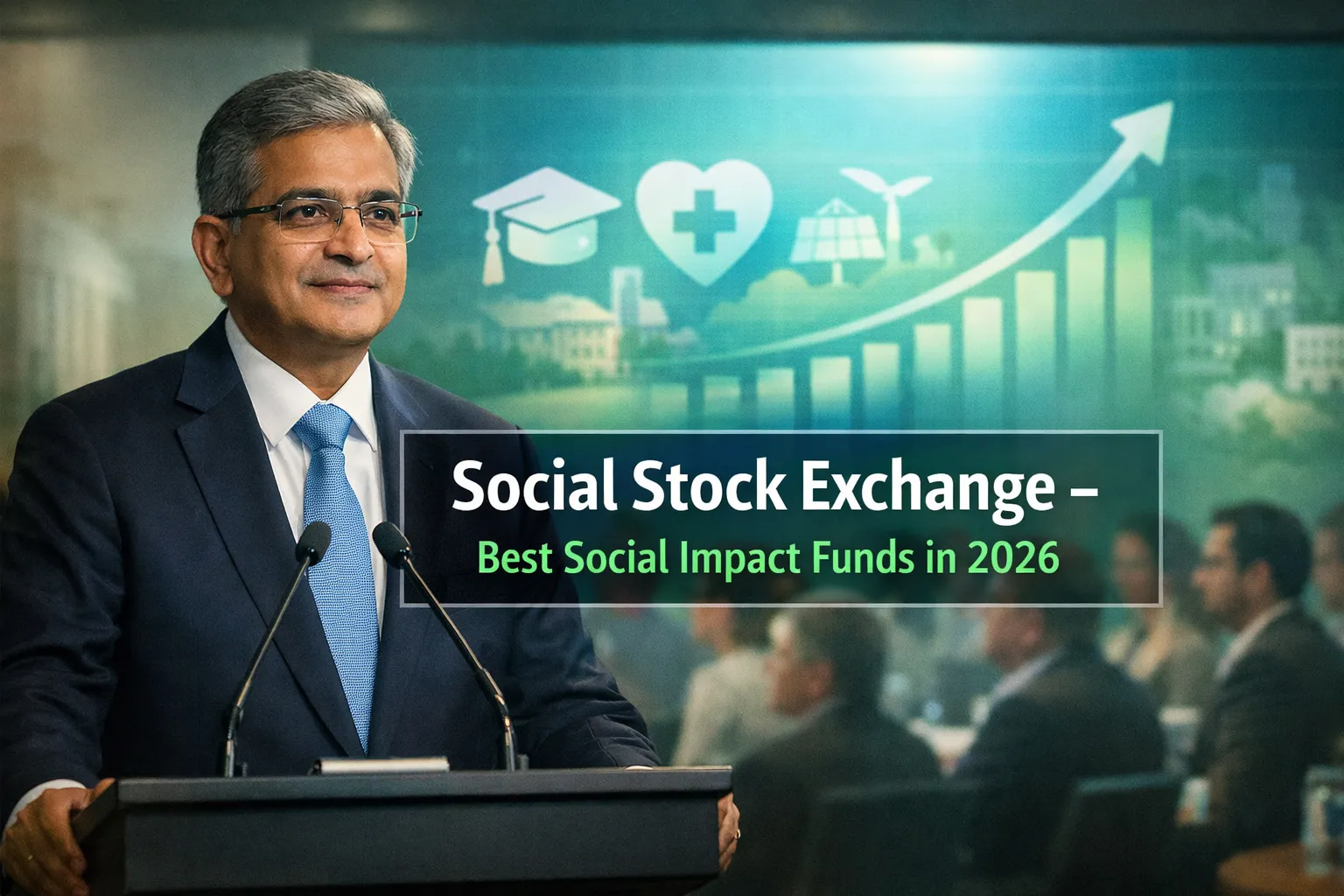
Are you an individual who wishes to assist society with their savings, while simultaneously wanting everything to be structured, safe and regulated? Social Stock Exchange in India is for individuals who fit this description. Simply, it provides a safe and social way for the common man to fund socially responsible organizations. SEBI regulates it, and you receive detailed reports on the actual social impact of your investment.
For an amateur investor, this Social Stock Exchange India Guide will provide you with the rules, eligibility, the benefits, the risks, the tax treatment, the real-life examples, and most importantly, the steps on how to invest.
We will provide you with a comparison with NGO donations. Everything is put in simple words and by the end of this guide, you will determine whether it allows you to achieve your goals by the end of 2026.
What is Social Stock Exchange India? (SSE India Explained)
The Social Stock Exchange India is just a concept that emerged in 2019-2020; however, it has gained traction and become an actual platform with the operation of the NSE and BSE in 2022-2023.
SSE is different from the traditional stock market in the sense that companies trade shares to gain profit; however, it is focused on social good. Non-profit organizations and for-profit social businesses can use this platform to raise funds in the areas of education, health, livelihoods, women's empowerment and the environment.
The mission is simplistic: to facilitate kind donors and investors and reliable social organizations in a transparent manner. Each organization is obligated to provide social impact reports annually to demonstrate accountability, similar to how businesses provide profit accountability reports.
This fosters trust and prevents money from being misallocated. As of early 2026, more than 100 non-profit organizations (NPOs) have registered and more than 10 have successfully acquired funding.
(Source: NSE )

Who Can Join SSE? Eligibility and Listing Rules (Deeper Detail)
Not every NGO can list on the Social Stock Exchange India. SEBI has stringent (yet reasonable) regulations so that only dedicated organizations participate. Here is the most recent (as of SEBI Master Circular January 2026) eligibility criteria for NPOs:
- Must be registered in India as a charitable trust, society, or Section 8 Company.
- The registration certificate must be valid for the subsequent 12 months.
- The organization must be a minimum of 3 years old.
- Documents must include Valid Income Tax Certificates (12A/12AA/12AB), 80G, and PAN.
- The organization must have expended a minimum of ₹50 lakh in the prior financial year.
- The organization must have received funding of a minimum of ₹10 lakh in the prior financial year.
- There must be a transparent ownership structure with no significant litigation or sanctions.
- The organization must only operate in 13 designated areas of social impact (i.e. poverty, education, health, environment).
Listing Steps:
1. Submit a registration application on either the NSE or BSE SSE.
2. Submit documentation for approval.
3. Submit Fundraising Documents (similar to a prospectus) to SSE for approval to raise capital.
4. The general public has 21 days to respond.
5. SSE reviews and approval is granted.
6. Issuance opens, enabling public investment.
Important notes about for-profit social businesses: you are obligated to spend a minimum of 67% of your revenue on social initiatives. Your interests are protected as the entire procedure is managed.
(Source: SEBI)
How Does SSE Work? Instruments and How to Invest
Through the social stock exchange in India, social organizations' fundraising is made simple.
- Zero Coupon Zero Principal Bonds (ZCZP)– These are very popular with NPOs. You lend your capital, and you will not receive interest or principal repayments. However, you will receive a complete tax exemption under Section 80G, as your money will go entirely towards social activities.
The minimum issuance size is ₹50 lakhs. The bonds are issued in demat form and are prevented from trading until maturation.
- Equity or Debt– This applies to for-profit social enterprises (where you can expect a return).
- Retail investments are now absolutely minimum (often even ₹1,000).
You invest through your regular demat account, be it Zerodha, Groww, or any brokerage firm. After investing, you will receive annual impact statements. For instance, “Your money supported 500 children to go to school” or “200 women received skill training.”
Only some social stock exchange India issues are available to retail investors. The entire system is digital and visible to all.
(Source: Zerodha )
Advantages of Social Stock Exchange India
- For you (investor): The entire process is transparent. You receive annual impact statements, a tax deduction under 80G, and the satisfaction of knowing that you are facilitating meaningful change.
- For organizations: They obtain simple, reliable access to fundraising solutions without the constant need to plead for donations. This also helps to establish their reputation.
- For society: Outdated donation methods are replaced with SSE which allows for funds to be directed toward urgent issues without constraints.
SSE uses a stock-market equivalent of donations. This ensures a level of discipline that is unprecedented in this area.
Risks for Retail Investors (Be Honest with Yourself)
There are always risks associated with every possible investment; in the case of SSE, it could be:
- With ZCZP bonds, the returns will NOT be financial. The only "return" you will receive will be social impact.
- The bonds are considered ILIQUID– you will not be able to sell them before the date that they mature.
- There is an impact risk. The organization may not create the change as promised (though this is what reports aim to mitigate).
- Small Market Risk– SSE is still in the early stages compared to the stock market.
- Changes in regulations may create delays with the approvals.
Who should invest?
People who are passionate about social good, have some extra money that they will not need in the next 3-5 years, and are okay with receiving zero monetary return.
Who should avoid?
Anyone who is only looking for high returns, people who need short-term liquidity, or people who would find it difficult to cope with zero financial return. If you are new, start small.
If you are still in the learning or wealth-building stage, it is better to first focus on understanding markets and investing strategies. You can explore Best Stock Market Courses in 2026: List, Fees, And Reviews before making decisions in platforms like SSE.
Tax Treatment
ZZCP bonds purchased on the social stock exchange in India are eligible for tax benefits under Section 80G of the Income Tax Act. As per the existing rules, you can avail 50% deduction on your donation. The latest news provides further benefits.
In some cases, corporates may also avail CSR benefits. You are advised to check the latest rules of your ITR with a tax consultant. Some cases are also free from STT and capital gains tax.
Improve your tax planning with the free Finowings tax planning strategies.
SSE vs NGO Donation – Comparison Table
Many people confuse these. Here is a simple data table for beginners:
|
Feature |
Social Stock Exchange (SSE) |
Normal NGO Donation |
|
Regulation |
Strict SEBI rules |
Less regulated |
|
Transparency |
Yearly impact reports + audited accounts |
Depends on the NGO |
|
Return for you |
Zero financial return (ZCZP) + social impact |
No return |
|
Tax Benefit |
80G deduction + possible CSR |
80G deduction |
|
Liquidity |
Locked till maturity |
Immediate |
|
Who it suits |
Impact-focused investors |
Pure donors |
|
Minimum Amount |
As low as ₹1,000 |
Any amount |
(Source: we forum )
Real Examples of Listed SSE Entities (2026 Update)
Here are success stories:
- SGBS Unnati Foundation (first listing): Created funding opportunities for skill training for young people from economically weaker sections of society.
- Swades Foundation: Funds were raised (Rs. 10 Cr) for projects related to the health and education of goats in rural areas.
- Missing Link Trust: Funded (Rs. 1.20 Cr) for the establishment of schools in South 24 Parganas.
- Foundation to Educate Girls Globally: focused on the education of girls and their retention.
- Routes 2 Roots: Provided digital education to schools in Himachal and Uttarakhand.
Overall, more than 10 organizations raised real funds and created real change, approximately 22 crores.
You can open a Demat account with us to participate in investing in SSE.

How to Evaluate an SSE Issue Before Investing – Practical Checklist
1. Examine the entire Fundraising Document (FRD)
Inquire about the vision, the objectives of the project, and how the money is intended to be utilized (the use of proceeds should be detailed).
2. Check the Organization’s Track Record
- Three of the most recent years are available for review.
- Social impact achieved (number of people assisted, results achieved).
- Consistency with the mission.
3. Assess the Target Segment and the Strategy
Does it specify who the beneficiaries are (the underprivileged poor/rural/women)? Does the approach seem sound, and does it contain an adequate description of the various steps?
4. Examine the Governance and the Management
- Have the board and team received substantial experience?
- Do unrelated parties have any problems?
- No related-party issues or red flags.
5. Evaluate the Plan for Social Impact
- Are the KPIs with respect to output and outcome clearly defined?
- Are the indicators based on the baseline data and are the target(s) measurable (e.g. "500 girls are expected to complete school")?
- The logic model is as follows: inputs → activities → outputs → outcomes.
6. Recognize the Risks and the Mitigation Plans
Is there a forthright acknowledgement of potential funding, execution, or external risks and the strategies to address them?
7. Fund Utilization & Reporting Commitment
- Is there a reasonable schedule for the project?
- Is it the case that a Plan for an Audited Social Impact Report is to be provided each year by a Social Auditor, who is a trained professional?
- What are the consequences of under-subscription?
8. Verify the Information
- Are there legal and tax-related issues?
- Is there a history of legal and tax compliance?
- Is the problem substantial, and are the registration and tax certificates valid?
9. Public Feedback and Approval from SSE
Check for significant questions from the public and how they were responded to during the 21 days of commenting.
Tip: The draft/final FRD from the NSE/BSE SSE website can be downloaded. If you have past impact reports, do a comparison. If you need clarification, reach out to the organization or an advisor.
How to Start Investing in Social Stock Exchange
1. Open a demat account (if you don’t have one).
2. Go to SSE on NSE or BSE and view the registered/listed organizations.
3. When a new issue opens, apply through your broker app.
4. Fundraising Document must be read in full.
5. Invest small first and observe the impact, report yearly.

Conclusion
Impact investing has been made transparent, simple, and secure for the average Indian with Social Stock Exchange India. It is all about purposeful money, not about profits. It is money that goes on to change lives. For impact investing in India with complete transparency and accountability, this is your starting point. It should be paired with your regular savings for the best effect.
Your step on SSE can make an enormous difference. Head to the official site and check out the organizations listed. Do not forget to talk to your financial advisor before putting your money into an investment. Past impacts and performances do not guarantee future results. This is the data collected for the start of 2026.
(Sources: SEBI, NSDL, Upstox, Reuters, ET, ToI).

DISCLAIMER: This blog is NOT any buy or sell recommendation. No investment or trading advice is given. The content is purely for educational and information purposes only. Always consult your eligible financial advisor for investment-related decisions.

.webp)