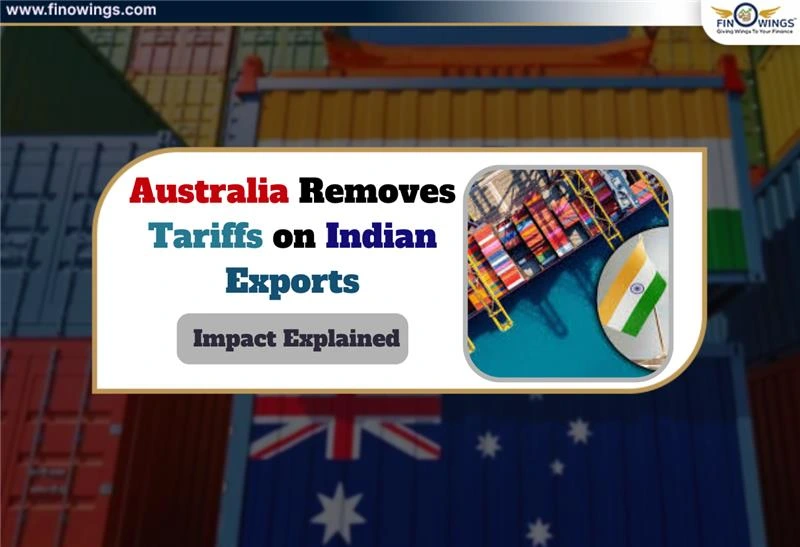
With the beginning of trade relations between India and Australia, a significant milestone in the field of Indian exports was achieved when, on July 24, 2023, Australia announced that it was going to cancel tariffs on several Indian shipments. Regarding exports, it is largely equivalent to cost-cutting, though it also indicates that the economic cooperation between the two countries is growing. There are exporters of all sizes that are likely to benefit, from micro MSMEs to large exporters.
In this guide, we will attempt to explain what the Australian removal of tariffs will mean, the Australian trade deals with India and their untapped potential, the potential impacts on Indian exporters, as well as what is likely to come next with the India Australia trade deal.
Growing Trade Between Australia and India.
As trade between India and Australia has continued to grow, it has been on the positive side of trade. For the last decade or so, trade relations with Australia have diversified from the core commodity imports of coal, minerals and education-related services.
Value-added trade is where we have seen the most diversification and growth.
Removing the tariffs is a positive trade step, but it also demonstrates a show of mutual trust and confidence in the economies of the two nations as they look toward a possible integrated value chain forming.
What Does "Australia Removes Tariffs on Indian Exports" Really Mean?
If Australia removes tariffs on Indian exports, it most likely means import duties on specified Indian products have been reduced to zero or near zero. This also means that costs have been further reduced on the entry of Indian products into the Australian market, enabling Australian buyers to import these products at much cheaper rates than products from other competing countries.

What are the likely consequences of Australia removing tariffs?
- Australian buyers will find Indian products cheaper in their markets.
- Exporters will have the ability to set higher prices.
- Market entry hurdles for MSMEs will be fewer.
- Over a period of time, the expectation is that the volume of trade will increase.
This is consistent with Australia’s general strategy of trade liberalisation through bilateral and regional trade agreements.
The Bigger Picture- India Australia Trade Deal.
Australia’s removal of tariffs has its largest influence from the India-Australia Trade Deal- more formally known as the Economic Cooperation and Trade Agreement (ECTA). This treaty has broad objectives of:
- Removing tariffs on a large number of goods that are traded.
- Providing ease of trade in services and the mobility of professions.
- Strengthening the flow of investments.
- Establishing resilient supply chains.
This trade deal, unlike previous trade agreements, also focuses on practical implementation through faster customs clearance, mutual recognition of standards, and stable, predictable policies.
Piyush Goyal's Australia Commitment: Policy Perspective from India
India's Commerce and Industry Minister Piyush Goyal has repeatedly framed Australia as a priority trade partner.
What his statement signals:
- Confidence in Indian exporters’ global competitiveness.
- The government’s focus on export-led growth.
- Synergy with Make in India and Atmanirbhar Bharat.
- Strategic equity of India in Australia.
Piyush Goyal’s remarks indicate that the construction of a long-term trade vision means the removal of import tariffs is a temporary concession.
Indian Exports to Australia: Key Sectors and Labour-Intensive Value-Added Sectors
Australia's tariff removal benefitted labour-intensive and value-added sectorswherein India has a competitive advantage in terms of cost and quality.
1. Textiles and Apparel
Tariff reduction provided Indian garments, home textiles and made-ups a price edge. Australia’s retail market is price-sensitive, so tariff-free access for Indian sourcing is competitive.
2. Gems and Jewels
Indian-cut diamonds and jewellery became more price competitive with SE Asia suppliers with reduced customs duties.
3. Pharmaceuticals
India’s generic medicines are already trusted in Australia, with its position as a reliable healthcare supplier becoming stronger with reduced customs duties.
4. Engineering Goods
Auto components, industrial machinery and electrical equipment have seen increased demand as price competitiveness has improved.
5. Other Foods
Rice, spices, pre-cooked meals, and certain processed foods will also be in demand, especially foods that adhere to Australia's rigorous food quality standards.

Impacts on MSMEs and Small-Scale Exporters
One of the most positive aspects of Australia's removal of certain tariffs concerns India’s MSME exporters.
Why MSMEs benefit the most:
- With lower tariffs, exporters won't have to provide steep discounts to sell their goods.
- Increased profits allow further investment, if they choose to.
- Exporters will more easily sell to wealthy consumers.
- Exporters can establish buyer-seller relations.
To many small exporters, Australia serves as a gateway market to the rest of the Asia-Pacific region.
Advantages for Australia
There are also some advantages from Australia removing tariffs and increasing trade with India.
- Access to more consumers.
- Decreased reliance on a small group of trade partners.
- More and better supply chain options for pharmaceuticals and IT.
- Stronger economic and diplomatic relations with India.
- Overall, the trade relationship between India and Australia is more balanced and resilient.
Strategic and Geopolitical Importance
Other than the economics involved, this has strategic significance as well:
- Builds the Indo-Pacific economic framework.
- Lessens reliance on concentrated global supply chains.
- Builds trust among the democratic economies.
- Fosters regional stability on account of trade interdependence.
- Here, trade policy is strategic diplomacy, not commerce only.
Challenges Indian Exporters Must Watch
Here are some challenges Indian exporters face:
Even with no tariffs, exporters have to:
- Australia has very high quality, safety, and biosecurity standards.
- For newer exporters, the compliance costs are high.
- Timelines on logistics and shipping need to be monitored and managed.
- In a mature market, branding and marketing are very important.
- Removing tariffs does create a new opportunity. It does come down to execution.
Long-Term Outlook for India-Australia Trade Deal
The India-Australia trade deal has a very bright future:
- Future expansion anticipated in services and digital trade.
- An increase in bilateral investment is expected.
- Enhanced collaboration in clean energy and critical minerals.
- Improved mechanisms for the resolution of disputes.
Australia is likely to become one of India’s most dependable developed-market partners as trade volume increases.

Final Thoughts
The tariff will be removed on Indian exports and this will be a breakthrough in the bilateral trade between Australia and India. It will make it more competitive, boost MSMEs and trust in a strategic partnership between Australia and India. Along with ‘policy clarity’ and strong signalling, such as Piyush Goyal’s statement, this will provide a strong impetus for Indian exporters to grow sustainably in a profitable market.
For India, it will not only be about more exports, but about better, smarter, and globally competitive products in a contemporary trade framework.

DISCLAIMER: This blog is NOT any buy or sell recommendation. No investment or trading advice is given. The content is purely for educational and information purposes only. Always consult your eligible financial advisor for investment-related decisions.