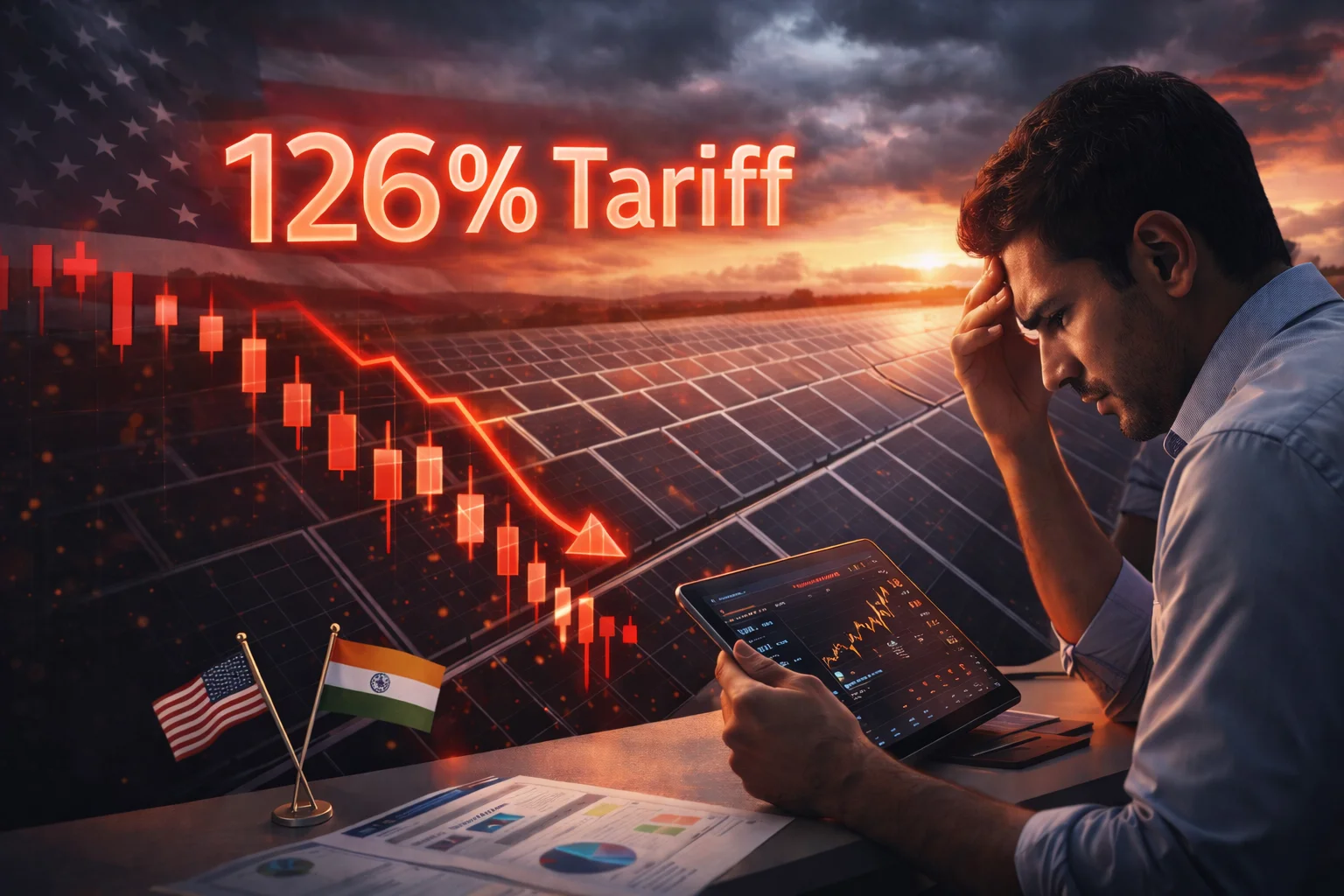
The Indian solar sector experienced unprecedented turbulence after receiving confirmation from the US Department of Commerce of preliminary countervailing duties of approximately 126% for solar cells and modules imported from India. Such US tariffs on Indian solar cells have led to a wave of recent panic investor response and negative impacts on the Indian solar sector stock market, with top solar lens and module companies such as Waaree Energies, Premier Energies, and Vikram Solar facing a staggering average of 8-18% single-day stock market loss.
Rewards and positive stock market sentiments from India's solar export boom have been eroded due to the recent duties on US-bound solar modules. However, is this the final frontier for the renewable energy sector of India, the fastest developing renewable energy sector in the world? Herein, we will critically analyze the 126% duties on solar imports and their probable impacts on the Indian solar sector, its potential impact on the US-India trade conflicts, and its probable effect on the renewable energy sector stock market.
What was the US Tariff on Indian Solar?
On February 24th, 2026, the US Department of Commerce posted the first findings of a Countervailing Duty (CVD) investigation and had a complaint statement from the Alliance for American Solar Manufacturing and Trade (AASMT). They accused Indian companies of receiving government subsidies, including the Advance Authorisation, Duty Drawback, RoDTEP, and Export Promotion Capital Goods Scheme subsidies.

The result was a 126% duty on solar imports from India (with almost the same rates on Indonesia and Laos) and the first returns on the case of the year, 2026 (CVD) and a case (anti-dumping) that is still ongoing, and the new shipments will be required to have cash deposits at these rates.
There are two companies of the Adani Group (Mundra Solar Energy and Mundra Solar PV), which, as mandatory respondents, and as a result of the investigation, have invoked the most strictest Conjectures of Adverse Factors (CA), raising the all-India rate to 125.87%-126.00%. Waaree Energies is also supposed to be in that range, even though they are cooperating.
The U.S. has increased its solar imports from India from only $84 million in 2022 to $792.6 million in 2023, and expects to import nearly 3 GW in 2025. India, Indonesia and Laos accounted for more than 57% of solar module imports to the U.S. in the first quarter of 2025. The Trump administration’s decision to impose tariffs on solar panels from India is typical protectionism - it shields U.S. manufacturers from so-called subsidized foreign competition.
It is also not isolated. It is part of the U.S.-India trade tensions, which include a recently announced 10% baseline tariff on some Indian products. The timing for the solar industry is especially bad, as India’s manufacturing capacity has increased 13 times since 2020, mainly as a result of the Production-Linked Incentive (PLI) scheme.
Market Reaction: Indian Solar Stocks Hit Hard
The negative impact on Indian solar stockswas quick and significant.
- Waaree: Down 15%
- Premier: Down 12-18%
- Vikram: Down nearly 8%
- Adani Green: Down about 8%
Broader renewable energy stocks also declined, as did related EPC and module players. Why the sell-off? Fear that the U.S. - a high-margin export market - would suddenly slam shut. Analysts have pointed out that this duty is primarily on modules that use Indian-manufactured cells. Several Indian exporters, Waaree included, are modularising cells from non-affected countries, which are often Chinese.
Waaree has publicly declared that she uses no Indian cells for US supplies and is increasing her US manufacturing capacity from 2.6 GW to 4.2 GW by FY26, along with an Omani polysilicon project.
Premier Energies has an almost fully domestic order book. Vikram Solar has domestic orders with US exposure limited to 16% of its forthcoming orders. In short, the knee-jerk reaction in renewable energy stocks seems to have been overdone, as multiple brokerages pointed out the following day, along with a 2% partial recovery in the stocks.
Solar Sector News India: A Domestic Powerhouse Facing Export Headwinds
While India’s solar story is an export setback, it’s being too hasty to panic-sell renewable energy stocks. India's renewable energy capacity has exceeded 250 GW, with solar energy as the country's primary focus. India aims to achieve 500 GW of non-fossil fuel capacity by 2030, which will increase the country's economy.
From 2022, the PLI scheme has contributed to 82 GW of new module capacity and 22.7 GW of new cell capacity. In total, India's new module manufacturing capacity, with about 140-160 GW, far exceeds the annual domestic demand of 45-50 GW.
This increase in capacity has created an Indian manufacturing solar module excess. In response, some plans with operating capacity utilisation rates of 40%. The US tariff on Indian solar adds risks to excess manufacturing, which will help reduce inflation.
Nevertheless, several long-term factors are also positive.
- Significant forthcoming tenders related to the PM Surya Ghar Muft Bijli Yojana scheme.
- Corporate Power Purchase Agreements (PPAs) and solar parks at the state level.
- Declining prices of solar modules worldwide improve project viability.
- Policy advocacy related to high-efficiency modules and tiered integration (cells, wafers, and ingots).
Exports to the US were profitable (better margins than domestic sales) but were not the whole picture. Many Indian manufacturers have expanded to Europe, the Middle East, Africa, and Latin America. Manufacturers with robust balance sheets and backward integration will be able to survive this better.
India has already interacted with the USITC, and the negotiation channels are still open. Previous experiences show that provisional tariffs are continuously revised in the final comments.
Should Solar Investors Exit Now? A Balanced Risk Assessment
This is the billion-rupee question for all holders of renewable energy stocks or anyone thinking of investing in this sector. Factors that may justify exiting or reducing holdings include:
1. Possibility of lower tariffs: resulting in anti-dumping measures and short-term volatility. Previous exports to the US were about 3 GW, so a decline in export volume is inevitable.
2. Margin pressure: Products priced higher from overseas markets lead to lower value products which could lead to lower value products which could lead to lower value products, which could lead to lower value products. Value can lose profitability for those who export.
3. Overcapacity risk: Inventory redirected domestically will result in price modules of 10-20%, creating pressure on smaller competitors.
4. Valuation multiples: Numerous solar stocks come from high predicted P/E ratios from expected continued high growth. A reality check is expected.

Reasons to hold or even buy on dips
1. Most leaders have limited real exposure: As explained, Waaree and others have structured supply chains to alleviate the exact duty hit. Localization of US manufacturing is already occurring.
2. Explosive domestic demand expected: To achieve targets, India must add 40-50 GW of solar capacity each year. PLI incentives of over ₹24,000 crores allocated will ensure local manufacturers are prioritised in government contracts.
3. Global solar supercycle: With reduced prices, energy security requirements and net-zero goals combined, demand will always be high. India stands as an alternative to China.
4. Company-specific resilience: Strong players are vertically integrating, expanding EPC arms, and entering battery storage - turning pure module risk into full-value-chain plays.
5. Precedent in history: Previous US solar tariffs on Asia (including 2022-2020)
For renewable energy stocks with varying risk profiles, investments in solar EPC, power generation (e.g. Adani Green, Tata Power), or ancillary (inverters, trackers) provide stronger protection than investments in pure module exporters.
Solar Investor's Smart Playbook for 2026 and Beyond
- Review the holdings company by company: Preference should be given to those with less than 10% US revenue exposure, strong domestic order books, and backward integration.
- Have strong diversification within renewables: Wind, hydro, green hydrogen, or battery storage plays are less affected by this specific tariff.
- Remain focused on fundamentals: order books, capacity utilisation guidance, debt levels, and PLI disbursement.
- Adopt a long-term perspective: For an investment horizon of 3 to 5 years, the 500 GW journey of India, along with global decarbonisation, presents strong tailwinds. Traders with short horizons may incur losses or hedge.
- Look out for the catalysts: the final ruling of the USA (July 2026), India and USA trade talks, new domestic tenders, or guidance for Q4 earnings from the solar majors.
The tariff on Indian solar from the USA is painful, but not fatal. It emphasises the risks of reliance on one single export market while trade tensions between the USA and India are rising. It accelerates the self-reliance push for India, which is exactly what the PLI was designed for.

Conclusion: Hold Steady, Don't Panic Exit
There has been a clear effect on the volatility of Indian solar stocks and renewable energy stocks due to the 126% duty on solar imports. While news of the solar sector in India reminds us of the geopolitical noise that can interrupt positive growth, when looking at the fundamentals of solar revolutions in India, there are still a lot of positive aspects, such as strong policy support, and an energy-hungry economy that is young and growing rapidly, and an enormous domestic demand.

DISCLAIMER: This blog is NOT any buy or sell recommendation. No investment or trading advice is given. The content is purely for educational and information purposes only. Always consult your eligible financial advisor for investment-related decisions.