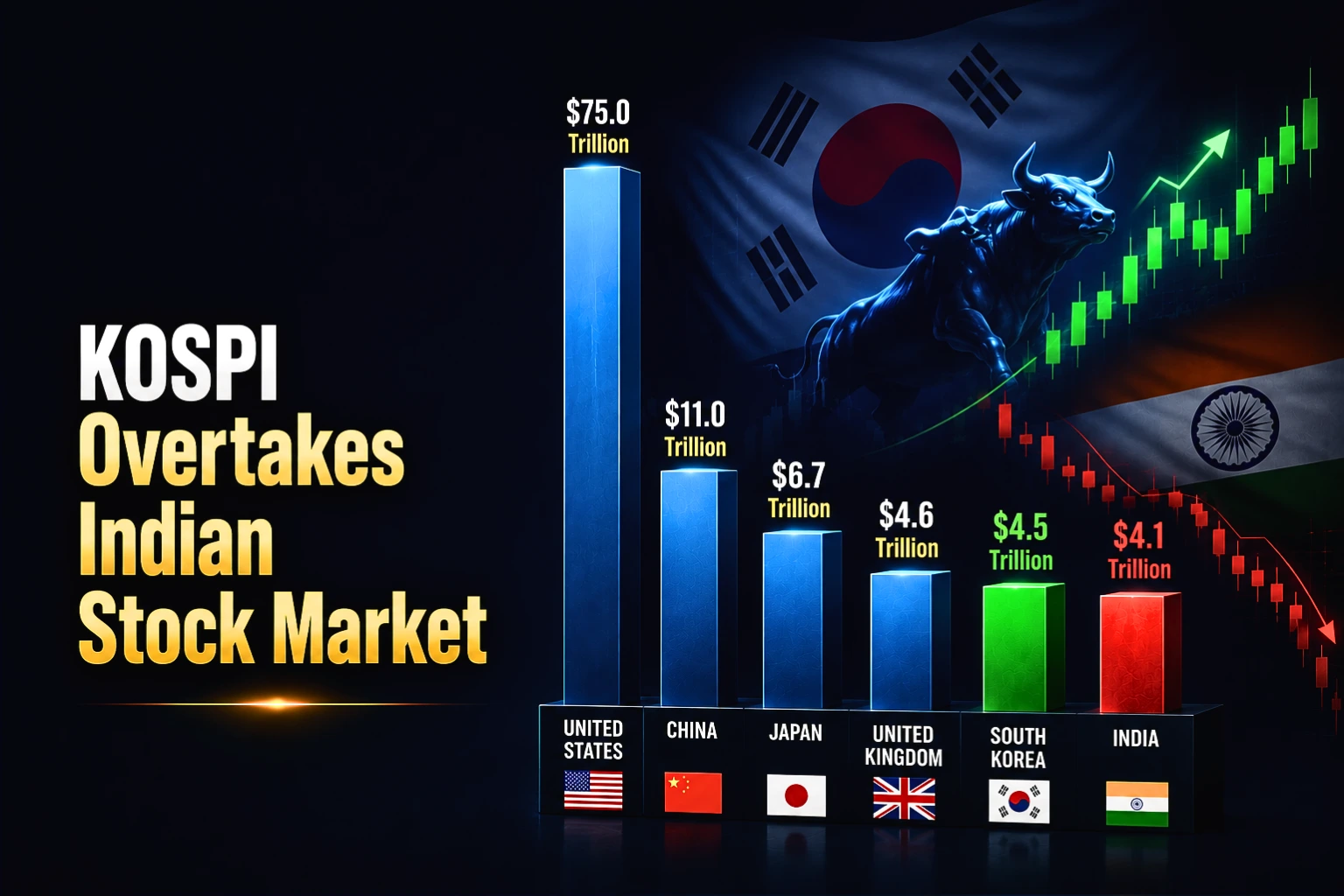
This is a rapidly evolving comparison. South Korea's KOSPI overtook India's stock market by total value in early June 2026, but India reclaimed its position by the end of the same month.
Yes — but briefly. Powered by a global AI and semiconductor rally, South Korea's KOSPI-listed companies grew their combined market capitalisation to about $5 trillion by early June 2026, overtaking India's roughly $4.8 trillion market and making Korea the world's sixth-largest stock market, ahead of India's seventh. By 29 June 2026, however, India had reclaimed the world's fifth-largest spot with a market cap of about $5.04 trillion, overtaking both South Korea (~$4.7 trillion) and Taiwan (~$5 trillion) as Korean and Taiwanese tech stocks saw profit-taking and Indian equities benefited from falling crude oil prices and returning foreign investor buying.
For years, the 'India story' was a favourite among global investors — a young population, a growing middle class, and a services-led economy. So when headlines in June 2026 said South Korea's stock market had overtaken India's, many beginner investors were caught off guard. The real story is more nuanced, and more useful, than a single headline: it's a case study in how fast global capital moves when a theme like AI takes hold, and how quickly rankings can reverse.
The Timeline: How the Rankings Flipped Twice in a Month
|
Date |
Event |
Market Caps |
|
Early June 2026 |
South Korea's KOSPI overtakes India to become the world's 6th-largest stock market, powered by an AI-driven semiconductor rally. |
South Korea ~$5.0 trillion (+86% YTD) vs India ~$4.8 trillion |
|
Mid-to-late June 2026 |
Korean and Taiwanese tech stocks see profit-taking; Indian equities rise as crude oil prices ease and foreign investors return as net buyers. |
South Korea -$230bn in June; Taiwan -$119bn in June; India +$135bn in June |
|
29 June 2026 |
India reclaims the world's 5th-largest stock market spot, overtaking both South Korea and Taiwan. |
India ~$5.04 trillion vs Taiwan ~$5.0 trillion vs South Korea ~$4.7 trillion |
Even after this bounce-back, it's worth noting the year-to-date picture looks very different: in dollar terms through late June 2026, India's Nifty was still down about 12.7% for the year, while the KOSPI had rallied roughly 86% and Taiwan's TAIEX around 53%. India's recent recovery in rankings is a June phenomenon layered on top of a weak first half of the year, not a reversal of the full-year trend — yet.

The Driver: AI and the Semiconductor Supercycle
The common thread behind Korea's surge is the global rush into Artificial Intelligence infrastructure. Demand for advanced memory chips — the kind used in AI servers and data centres — has exploded, and South Korea is a world leader in this segment. Samsung Electronics and SK Hynix, both newly minted members of the $1 trillion valuation club, powered most of the KOSPI's gains. The rally also had a domestic tailwind: President Lee Jae Myung's push for corporate governance reform coincided with the AI theme, and the KOSPI blew past his 5,000-point target earlier in 2026, with some Wall Street analysts now talking about 10,000 as the next milestone.
Indian IT majors, by contrast, are strong in software services and applying AI for clients, but have far less direct exposure to the AI hardware and memory-chip supply chain that has driven Korea's rally. That structural difference — hardware versus software exposure — explains much of the gap in 2026 performance between the two markets.
Why India Slipped — and Why It Bounced Back
India's underperformance through most of 2026 reflected a mix of factors rather than any single cause:
- Earnings growth: Corporate profit growth was slower than expected in several sectors, with IT services facing a cautious global client environment.
- Valuations: Indian equities carried premium valuations relative to earnings, making the market look expensive just as global capital rotated toward AI-linked opportunities elsewhere.
- FII outflows: Foreign Institutional Investors turned net sellers for stretches of the year, rotating toward tech-heavy markets like Korea and Taiwan and booking profits in India.
- Global macro: Elevated crude oil prices earlier in the year (tied to US-Iran tensions) weighed on sentiment for oil-importing India.
The recovery through late June 2026 was driven by the mirror image of these pressures easing: Brent crude fell roughly 37% from its recent peak to around $74 a barrel, foreign investors turned net buyers again (around $1.27 billion in the final two weeks of June), and profit-booking in richly-valued Korean and Taiwanese tech stocks gave India room to close the gap. Domestic investors — through SIPs and mutual funds — continued buying through the volatility and provided a floor under the market for most of the year.
Sector-Wise Comparison
|
Sector |
South Korea (KOSPI) Focus |
India Focus |
Key Takeaway |
|
Technology / Semiconductors |
Strong surge in memory chipmakers (Samsung, SK Hynix) |
IT services under margin pressure |
Hardware exposure vs software exposure |
|
Financials |
Supported by broader economy and reform push |
Mixed, with domestic-demand resilience |
India's large banking base is a structural buffer |
|
Consumer Goods |
Export-driven |
Demand slowdown in some segments |
India's consumption story remains a longer-term thesis |
|
Overall Market Structure |
Concentrated in a handful of tech giants |
Broader, more diversified across sectors |
Diversification cushions India's swings both ways |
Korea's rally has been powered overwhelmingly by a small number of semiconductor giants, while India's market is spread across banking, consumption, industrials, and technology. That concentration is exactly what makes Korea's gains both spectacular and fragile.
Risk Analysis: What Could Unwind Korea's Rally
- Concentration risk: A handful of chipmakers account for a disproportionate share of the KOSPI's gains — any cooling in AI demand or memory-chip pricing would hit the index hard.
- Valuation risk: An 86% year-to-date rally invites sharp corrections on rate changes, profit-taking, or shifts in global tech sentiment — exactly what triggered India's rebound in late June.
- Flow sensitivity: Korea's gains have been heavily driven by foreign capital chasing the AI theme; the same flows can reverse quickly.
- External shocks: Trade tensions, global tech capex cycles, and energy prices can all move an export-dependent economy like Korea's.
India's more diversified market structure offered less explosive upside during the AI wave, but also more downside cushioning when Korean and Taiwanese tech stocks corrected in June — a trade-off worth understanding rather than a simple case of one market being 'better' than the other.
What Beginner Investors Can Learn From This
- Global themes move fast: A single theme like AI can redirect enormous amounts of capital across borders within months.
- Rankings can reverse quickly: India went from world's 4th-largest market to 7th to 5th within the same year — headlines about 'permanent' shifts should be treated cautiously.
- Concentration cuts both ways: A market driven by a few large stocks can rally harder — and fall harder — than a diversified one.
- Valuation matters: Expensive markets can lag when cheaper opportunities appear elsewhere, even if the underlying economy is healthy.
- Stay diversified: Exposure across countries and sectors smooths out these swings for long-term investors.

Conclusion
The KOSPI-vs-India story of 2026 isn't really about one market being permanently better than the other — it's about how quickly global capital moves toward a dominant theme, and how quickly it can rotate away again. India's semiconductor and technology infrastructure ambitions could support a stronger showing going forward, while Korea will need to prove its rally can extend beyond a handful of chipmakers. For investors, the practical lesson is the same one that applies to every market cycle: stay diversified, focus on fundamentals over headlines, and don't mistake a one-month ranking flip — in either direction — for a permanent verdict.
Sources: Bloomberg; Business Standard; Trading Economics; CEIC Data. Market-cap and index figures are as of late June 2026 and will change as markets move — treat all figures as indicative of the period discussed, not real-time data.

DISCLAIMER: This blog is NOT any buy or sell recommendation. No investment or trading advice is given. The content is only for educational purposes. Always discuss with your SEBI-registered financial advisor for investment-related decisions.










 (1).webp)