RBI's New E-Mandate Regulation: What Changed in 2026 and What It Means for You
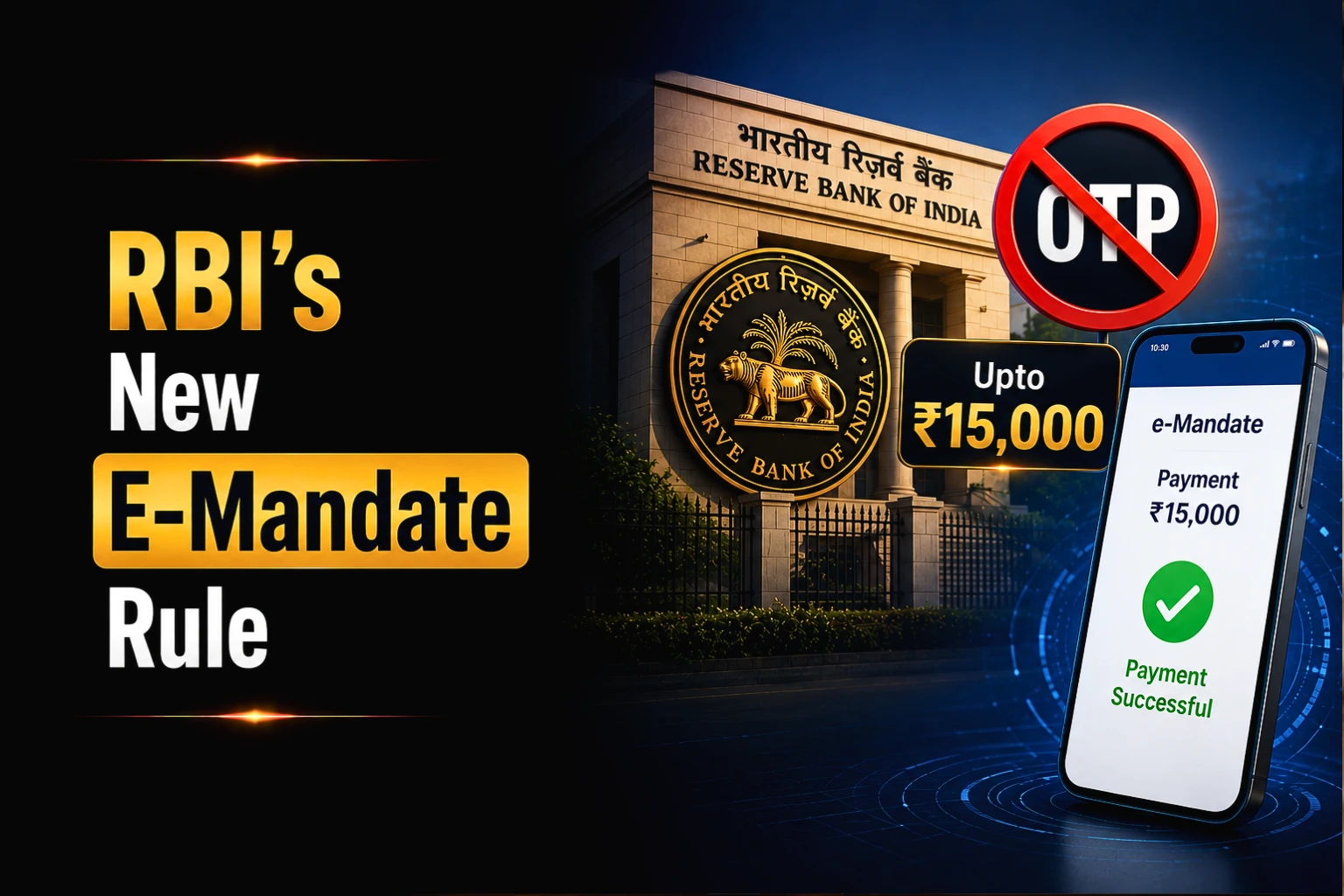
In 2026, RBI issued the Digital Payments – E-mandate Framework, replacing 8 older circulars. The headline change: recurring payments up to ₹15,000 no longer need an OTP each time, and SIPs, insurance premiums, and credit card bills get an even higher ₹1,00,000 no-OTP limit. You still get a mandatory alert 24 hours before every debit, and you can opt out of any single payment without cancelling the whole mandate.
As of July 2026, this remains the current, active framework — no further RBI updates have been issued since it was notified.
If you run a SIP, pay insurance premiums by auto-debit, or have Netflix/subscriptions on autopay, this rule affects you directly. Here's everything explained simply — no legal jargon.
What Is an E-Mandate?
An e-mandate is the standing permission you give a bank or payment app to automatically debit a recurring amount — a SIP instalment, an EMI, an insurance premium, or a subscription fee — without you approving each payment. You set it up once; the deductions then run on their own until you cancel them.

What Exactly Changed Under the 2026 Framework?
RBI notified the "Digital Payments – E-mandate Framework, 2026" (Circular No. RBI/DPSS/2026-27/396, dated April 21, 2026). It consolidates eight separate circulars issued between 2019 and 2024 into one single rulebook and comes into effect immediately.
The core change is simple: the no-OTP limit for recurring payments has moved from ₹5,000 (the old 2021 rule) up to ₹15,000 for regular auto-debits, and up to ₹1,00,000 for three specific categories — insurance premiums, mutual fund subscriptions (SIPs), and credit card bill payments.
Old Rule vs New Rule: Side-by-Side Comparison
|
Particular |
Old Rule (2021–2024) |
New Rule (2026) |
|
General no-OTP limit |
₹5,000 per transaction |
₹15,000 per transaction |
|
SIP/insurance/credit card bill limit |
₹1,00,000 (added later, in 2024) |
₹1,00,000 (retained, now unified) |
|
Regulatory structure |
Spread across 8 separate circulars |
One consolidated Master Direction |
|
Pre-debit alert |
24 hours before debit |
24 hours before debit (unchanged) |
|
Applicability |
Cards mainly, UPI added later |
Cards, UPI, and PPIs — one uniform rule |
|
Cross-border coverage |
Inconsistent across circulars |
Explicitly covered, domestic and cross-border |
|
Card reissuance |
Mandates often had to be re-registered |
Existing mandate auto-maps to the reissued card |
|
Grievance redressal info |
Not always specified in notifications |
Must be included in every post-debit alert |
When Do You Need to Approve a Payment with OTP?
This is the most-asked question, so here's the direct breakdown:
- First-ever payment on any mandate: Always needs OTP, no exceptions — even if the amount is small.
- Recurring payments up to ₹15,000 (subscriptions, most EMIs, utility bills): No OTP is needed after the mandate is set up.
- SIPs, insurance premiums, credit card bills up to ₹1,00,000: No OTP needed for these three categories specifically.
- EMI payments above ₹15,000: Still need OTP every single time — loan EMIs are not covered by the ₹1 lakh exception.
- Anything above ₹15,000 outside the three special categories: OTP required every time.
- FASTag and NCMC top-ups: Exempted from the pre-debit notification requirement entirely, since they're small, frequent replenishments.
How Does This Affect Your SIPs?
If your monthly SIP instalment is under ₹1,00,000, it can now go through without you approving an OTP each month — as long as the mandate is already registered. You'll still get an alert at least 24 hours before each debit, with the option to skip that specific instalment if you want to.
What doesn't change: your SIP amount, your fund allocation, or your ability to pause or stop the SIP entirely — none of that is affected by this rule. This is purely about the authentication step behind the scenes.
How Does This Affect Your Insurance Premiums?
The same logic applies. If your annual or monthly premium is up to ₹1,00,000, the deduction can be processed without a fresh OTP, provided you've already set up the mandate with your insurer or bank. You still get the mandatory pre-debit alert and can opt out of a specific premium payment if needed — though skipping a premium payment can still lapse your policy, so that's worth being careful about.

How Does This Affect Your EMIs and Loan Repayments?
This is where people get confused, so it's worth being precise: EMIs above ₹15,000 are not covered by the ₹1 lakh exception. That exception applies only to insurance, SIPs, and credit card bills. If your home loan or car loan EMI is above ₹15,000, it will continue to require OTP authentication every single cycle, exactly as before. Only EMIs at or below ₹15,000 benefit from the no-OTP change.
How Does This Affect OTT Subscriptions and Recurring Bills?
Netflix, Spotify, gym memberships, utility bills — anything under ₹15,000 now runs without repeated OTP prompts once the mandate is set. This is the change most people will actually notice day to day, since these are the payments that used to fail most often due to a missed OTP notification.
What Protections Do You Still Have?
The new framework didn't remove any consumer protections — if anything, it tightened a few:
- Mandatory 24-hour pre-debit alert, every time, with the merchant name, amount, date, and reason for the debit.
- Opt-out facility on every alert — you can block a single transaction without cancelling the entire mandate.
- Mandatory post-debit confirmation after every successful payment is now required to include grievance redressal details.
- Zero-liability protection for unauthorised transactions applies to e-mandate debits too, provided you report them promptly.
- No charges — banks and payment apps cannot charge you for using the e-mandate facility.
- Free cancellation anytime, with OTP-based confirmation so no one else can cancel your mandate without your consent.
Does This Apply to UPI Autopay Too, or Just Cards?
Yes. This is a genuinely unified rule — it applies equally across cards, UPI, and prepaid payment instruments (PPIs). Whether your SIP mandate runs through a bank's NACH system, a card, or a UPI Autopay app, the same ₹15,000 / ₹1,00,000 limits and the same 24-hour alert rule apply. There's no separate, weaker, or stronger version depending on which payment rail you use.
What Should You Do Right Now?
- Nothing is required from you immediately — existing mandates continue to work; you don't need to re-register anything just because of this update.
- Check your notification settings — make sure your registered mobile number and email are current, since pre-debit alerts are your main window to catch or stop an unwanted debit.
- Review your active mandates periodically — most banking apps now show a dashboard of all your registered e-mandates; check that you don't have SIPs or subscriptions still running that you meant to cancel.
- Know your opt-out rights — you can block a single instalment without killing the whole SIP or subscription, useful if you're short on funds for one particular month.
- If an unauthorised debit happens, report it to your bank immediately — the zero-liability protection applies from the point of reporting, so speed matters.

Conclusion
RBI's 2026 e-mandate framework doesn't change what you pay — it changes how much friction there is in getting it paid on time. Recurring payments under ₹15,000 and SIPs/insurance/credit card bills under ₹1,00,000 will now go through more smoothly without OTP failures interrupting them. Your protections — the 24-hour alert, opt-out facility, and zero-liability cover — remain fully intact. The one thing worth double-checking: if you have loan EMIs above ₹15,000, don't expect this rule to remove your OTP step — that one still applies exactly as before.
Source: Reserve Bank of India, Circular No. RBI/DPSS/2026-27/396

DISCLAIMER: This blog is NOT any buy or sell recommendation. No investment or trading advice is given. The content is only for educational purposes. Always discuss with your SEBI-registered financial advisor for investment-related decisions.