Home >> Blog >> What is Prospectus in IPO? Meaning, Types & Key Details Explained
What is Prospectus in IPO? Meaning, Types & Key Details Explained
Summary
- An IPO prospectus is a mandatory legal document that provides complete details about a company before it goes public.
- It includes key information like business model, financials, risks, promoters, and use of IPO funds.
- There are three main types: DRHP (draft), RHP (with price band), and Final Prospectus (with final price).
- Investors should focus on risk factors, financial performance, management quality, and the purpose of funds before investing.
- Reading the prospectus helps investors avoid hype and make informed, long-term investment decisions.

Table of Contents
Imagine you're a young professional in Lucknow who has saved some money and wants to grow it by investing in the stock market. One day, you hear about a hot new company launching its IPO (Initial Public Offering). Excited, you wonder: "Should I invest? Is this company worth my hard-earned money?" Before you click "Apply," there's one crucial document you must understand: the IPO prospectus.
This is where the story of smart investing begins. Let's dive into the IPO prospectus meaning, explore what a prospectus is in IPO, understand different types, and learn how to read IPO documents explained in simple, beginner-friendly language. By the end, you'll feel confident and empowered to make better decisions.
If you're new to the stock market, it's also important to understand what happens after a company goes public. Read our guide on What is a Listed Company? Meaning, Benefits & Stock Market Role Explained.
The Day the Company Decides to Go Public: Why a Prospectus Exists
Picture a successful private company that has grown steadily with help from founders, family, and a few investors. Now, it wants to expand faster, build new factories, enter new markets, or repay loans. To raise big money from the public, it must "go public" through an IPO.
But selling shares to thousands of strangers isn't simple. Regulators like SEBI (Securities and Exchange Board of India) want to protect everyday investors like you from hidden risks or misleading claims. That's why the company must prepare and file a detailed legal document called the prospectus.
IPO prospectus meaning in simple words: It is an official, comprehensive booklet (often 200-500+ pages) that acts like a "company report card." It discloses everything important about the business, its finances, plans, promoters, and risks, so you can decide whether to invest wisely.
Without this document, no IPO can legally open for subscription. Think of it as the company's honest conversation with potential shareholders: "Here's who we are, here's how we make money, and here's what could go wrong."

What is a Prospectus in an IPO? A Simple Breakdown
It is the main offer document filed with SEBI and the Registrar of Companies (RoC). It contains all the material information that could influence your investment decision.
In easy terms:-
- It tells the company's story—from its humble beginnings to current operations.
- It explains the reason for the IPO(called "Objects of the Issue"—will money go into new projects or will promoters/early investors sell some shares?).
- It shares financial numbers, management details, and potential dangers.
SEBI reviews this document carefully. Companies can't hide bad news; they must list risk factors prominently. This transparency is the heart of the SEBI IPO documents framework, which ensures fair play in the market.
For beginners: Don't feel overwhelmed by the size. Start with the summary section—it's like the trailer of a movie. Then move to key parts like business overview, financials, and risks.
The Journey of an IPO Prospectus: Types Explained
An IPO prospectus doesn't appear overnight. It evolves through stages. Here are the main types of IPO prospectuses you will encounter:
Draft Red Herring Prospectus (DRHP)
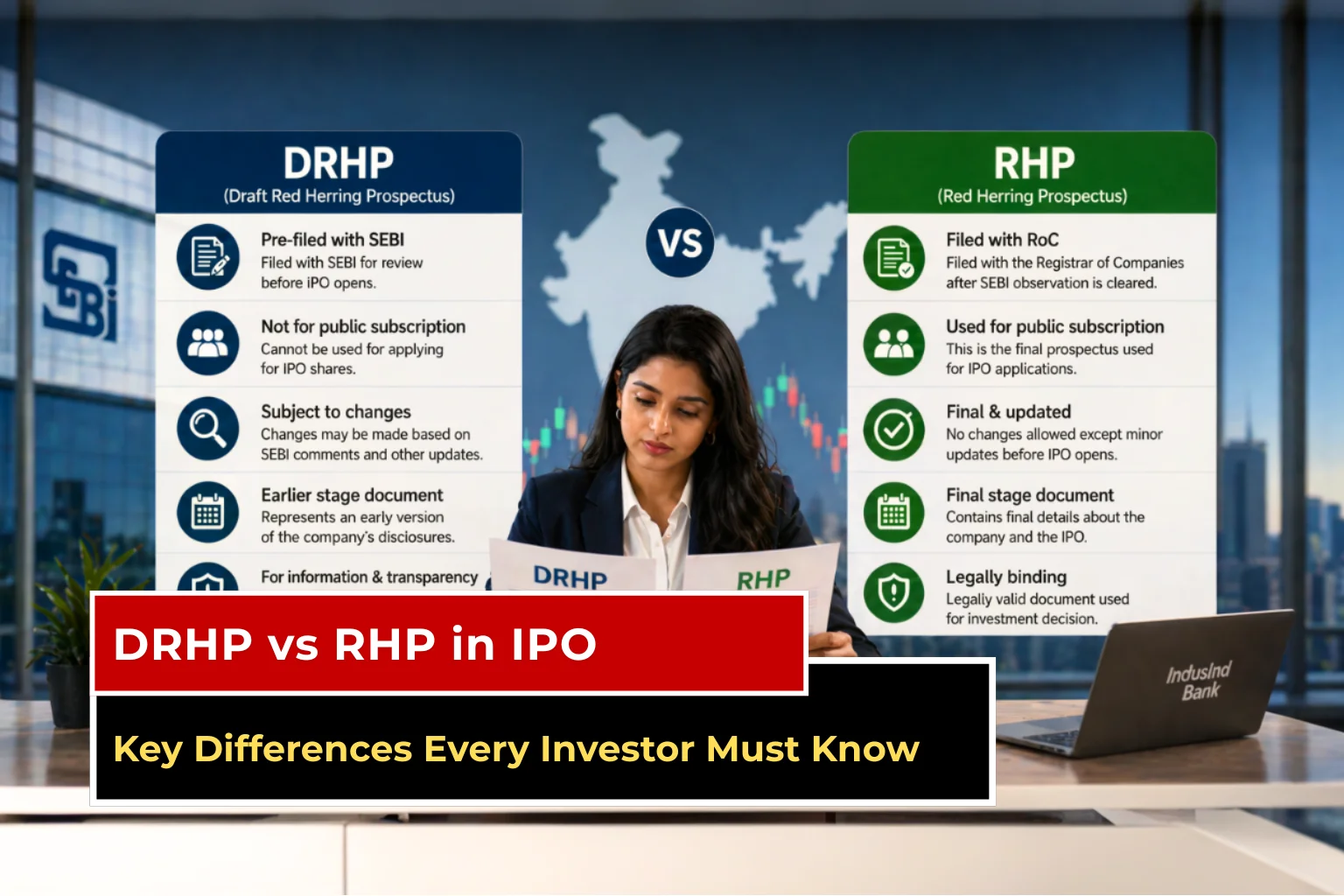
This is the first version filed with SEBI. It has almost all details about the company, but no final price or exact number of shares. The term "Red Herring" means it has some missing pieces (like a story with a few blanks). SEBI reviews it, raises observations, and the company makes changes. This draft is open for public comments too. Since the prospectus starts with the DRHP filing, you should also understand the complete timeline. Read our detailed article on the IPO Filing Process in India.
Red Herring Prospectus (RHP)
After SEBI's approval and updates, this version comes out. RHP includes the price band(e.g., ₹200-₹250 per share), issue size, and more updated financials. This is what most retail investors read before bidding. It is still called "red herring" because the final price is decided later through book-building.
Final Prospectus
After the IPO bidding closes and the final price is fixed, the company files this with the RoC, which is called "Final Prospectus". It has every confirmed detail—exact price, allotment basis, etc. This becomes the ultimate legal record.
Other types (less common for standard equity IPOs):-
Shelf Prospectus
A shelf prospectus is a single prospectus filed with the regulator (like the Securities and Exchange Board of India) that lets a company issue securities in multiple tranches over a period (usually up to 1 year).
Think of it like this:
- One approval → Multiple fund-raising rounds
Abridged Prospectus
An abridged prospectus is a concise summary of the main prospectus attached with application forms or accessible via QR code (SEBI now encourages digital access), provided to investors when they apply for an IPO. It contains key information so investors can quickly understand the offer without reading hundreds of pages.
Here's a clear comparison table for quick understanding:-
|
Feature |
DRHP (Draft) |
RHP (Red Herring) |
Final Prospectus |
|
When Filed |
Early stage with SEBI |
After SEBI observations, before the IPO opens |
After the IPO closes |
|
Price Details |
Not mentioned |
Price band included |
Final price fixed |
|
Purpose |
SEBI review & public feedback |
Investor decision-making |
Final legal record |
|
Changes Possible |
Many (based on SEBI) |
Minor |
None (final) |
|
Availability |
On the SEBI/Company/Exchanges website |
Widely available before bidding |
Filed with RoC |
This table shows how the document matures step by step, ensuring better transparency.
Red herring prospectuses are the ones beginners see most often when an IPO is about to open. Always download the latest RHP from official sources like the SEBI website, NSE, or BSE.
If you want to understand these stages in more detail, you can read our detailed guide on DRHP vs RHP in IPO, where we break down how these documents impact your investment decision.

IPO Documents Explained: Key Sections You Must Read
Reading the full document feels like studying for an exam, but you don't need to read every word. Focus on these key details that matter for beginners:
- Prospectus Summary / Cover Page: Quick overview of the company, issue size, promoters, and listing details.
- Risk Factors: The most honest (and sometimes scary) part. It lists internal risks (like dependence on a few clients) and external risks (market competition, regulatory changes, economic slowdown). Read this carefully—good companies disclose risks transparently.
- About the Company / Business Overview: What does the company do? Its products/services, market position, competitors, and growth strategy. Look for sustainable competitive advantages.
- Financial Information: Audited profit & loss, balance sheet, and cash flow for past years. Check revenue growth, profits, debt levels, and key ratios. Compare with industry peers if possible.
- Objects of the Issue (Use of Proceeds): Where will your money go? Fresh issue money usually goes to company growth (capex, working capital, debt repayment). Watch for high promoter selling (OFS—Offer for Sale).
- Management and Promoters: Background of founders and key executives. Any past controversies? How much stake do promoters retain post-IPO? High skin in the game is usually positive.
- Industry Overview and Competitive Landscape: Helps you understand opportunities and threats.
- Legal and Regulatory Information: Any pending litigations or penalties?
Pro Tip for Beginners: Use the table of contents. Jump to sections using PDF search. Many platforms now offer summarized versions, but always cross-check with the original SEBI IPO documents.
After reading the prospectus and applying for an IPO, the next important step is allotment. Learn how shares are distributed in our guide on IPO Allotment Process Explained.
Why Should Beginners Care About the Prospectus?
Investing without reading (or at least understanding) the prospectus is like buying a car without checking its service history. It protects you from hype. Many IPOs get oversubscribed due to market excitement, but long-term success depends on the company's fundamentals revealed in the document.
SEBI's role ensures IPO documents are explained properly so retail investors aren't misled. In India, rules under SEBI (ICDR) Regulations make disclosures mandatory and standardized.
Real-life example: When companies like Zomato or Paytm came to market, their prospectuses highlighted rapid growth but also heavy losses and risks—helping informed investors decide.
Before allotment, IPOs go through a subscription phase where demand is measured. To understand this better, explore IPO Subscription Explained.
How to Access and Read an IPO Prospectus Practically
- Visit SEBI website → Filings → Public Issues.
- Check the company website or stock exchange sites (NSE/BSE).
- Look for DRHP when the company files, RHP a few days before opening.
- Use CTRL+F to search keywords like "risk", "financial", "promoter", "objects".
Start small: Read 20-30 pages focusing on summary, risks, and use of funds. Over time, you'll get comfortable.
Data Table: Must-Check Metrics from Prospectus
Here's a simple checklist table you can use while analyzing any IPO:
|
Section to Check |
What to Look For |
Why It Matters for Beginners |
|
Revenue & Profit Growth |
Consistent upward trend over 3-5 years |
Shows business health |
|
Debt Levels |
Low or manageable debt |
Less burden on future profits |
|
Promoter Holding (Post-IPO) |
High retention (ideally >50-60%) |
Promoters' confidence |
|
Objects of Issue |
Growth-oriented (capex, R&D) vs selling |
Offer benefits to the company or exits? |
|
Risk Factors |
Specific, not generic |
Realistic assessment of challenges |
|
Management Experience |
Relevant industry background |
Ability to execute plans |

Final Thoughts
Understanding the IPO prospectus meaning and what a prospectus is in IPO transforms you from a guessing investor to a thoughtful one. It may feel lengthy at first, but with practice and focus on key sections, it becomes your superpower.
Next time an exciting IPO comes up, don't just check the GMP (Grey Market Premium) or social media buzz. Open the red herring prospectus, read the risks and numbers, and ask: "Does this story make long-term sense for my goals?"
Investing is a journey of learning. Start today by downloading any recent DRHP or RHP. Your future self (and your portfolio) will thank you for it.
Once the IPO process is complete and the final prospectus is filed, the company gets listed on the stock exchange. To understand what happens after listing, check our guide on IPO Listing Explained.
Sources: Bajaj Finserv, PL India, Chittorgarh, SEBI Official Filings

DISCLAIMER: This blog is NOT any buy or sell recommendation. No investment or trading advice is given. The content is only for educational purposes. Always discuss with your SEBI-registered financial advisor for investment-related decisions.