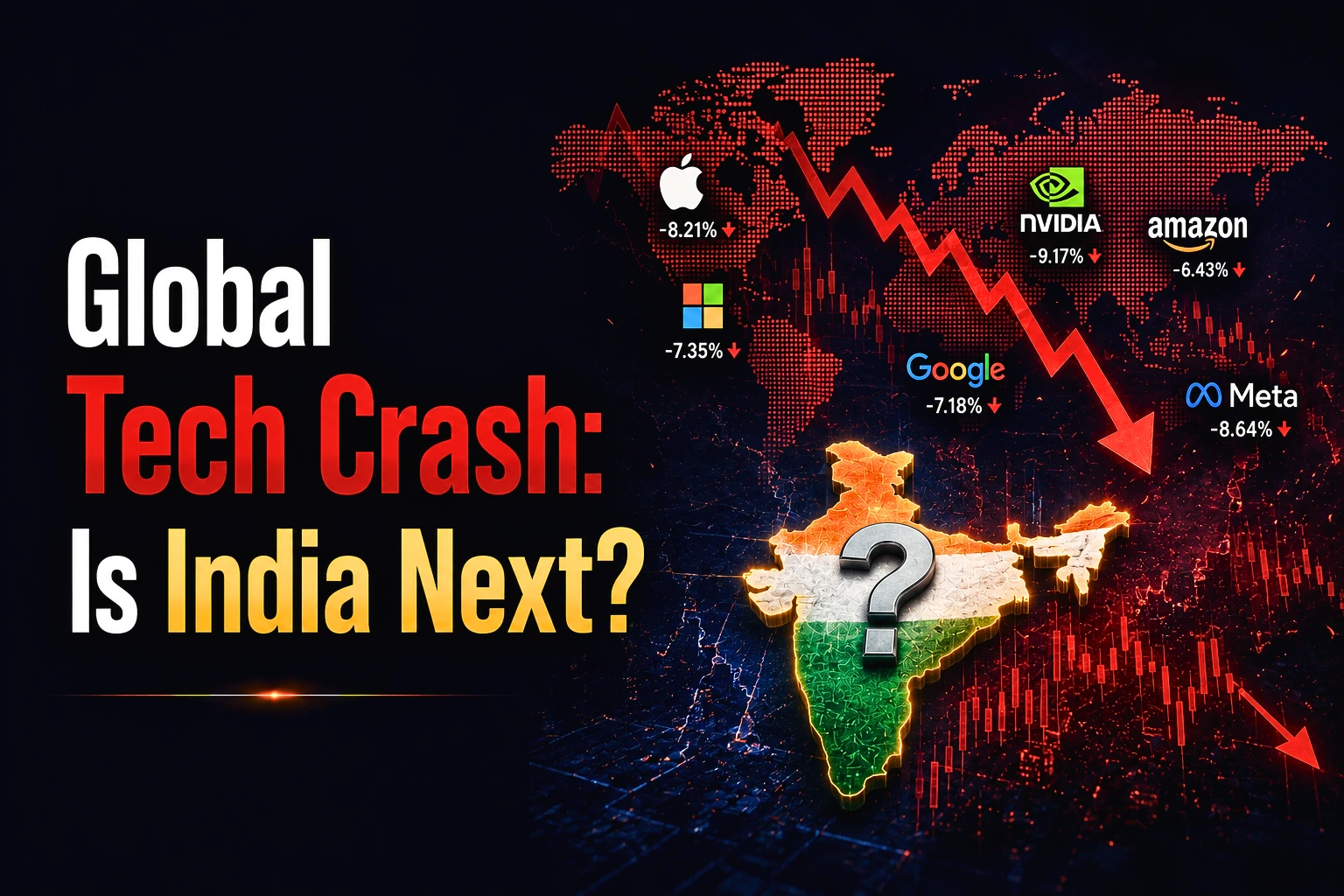
In the midst of this global tech crash, the smartest approach for beginners is to stay calm, avoid panic decisions, focus on learning market cycles, and consider diversified investments suited to their own goals and risk tolerance.
Imagine waking up one morning to see red arrows flashing across your phone screen. Tech giants in the US are tumbling. Stocks in South Korea have faced sharp declines. And suddenly, questions flood your mind: Is this the beginning of a big collapse?
Will it reach India's IT sector too? This is exactly how many new investors felt during the recent global tech crash that sent shockwaves through markets worldwide in June 2026.
Timeline of the Global Tech Crash and Its Ripple to India (2026)
Early 2026 (Jan-Feb): AI disruption fears intensify. Nifty IT starts declining sharply.
March-April 2026: Quarterly earnings show mixed results with cautious guidance. Pressure builds.
June 2026: Key Nasdaq crash episodes occur. On June 23, the Nasdaq falls ~2.2%, while South Korea’s Kospi sees a significant correction amid a chip sell-off (around 11.5% in the period). Indian IT reacts — Nifty IT dips 2%+ on days like June 8. Accenture’s cautious outlook in mid-June triggers a broader sell-off, with IT stocks falling 3-7% in affected sessions.
By late June/early July 2026: Nifty IT is down ~29% year-to-date and has fallen around 43% from its December 13, 2024 peak of 46,089, making it the worst-performing major sector (compared to ~8-9% decline in Nifty 50).
This timeline shows how global events quickly impacted the Indian IT sector.

Nifty IT Performance Snapshot
Nifty IT has been one of the weakest sectors in 2026 so far. As of early July 2026, it reflects a substantial YTD decline of approximately 29%, with a deeper drawdown from its late-2024 peak.
Latest Update (as of July 2, 2026)
After a sharp decline and a four-session losing streak, Nifty IT rebounded around 3.7%. Stocks like TCS rose ~3% and Infosys gained ~4.8% in that session. However, the sector remains under pressure due to ongoing AI disruption fears, weak global tech sentiment, and concerns over US interest rates.
Comparison of Major IT Stocks: TCS, Infosys, Wipro, HCLTech, Tech Mahindra
Here's a comparison based on Q3 FY26 results:
|
Company |
Recent Pressure Example |
Q3 FY26 Revenue (Rs Cr) |
Net Profit (Rs Cr) |
Key Notes |
|
TCS |
Down 12-16% in periods |
~67,087 |
~10,657 (impacted) |
Stable execution; strong AI focus (~$1.8B annualized AI revenue reported) |
|
Infosys |
Down 0.1-7%+ in sessions |
~45,479 |
~6,654 |
Growth but pressure |
|
Wipro |
Down 5-6%+ often |
~23,556 |
~3,119 |
Volatile |
|
HCL Tech |
Drops of 4-11% |
~33,872 |
~4,076 (impacted) |
Mixed momentum |
|
Tech Mahindra |
Down 4-8%+ |
~14,393 |
~1,122 |
Variable |
TCS has often shown more resilience due to its scale. Note: One-time costs affected reported profits across companies.
US Revenue Dependency: Why Global Events Matter
Indian IT firms earn a large share from the US (often 50-65%):
- TCS: ~50-52%
- Infosys: ~58-61%
- Wipro and others show similar or higher exposure.
This dependency means Nasdaq crashes or US slowdowns directly influence revenues, client spending, and sentiment in the Indian IT sector.
Quarterly Earnings Context (Q3/Q4 FY26)
Q3 FY26 results were mixed. Revenues showed modest growth (e.g., Infosys up ~8.9% YoY), but profits faced one-time impacts. Guidance for FY27 stayed cautious. Q4 earnings continued the theme of slower growth and careful outlooks.
AI Disruption Impact on IT Services
AI disruption is a key theme. Advanced tools can automate parts of application development, testing, and managed services. Analysts note potential longer-term revenue pressure (estimates around 9-12% over years) and near-term pricing effects of 1-3%.
Short-term challenges exist, but companies like TCS, Infosys, and Wipro are investing in AI services to adapt. TCS, for example, highlighted significant annualized AI revenue. The shift is toward higher-value work, though traditional outsourcing margins may face pressure.
Valuation and Margin Explanation
IT stocks have historically traded at premiums due to growth prospects and strong cash flows. The 2026 correction adjusted some valuations amid slower growth expectations. Operating margins (typically 20-26%) indicate efficiency; one-time costs affected Q3 reports, but core operations for leaders remain solid.
Practical Tips for Beginners
- Stay calm during global tech crash volatility and stock market news.
- Learn about US dependency and AI trends through reliable sources.
- Beginners may consider learning about SIPs, index funds, and diversified mutual funds before exploring individual stocks.
- Always study company fundamentals carefully.

Conclusion
The global tech crash has challenged the Indian IT sector, but leading companies continue adapting. For beginners, this is a valuable time to build knowledge and focus on long-term learning. Markets move in cycles, and understanding them helps.
(Sources: NY Times, BBC, Yahoo Finance, Fortune, Reuters)

DISCLAIMER: This blog is NOT any buy or sell recommendation. No investment or trading advice is given. The content is only for educational purposes. Always discuss with your SEBI-registered financial advisor for investment-related decisions.











.webp)