
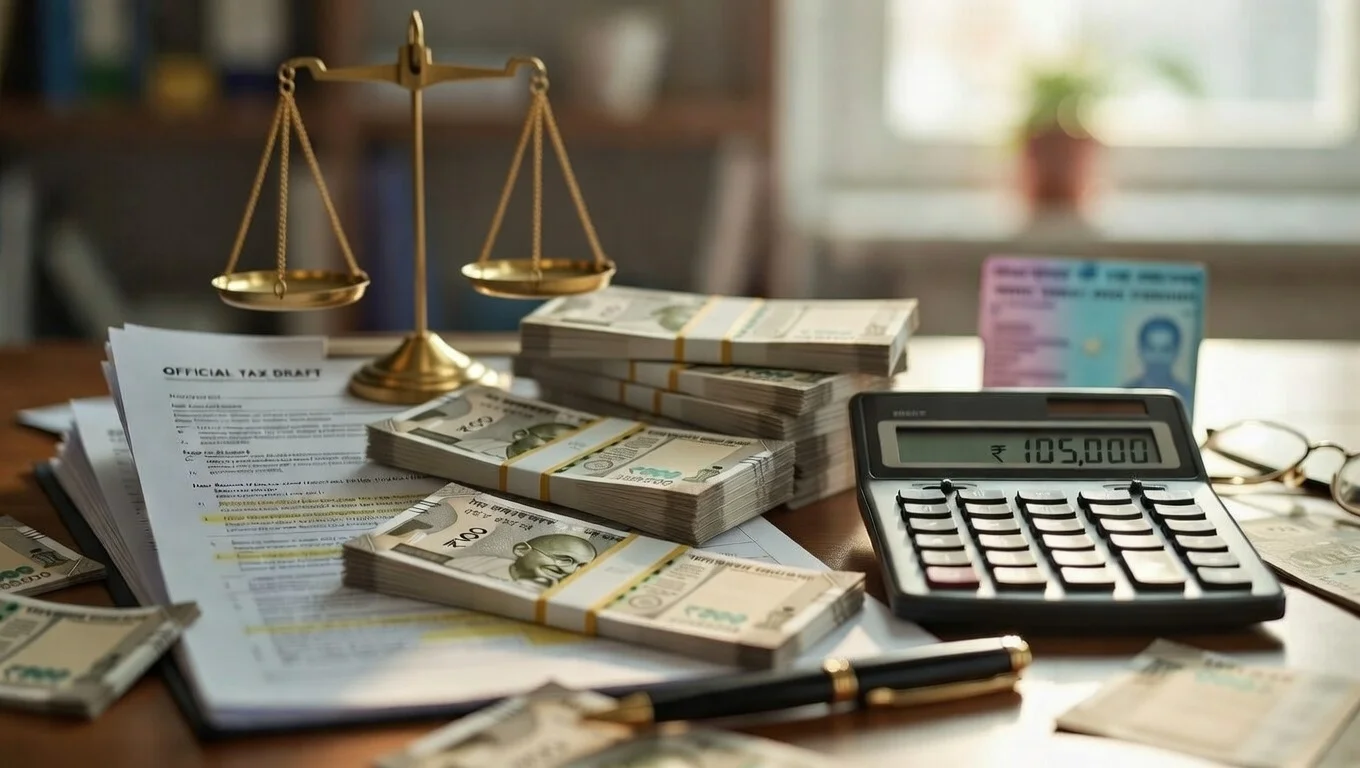
New income tax rules affecting salaried Indians are here. The CBDT drafted rules for the Income Tax Act for 2026 and released them as the Draft Income Tax Rules, 2026. The Draft Income Tax Rules, 2026 will come into effect on 1 April 2026 and will deal with 2027-28 as the Assessment Year 2027-28. This income tax update 2026 will focus on employee perquisites, employee allowances, and PAN transaction rules.
Tax Changes India aims to address economic realities while easing tax compliance. From the PAN limits 2026 to the Meal Voucher Exemption claiming procedure, the tax changes India will impact everyday transactions.
Importance of the 2026 Tax Draft
The Income-tax Act, 2025 will be modernised for 2026 to replace the provisions from the year 1962. The provisions will be effective for the financial year 2026-27 after the notified date, and the draft will be available for public comments until 22 February 2026.
Key takeaways:
- New higher exemption thresholds for usual benefits
- New perquisite valuation (gifts, cars, etc.)
- Major changes to PAN transaction rules involving cash, property, vehicles, etc.
These tax changes India impact the most salaried employees under the old tax regime which may now become comparatively more beneficial than the new regime for a whole lot of people.

How to Get the Most Out of the Meal Exemption (up to ₹1.05 lakh) – Biggest Perk in the 2026 Tax Draft
A lot of people are discussing the 2026 tax draft changes to the tax-free limit for meals of employees and the limit is staggering.
Previous Limit vs Proposed Limit
- Previous limit: ₹50 per meal (maximum ₹26,400 per year for 2 meals a day)
- Proposed limit: ₹200 per meal
Calculation for the ₹1.05 lakh meal exemption(22 working days in the month):
- ₹200 x 2 Meals = ₹400 a day
- ₹400 x 22 = ₹8,800 a month
- ₹8,800 x 12 = ₹1,05,600 a year
Therefore, in comparison to the previous limit, an additional ₹79,200 becomes tax-free.
Who is Eligible to Claim It and What Is The Process?
The exemption pertains to:
- Provision of free food or non-alcoholic drinks in office canteens during work hours, or
- Meal vouchers/coupons (Sodexo/Pluxee, Zaggle, Zeta, etc.) that are non-assignable vouchers and are redeemable at specific restaurants
Other key conditions:
- The food/drink must be consumed within work hours
- Claims cannot be made for tea or light refreshments
- Not applicable in remote/ offshore locations (different rules apply here)
- The company must have structured your salary package to include this benefit.
Procedure to Claim Meal Exemption of 1.05 Lakhs:
1. Request your HR to add meal vouchers to your CTC structure in lieu of some of the taxable components (like special allowance).
2. Ensure that meal vouchers are exclusively issued to you and are non-transferable.
3. The employer will include this benefit in the Form 16 that is submitted to the Income Tax Department.
4. The amount is included in the salary package so there is no need to submit a claim in the ITR as it is omitted from the taxable salary.
For example, if you fall into the 30% tax bracket, plus 4% cess (31.2% effective):
- Additional ₹ 79,200 exemption → tax savings ≈ ₹24,710 per annum
In the 20% bracket, savings are about ₹ 15,840. This, together with the higher education/hostel allowances (₹ 3,000 and ₹ 9,000 per child per month, respectively) and standard deduction, makes the old regime much more attractive.
Tax regimes comment: The exemption is indisputably applicable under the old regime. In the new regime (Section 115BAC), the draft rules do not clarify the situation comprehensively, but the majority of analysts treat it as old-regimed for the time being.
New PAN Limits 2026: Major Relief in PAN Transaction Rules
The 2026 tax draft has also updated PAN transaction rules under what will be the new Rule 159 (formerly Rule 114B). Most thresholds have been updated, and the compliance burden for smaller transactions has been relieved.
Preview of key 2026 PAN limits:
|
Transaction Type |
Old Limit |
New Proposed Limit (2026) |
Impact |
|
Cash deposits in bank/post office |
₹50,000 in a single day |
₹10 lakh aggregate in a financial year (across all accounts) |
Huge relief for frequent small deposits |
|
Cash withdrawals |
No specific annual limit |
₹10 lakh aggregate in a financial year |
New annual tracking instead of daily |
|
Hotel/restaurant bills (cash) |
₹50,000 at one time |
₹1 lakh at one time |
Easier for events, conferences, family dinners |
|
Purchase/sale of immovable property |
₹10 lakh |
₹20 lakh |
No PAN needed for deals up to ₹20 lakh |
|
Purchase of motor vehicle (incl. two-wheelers) |
Irrespective of value (except for some) |
Exceeding ₹5 lakh (incl. motorcycles, excl. tractors) |
Threshold introduced for smaller vehicles |
|
Life insurance premium/account opening |
₹50,000 premium per year |
Mandatory at the commencement of any account-based relationship |
PAN is needed even for small policies now |
The new 2026 PAN limits are a welcome simplification. For instance:
- Wedding reception at a hotel, and you need to pay ₹ 80,000 in cash? No PAN is needed with the new rule.
- Buying a second-hand flat for 18 lakh? No PAN required.
- Each year, you deposit 9 lakh cash? No reporting requirement.
But PAN-Aadhaar linking has become mandatory, and there will be a tightened compliance framework. Other government digital reporting is due in 2026.

Other Draft 2026 Tax Changes India
The income tax update 2026 includes more than just meals and PAN:
- Children Education Allowances: Increased from ₹100 to ₹3,000 (max 2 children).
- Hostel Allowances: Increased from ₹300 to ₹9,000 per child.
- Non-cash gifts: Previously, the exemption limit was raised from ₹5,000 to ₹15,000 per year.
- Company car perquisite valuation: Revised and increased significantly (higher taxable value for employees).
- Foreign treatments: Tax-free and income is less than ₹8 lakh (previously, it was 2 lakh)
With these changes, the old regime's total exemptions will exceed 10 lakh for families with children, making it truly competitive once more.
Who Benefits Most from These Tax Changes in India?
- Employees in metros who get meals from their employers.
- Families with children who receive education, hostel, and boarding allowances
- People working in cash, as cash transactions below ₹10 lakh a year are exempt from reporting
- Taxpayers who were choosing between tax regimes and prefer the old tax regime for its complexity.
Steps to Take Before April 2026
1. Employer— Negotiate to get your CTC restructured to include more meal vouchers and other benefits.
2. Transactions in your PAN— Make sure all your bank accounts are linked to your Aadhaar.
3. Cash Management— If possible, keep your cash deposits and withdrawals below ₹10 lakh in a year to avoid cash reporting requirements.
4. Tax regime re-evaluation— Do the calculations for both tax regimes after considering the new changes.
5. Be informed— Changes based on feedback from February 22, 2026, will be finalised.

Conclusion
The 2026 tax draft is a welcome change for all taxpayers and acknowledges the increase in living costs. Middle-class employees will save around ₹15,000-₹25,000 due to the ₹1.05 lakh meal exemption and the new PAN limits 2026 will cut down repetitive and mundane work.
Updates on income tax 2026 and new tax slabs India indicate the government is paying attention to salaried taxpayers. Be it a software engineer in Bengaluru, a banker in Mumbai or a teacher in Lucknow, these changes have the potential to significantly increase your take-home pay.
(Source: Upstox)

DISCLAIMER: This blog is NOT any buy or sell recommendation. No investment or trading advice is given. The content is purely for educational and information purposes only. Always consult your eligible financial advisor for investment-related decisions.









.jpeg)
.jpeg)
.jpeg)


