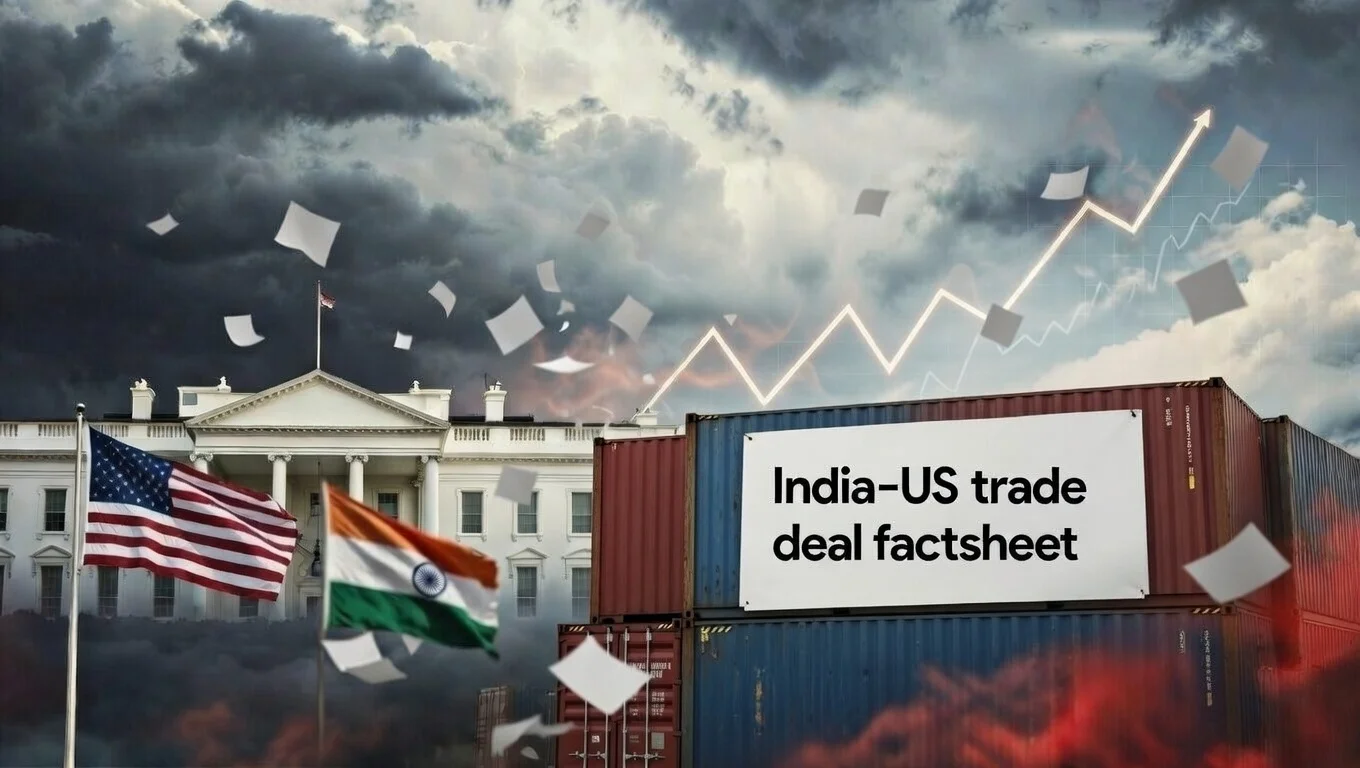
The India-US trade deal of February 2026 has sent shockwaves through global markets. The White House's trade fact sheets, released on 9th February and revised 24 hours later, reveal the truth behind the India-US Trade Deal. Starting with the White House claiming there were “zero tariffs” and making substantial commitments, news of the India-US Trade Deal is more nuanced, with US tariffs on India focusing on lower tariffs and international relationships.
The Facts: This is how the India-US Trade Deal started
The partnership between India and the US began in February 2025, with Trump and Modi. By 2026, the partnership reached a standstill with the US imposing a 25% tariff on Indian goods. A 25% tariff was also applied to Russian oil purchases, causing Indian exports to drop by nearly 50%.
Then came the breakthrough. On 6th February 2026, the two sides released a joint statement announcing a framework for an Interim Agreement. President Trump lifted the 25% Russia-related tariff. In turn, India agreed to stop buying Russian oil and further open its market to the US.
The White House trade factsheetthat followed described the India-US new deal as “historic” market access for US exporters. However, within hours, the key language was softened - that’s where the real story begins.

What Changed in the White House Trade Factsheet
The first version of the factsheet, now removed, claimed that India would “eliminate or reduce” tariffs on US industrial goods and agricultural products, including “certain pulses.” It also asserted that India had “committed” to purchasing over $500 billion of US goods and removing the digital services tax.
The updated White House trade factsheet is more cautious and now states that:
- India will eliminate or reduce tariffs on all US industrial goodsand a broad range of food and agricultural products (dried distillers’ grains, red sorghum, tree nuts, fresh and processed fruit, soybean oil, wine and spirits - but no longer mentions pulses).
- India “intends” to buy more than $500 billion of US energy, ICT, coal, and other products over five years (the word “committed” was dropped).
- References to eliminating India’s digital services tax were removed. These changes were made within 24 hours of publication. Indian farmer groups have protested the omission of pulses, fearing that cheap US imports would crash domestic prices. “Intends” instead of “committed” implies that the $500 billion purchase figure is aspirational.
This editing reveals the shocking truth behind the White House trade factsheet. The initial announcement was more aspirational than the final version. The deal is real, but the details matter.
Tariff Impact on India: Who Wins, Who Loses?
For Indian exporters, the news is overwhelmingly positive.
India's reciprocal tariff with the US has been reduced from 25% to 18%. Other national-security tariffs imposed on Indian aluminium, steel, copper, and specific auto components have been removed or modified into preferential quotas. The sectors most impacted include:
- Textiles, apparel, leather and footwear are significant employment generators.
- Gems and jewellery - India’s largest export to the US.
- Generic pharmaceuticals - expected to see reciprocal tariffs removed.
- Parts of aircraft and specific machinery.
According to analysts, the reduction of tariffs will likely result in a 15-25% increase in Indian exports to the US over the next two years. Indian IT and pharmaceutical companies have started to celebrate.
Conversely, Indian manufacturers and farmers will face increased competition. Industrial goods from the US, including machinery, chemicals, and automobiles, will be available in India at reduced or zero tariffs. Additionally, agricultural goods from the US such as soybean oil, tree nuts, spirits, animal feed, and wine will be more accessible. Although there was domestic resistance to including pulses, the potential for future negotiations remains.
The impact of tariffs on India is twofold: export growth and increased competition in sensitive sectors from imports.
What is coming next with the recent India and US trade news?
The recent interim agreement is not the final BTA. However, both the US and India have committed to finalising a full Bilateral Trade Agreement within months. Currently, the most important pending issues include:
- Remaining non-tariff barriers, especially for medical devices, ICT standards, and food safety.
- Rules of origin to prevent Chinese goods from routing through India.
- Digital trade rules (the factsheet still commits to addressing “discriminatory or burdensome practices”).
- Further tariff liberalisation in both directions.
As of now, Indian Commerce Minister Piyush Goyal has said a formal signing could happen by March 2026. Until then, the current 18% US tariff on Indian goods is already in effect (from February 7, 2026).

Global Trade Impact: A New Template for Reciprocity?
The India US trade deal is bigger than bilateral numbers. It signals a new reciprocal trade under the Trump administration.
Here's what other countries are focusing on:
- Vietnam, Bangladesh, and Cambodia are competing with India on apparel and footwear.
- Brazil and Argentina are agricultural exporters.
- China, which is already dealing with even steeper effective tariffs.
About the US's attempt to trade for Russian oil, and the US using trade for weapons, India is diversifying away from cheap Russian crude, which may alter the world's energy configuration and will lift the price of crude oil for buyers in the east.
The agreement signals the first of “Mission 500” - the goal to strengthen bilateral trade to $500 billion by 2030, which is a mid-term trade agreement that paves the way for other agreements to be made with states with high tariffs.
Sector-wise Breakdown: Things Businesses Should Know
Winners in India
- Textile, gems, pharma, and engineering goods exporters.
- Defence and tech (GPU, data centre) cooperative companies.
- Energy importers switching to US LNG and coal.
Challenges in India
- Domestic pulse, oilseed, and fruit farmers.
- Small and medium-sized auto-component manufacturers.
- Industries with government-imposed non-tariff barriers that are now being examined.
US Firms Can
- Agri-based exporters, particularly feed grains and processed food.
- Tech and energy firms looking to capitalize on the $500 billion purchase pipeline.
- Firms in Med Tech and ICT.

The Bottom Line: An Unorthodox, Imperfect Agreement
The rapid revisions on the White House trade factsheet tell us the truth about tariffs: in a geopolitically heated world, trade agreements are no longer about 'simple bilateral reductions in tariffs', but about far more complex trade agreements that mix economics, national security, and domestic politics.
For India, in the short run, the 'tariff impact' will be positive. An increase in US exports, due to reduced tariffs, will result in the creation of more jobs and an increase in the value of the Indian Rupee. However, the trade-off to make concessions will be challenging for the Indian industry and agriculture.
From a global perspective, this India US trade deal highlights the ability of the world’s largest emerging market to make concessions and open its market, even if it means facing punitive tariffs. It also demonstrates that the case of “reciprocal trade” becomes the new normal.
As the full BTA negotiations continue, it’s clear that the era of one-sided trade deals is over. Exporters, importers, farmers, and even policymakers, this trade deal's global impact will be felt for years to come.

DISCLAIMER: This blog is NOT any buy or sell recommendation. No investment or trading advice is given. The content is purely for educational and information purposes only. Always consult your eligible financial advisor for investment-related decisions.











.jpeg)
.jpeg)